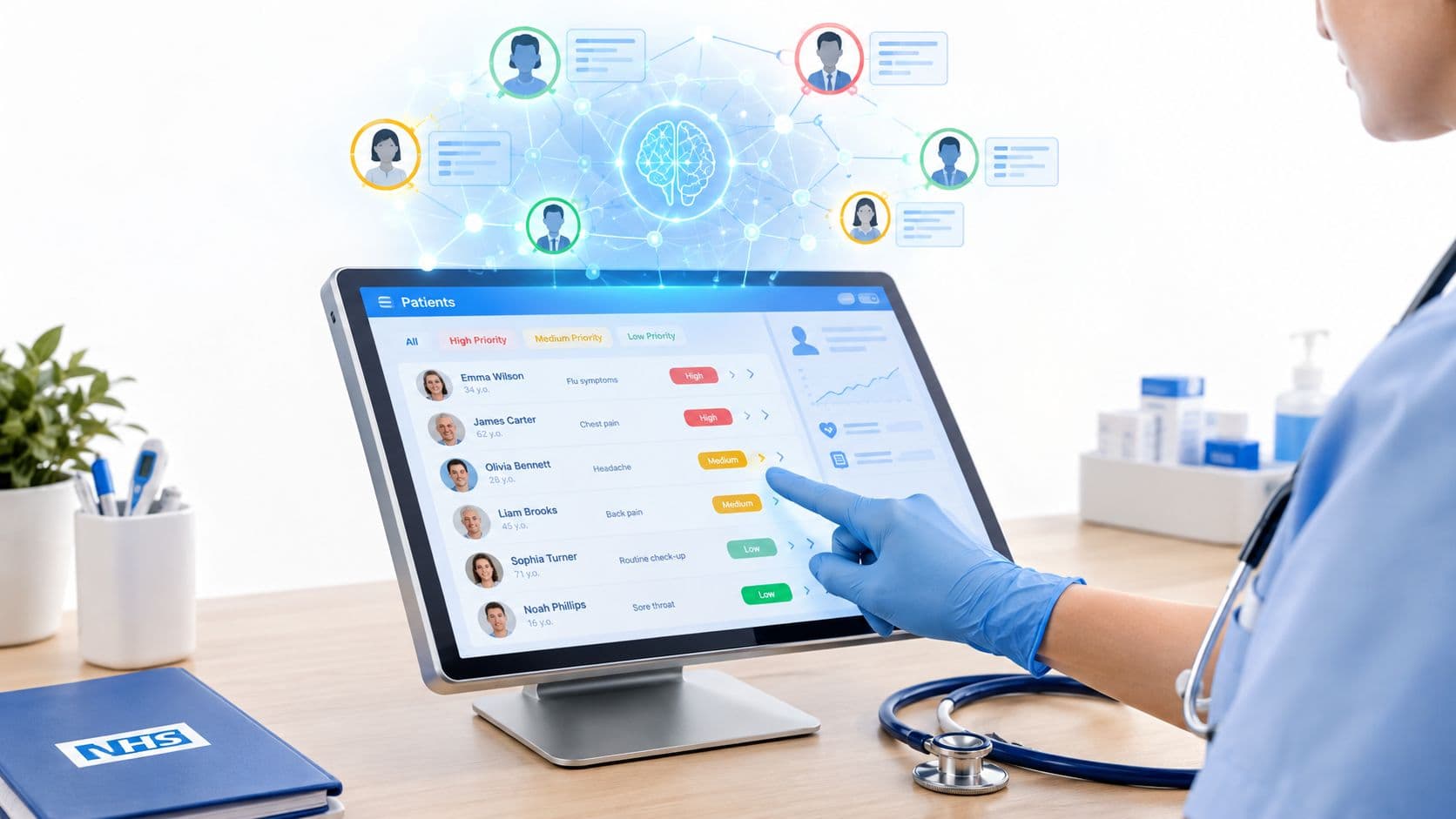
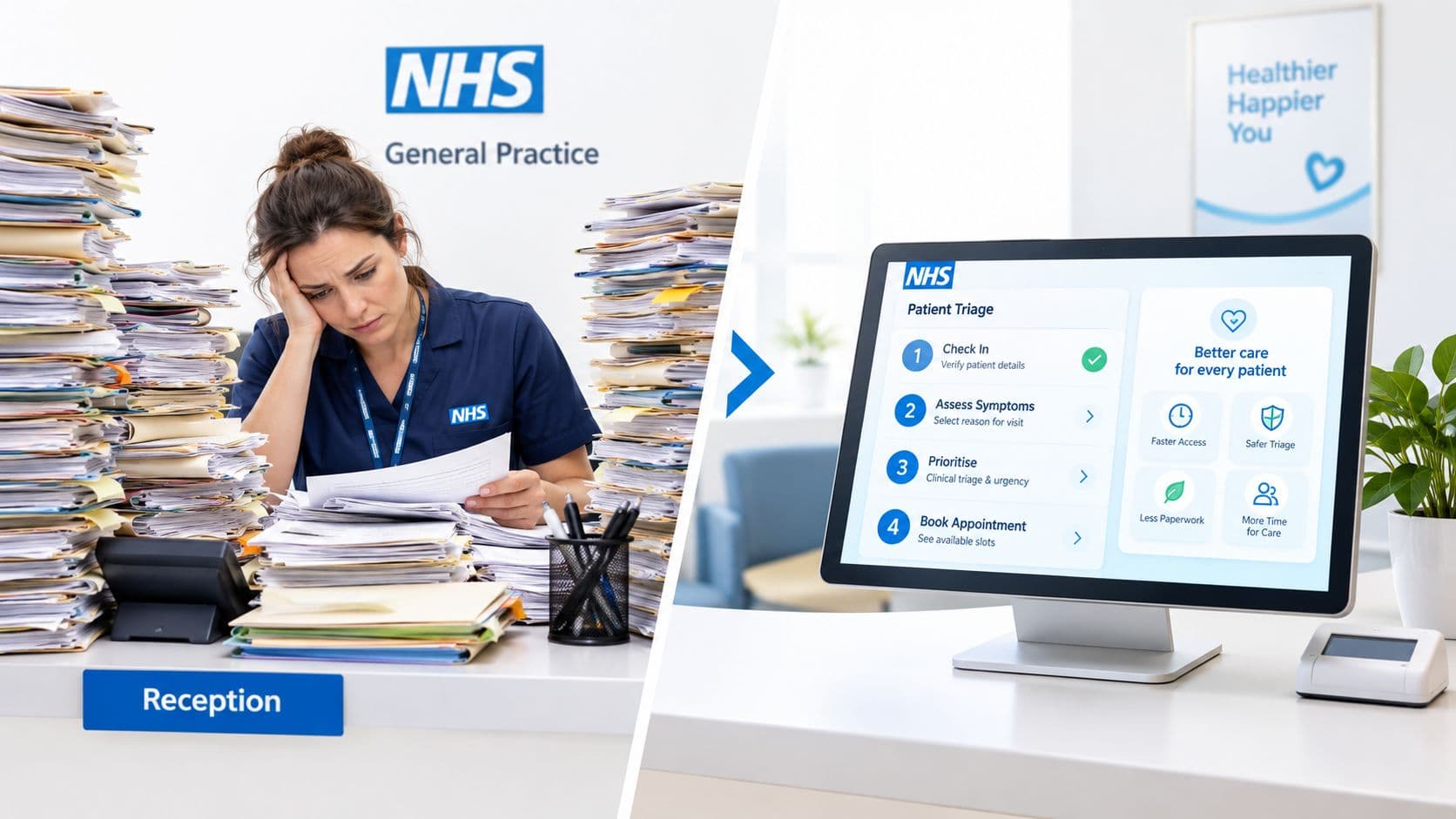
A Monday morning access queue can expose the problem before the day has properly started. Calls arrive together, online requests join the inbox, reception staff collect more information, and a GP or nurse begins sorting cases against the appointments that remain. By late morning, the team has worked hard, yet the queue has often moved rather than disappeared.
That experience creates a tempting conclusion: the practice needs more triage capacity. Sometimes it does. But manual triage no longer scales because the underlying model adds a human review step to every request. More staff can increase capacity for a time, but they don't remove the repeated work of collecting information, judging urgency, documenting decisions, contacting patients, and matching requests to live availability.
This matters across NHS general practice. The challenge isn't limited to one channel, one professional group, or one difficult Monday. It reflects a service handling more contacts, a larger same-day workload, and demand that arrives continuously rather than in neat batches.
Why Access Feels Harder Even With More Effort
At 8am, the practice's phone system begins filling. Receptionists answer calls while monitoring online requests and dealing with patients already at the desk. A patient with a straightforward administrative need may be placed in the same operational queue as someone describing symptoms that require prompt clinical review.
The team then starts a sequence of manual decisions. Someone gathers the details. Someone decides whether the request needs a GP, nurse, or another route. Someone checks capacity. Someone calls back, updates the practice's clinical system, or records the outcome. If the patient can't be reached, the work may repeat.
Each action can be reasonable in isolation. The difficulty comes from multiplication. When every new request creates another review and often another contact, the practice's workload grows with demand instead of being absorbed by the workflow.
The NHS England delivery plan for recovering access to primary care recognises the pressure around the opening hour. It says an average-sized practice can receive over 100 calls in the first hour of opening on a Monday, and that requests should be assessed on the day, with urgent needs dealt with the same day and non-urgent appointments scheduled within two weeks. NHS England's delivery plan for recovering access sets out that expectation in the context of tackling the 8am rush.
Practical rule: If the process depends on a person reviewing every request before the next action can happen, increasing demand will eventually increase review work as well.
This guide is for practice managers, GP partners, PCN and ICB digital leads, and Clinical Safety Officers who need to assess that problem without being distracted by technology claims. The useful question isn't whether digital triage sounds attractive. It's whether the operating model removes work, moves it elsewhere, or merely makes the same manual decision easier to handle.
The distinction becomes clearer when demand, workflow design, safety, patient understanding, and governance are considered together. By the end, a practice should be able to identify its scaling limit and judge whether a different triage model addresses the cause rather than treating the symptoms.
Why Demand Has Outgrown Manual Triage Capacity
A request arrives, capacity changes, and another request follows before the first decision is complete. That sequence can repeat across the day, not just during the opening rush. NHS England reported approximately 383.3 million general practice appointments in the 12 months to June 2025, compared with approximately 375.7 million in the previous year. It later reported a record approximately 388 million by March 2026. NHS England's GP access statistics show the scale at which small delays and duplicated steps become material operational work.
The Institute for Government noted that primary care appointments rose from approximately 300.0 million in 2019/20 to approximately 377.4 million in 2024/25, an increase of approximately 25.8%, while appointments delivered per GP fell approximately 2.7% compared with 2019. Its analysis of NHS access and capacity describes a direct mismatch for practice teams. More requests are arriving, while clinician capacity has not increased at the same pace.
The pressure also comes from the timing of requests. In May 2025, approximately 44.2% of appointments were booked and completed on the same day, according to the NHS England GP appointment figures. A process designed around one morning sorting exercise is poorly matched to demand that continues to arrive and requires decisions throughout the day.
Same-day work creates a continuous queue
NHS England reported approximately 31.4 million GP team appointments in June 2025 and approximately 33.6 million in July 2025, with July approximately 24.3% higher than the same month before the pandemic. The British Medical Association reported approximately 386 million standard appointments over the 12 months to July 2026, with approximately 44.7% booked for the same day and approximately 82% taking place within two weeks. The NHS England delivery update illustrates why the workload remains immediate even when practices provide more appointments.
Planned work can be grouped and allocated. Same-day requests require a live judgement about urgency, suitability, and available capacity. A reviewer must repeatedly check what has arrived, what can wait, which professional should respond, and whether the relevant slot is still free.
Evidence from a UK cluster randomised trial found that telephone triage increased total primary-care contacts per patient by approximately 33%, with a rate ratio of approximately 1.33, even though face-to-face contacts fell. The trial report concluded that telephone triage was associated with higher overall workload. A related NIHR trial found increased workload in the 28 days after a consultation request, with mean contact times of approximately 4.00 minutes for GP triage and approximately 6.56 minutes for nurse triage. The NIHR Health Technology Assessment report shows how reducing one contact type can still increase the total work around a request.
When triage creates an additional interaction, it may redistribute demand without removing it.
That is the structural limit. Across manual, telephone, online, hybrid, and assisted models, digitising the intake or moving the review to another queue leaves a person responsible for the repeated decision. Only autonomous triage removes that manual step. It can assess requests against defined rules, account for changing capacity, and route the next action without turning every new request into another piece of review work.
Where Manual Workflows Break Under Continuous Demand
Manual triage tends to fail at handovers and decision points. A request may start with reception, move to a nurse, return to reception for a callback, and then require another update in the practice's clinical system. Each handover introduces waiting, duplication, or the risk that the next person lacks the context needed to act.
The 8am rush makes that fragility visible, but it isn't the only pressure point. Patients enter through the phone, online forms, reception, and other practice routes. These channels may collect different information and present requests in different queues. Staff then have to create a consistent view of urgency from inconsistent starting points.
Cognitive load is an operational risk
Manual reviewers also work with variation. Presentations differ by symptom, age, time of day, patient history available to the reviewer, and the capacity left in each clinical session. A nurse-led model may redistribute work away from GPs, but it still depends on skilled staff performing continuous assessment.
A 2025 integrative review of UK primary-care triage found that triage is predominantly nurse-led and creates work redistribution rather than work removal. It also highlighted variation by time of day, age group, and presenting symptom pattern. The review of UK primary-care triage is useful because it frames scaling as a workload and consistency issue, not only a speed issue.
Practice managers can spot the failure points by asking:
Where does the request wait? Is it held in a phone queue, inbox, callback list, or clinician session?
Who repeats the work? Does the patient explain the issue more than once?
What triggers a handover? Are staff transferring requests because the original channel can't complete the next action?
What happens at capacity? Does the practice absorb demand, or does it close, defer, or redistribute access?
If the answer to each question involves another human review, the workflow is still scaling by adding labour.
The Five Triage Models And Where Each Stops Scaling
The phrase “digital triage” covers several different operating models. They shouldn't be treated as interchangeable. Some digitise the entry point, some accelerate information gathering, and some reorganise the clinical decision. Only one removes the manual triage step itself.
| Triage Model | What It Changes | Who Still Decides | Scaling Limit |
|---|---|---|---|
| Manual reception triage | Reception collects information and directs the request | Reception staff, with escalation where needed | Every request still depends on staff judgement and live availability checks |
| Manual GP-led triage | A GP reviews requests before deciding the next route | A GP | Scarce GP time remains the gate for each request |
| Form-based online consultation | Patient information is captured digitally before review | Reception or a clinician | The practice has digitised demand, but the team still triages every request |
| AI-assisted total triage | AI gathers and organises information to support prioritisation | A human reviewer | Human decision-making remains, so review workload can remain substantial |
| Autonomous AI triage | The system assesses the request and moves it to the configured pathway | The system acts within the approved safety model, with governance oversight | The practice must assure safety, configuration, escalation, integration, and exception handling |
AI-assisted is an improvement, not the same as autonomous
AI-assisted total triage deserves a fair assessment. It can organise patient information, identify relevant features, and help a reviewer reach a decision more consistently. That can be a meaningful operational improvement, especially where the current process requires staff to read unstructured requests and chase missing details.
The precise limitation is that AI-assisted means a human still decides. The system supports the reviewer, but the reviewer remains responsible for the next action. If the practice's objective is to reduce the amount of manual triage work, assistance may not be enough.
Autonomous AI triage is different in kind. The system makes the triage decision within the practice's configured safety model, then routes the request according to the agreed pathway. That doesn't remove governance or clinical accountability. It removes the routine manual gate from the operational workflow.
This is the category in which GP Triage operates. The platform uses Infermedica, a Class 2B medical device in the UK framework, with UKCA and MHRA positioning and DCB0129 and DCB0160 documentation. It supports adult and paediatric presentations, integrates with the major UK clinical systems, and pushes a triage summary into the booking record.
The right question for a practice isn't which model sounds most advanced. It's where the human decision remains, and whether that is the work you need to remove.
Safety Consistency And Patient Experience At Scale
Scaling triage safely isn't the same as processing requests quickly. A practice needs to know what information was collected, how urgency was assessed, when a case was escalated, and how the outcome was recorded. Patients also need to understand what happens after they submit a request.
That last point is frequently underestimated. A 2025 Healthwatch desktop study found that only approximately 59.3% of GP practices explained how triage works. Patient feedback showed confusion about whether a receptionist or clinician reviews the request before an appointment is offered. The Healthwatch access report also recorded approximately 20.7% of callers waiting more than 30 minutes to get through.
Automation still requires assurance
Technology doesn't remove the need for clinical safety work. NHS guidance on determining whether software is a medical device states that software with a medical intended purpose can be regulated as a medical device. The MHRA symptom-checker flowchart indicates that symptom checker devices are generally Class I unless they allow direct diagnosis, in which case they are Class IIa. NHS materials describe Class IIb as a medium-risk class in the UK framework. The NHS guidance on medical-device determination provides the starting point for a due-diligence conversation.
For teams assessing AI in sensitive workflows, practical assurance also includes secure data handling, bounded use cases, auditability, access controls, and human oversight.
For GP Triage, the approved safety wording is precise: to date, zero recorded clinical safety incidents and around 97% concordance with GP decision-making. These are reported outcomes to date, not guarantees. A CSO should still examine the intended purpose, evidence, documentation, local configuration, escalation arrangements, and monitoring plan.
What Measurable Change Looks Like In Practice
A practice should measure the change in work, not just the number of requests entering a digital route. The most useful baseline separates GP-led triage time, other clinical time, reception administration, callbacks, and the effort involved in booking or recording outcomes.
That separation matters. “Hours saved” can become misleading if GP-specific hours are mixed with combined clinical and administrative hours. The practice should record which staff group previously performed each task and whether the new model removes that task, changes its timing, or moves it to an exception pathway.
Two approved examples
Langton Medical Group serves approximately 14,000 patients across three sites. To date, the practice has removed approximately 30 hours of GP-led triage per week, according to the approved case evidence. That figure should be read as a description of Langton's operating context, not as a promise for every practice.
Swanscombe Health Centre serves approximately 37,000 patients. In its first four weeks, the practice returned approximately 422 or more hours and booked approximately 5,000 appointments autonomously, to date. These measures show the two sides of the change: operational hours returned and routine booking activity completed without the same manual step.GP Triage offers an autonomous AI triage and booking platform for NHS primary care, with adult and paediatric support, integration with the major UK clinical systems, and triage summaries pushed into the booking record.
If your practice has reached the limit of manual review, visit GP Triage to arrange a demonstration focused on your workflow, safety model, integration requirements, and measurable baseline.