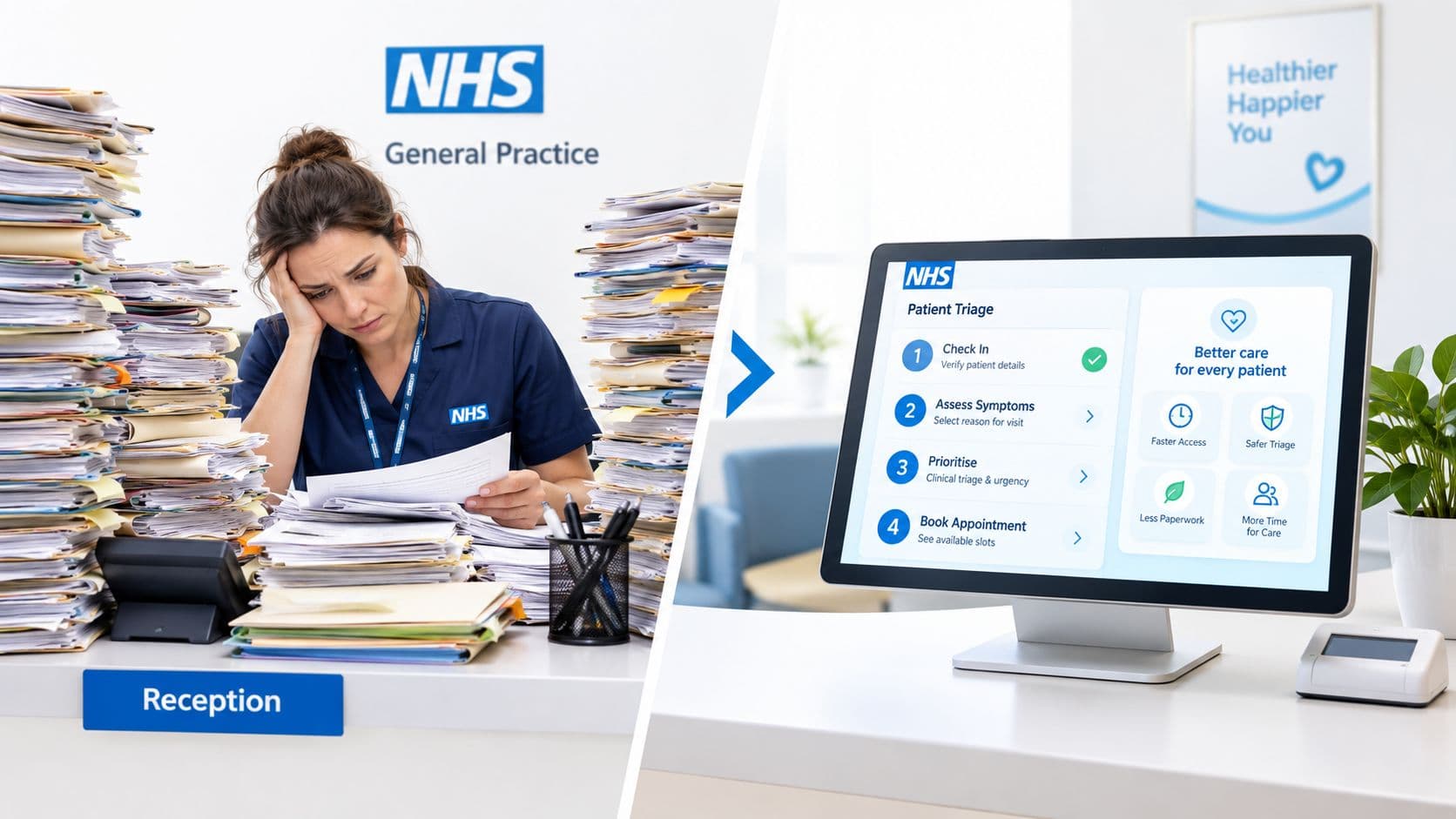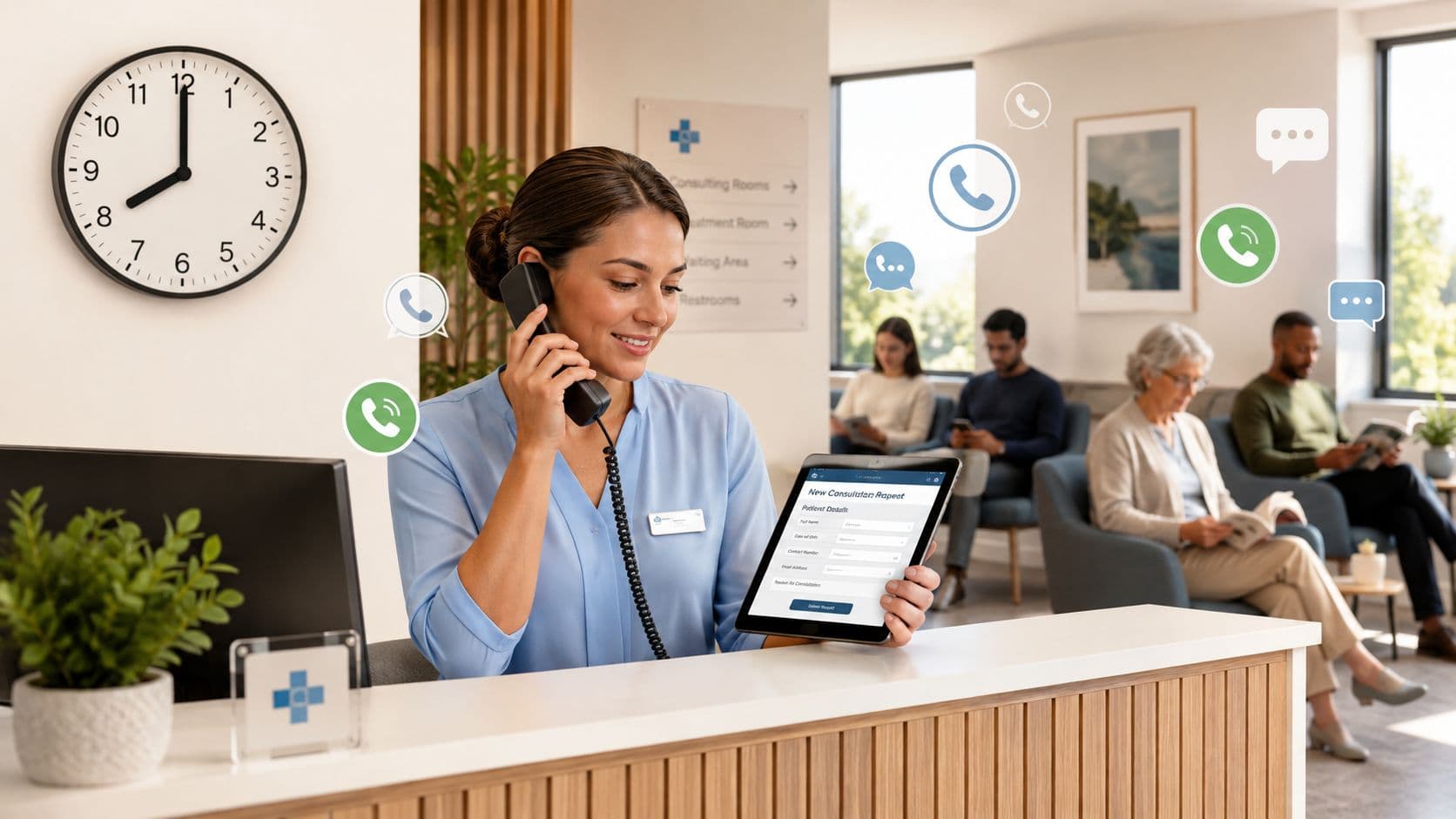

At 8am, the practice phone queue fills before the first clinician has opened the appointment book. Moving the front door online can reduce pressure on reception, but it doesn't automatically remove the work. If every digital request still lands in an inbox for a receptionist or GP to read, assess, prioritise and book, the bottleneck has only changed location.
That distinction matters because autonomous AI triage isn't just a digital form or a faster way to present information to a clinician. It describes a model in which the system gathers the relevant history, assesses urgency and routes the patient to an appropriate outcome without a person manually triaging each request. For NHS primary care leaders, the question is no longer whether digital intake is possible. It's whether the chosen model removes enough manual work while remaining governable, transparent and safe.
The Access Problem That Will Not Go Away
The familiar morning scramble has evolved rather than disappeared. Patients now use online consultation tools throughout the day, and practices must keep those tools available during core hours. Government guidance confirms that GP practices in England must keep online consultation tools open throughout approximately 8am to 6.30pm on weekdays from 1 October 2025.
That creates a practical challenge. A patient may submit a request online instead of calling, but someone may still need to open the request, interpret the symptoms, decide the urgency, choose the appropriate appointment type and complete the booking. The patient has gained a digital route, while the practice has gained another queue to manage.
Demand is already substantial. NHS England reports approximately 83 million online consultation requests in the 12 months to March 2026, with around 8.6 million submissions in February 2026 alone, an increase of approximately 85% compared with February 2025. These figures show the scale of digital demand now entering general practice.
Operational rule: Digital access only solves the access problem if the practice also changes what happens after the request arrives.
The NHS has already demonstrated that digital symptom assessment can operate at scale. In 2024–25, the NHS 111 online pathway handled approximately 7,794,000 completed triages from around 8,245,200 started triages, with a median duration of approximately 82 seconds. Around 44% of completed triages were recommended for primary care. The NHS England flow data provides a useful benchmark for large-scale digital assessment and routing.
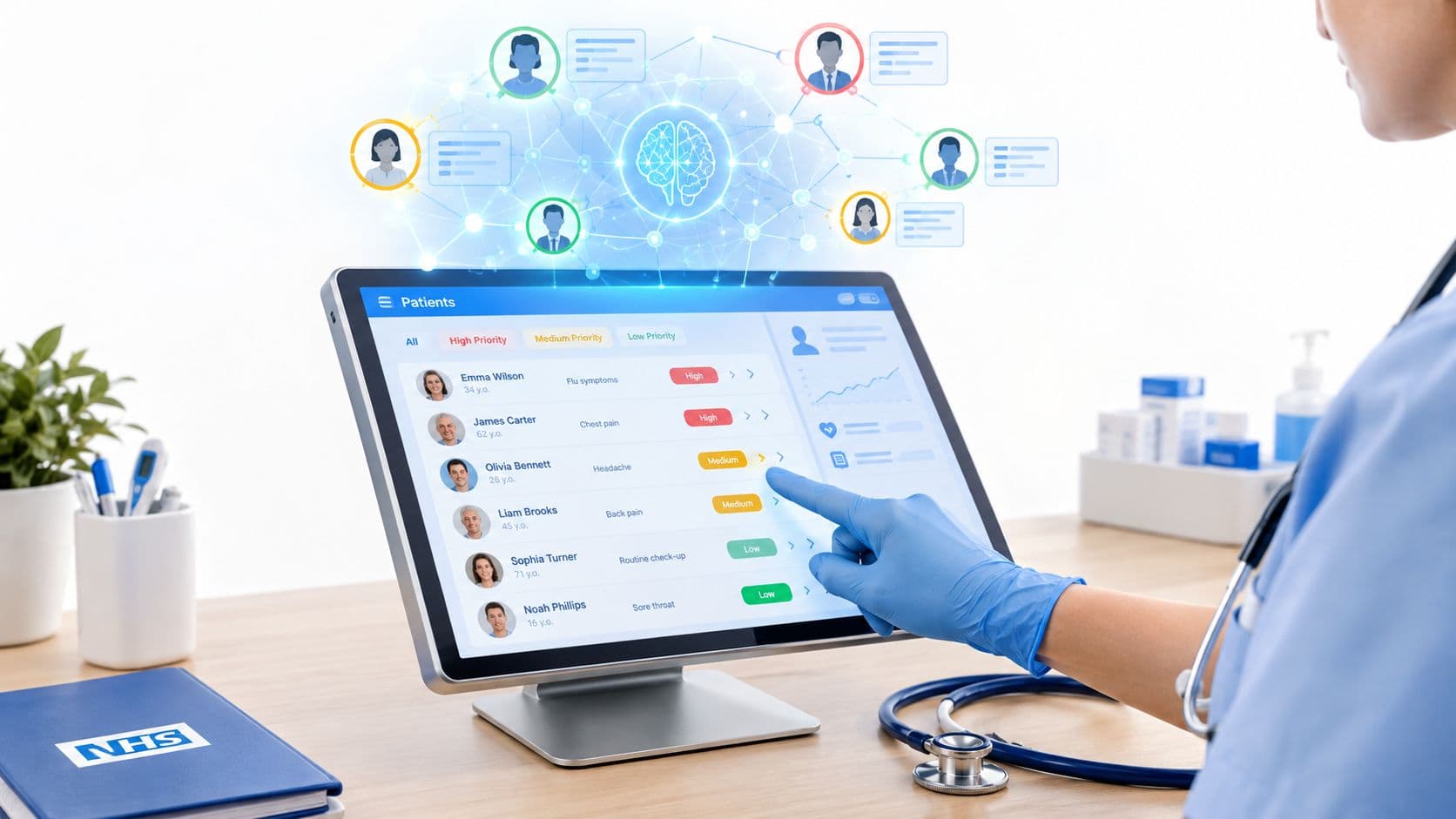
Autonomous triage applies that structural idea to the practice workflow. It isn't another inbox for staff to clear. It's a route through which routine demand can be assessed and booked without the manual triage step, while urgent or complex presentations remain subject to the practice's safety model and escalation pathways.
Five Models of Triage in UK Primary Care
UK primary care now operates across five distinct models. The difference between them isn't whether technology is present. The important question is who makes the triage decision and who carries out the booking work.
The taxonomy in practice
Manual reception triage relies on trained reception staff to gather enough information to direct the patient. It remains workable for some smaller lists and for straightforward administrative pathways, but it depends on staff availability, confidence and consistent application of local rules.
Manual GP-led triage moves the clinical decision to a GP or another clinician. This can provide strong clinical oversight, particularly where the presentation is uncertain, but it consumes clinical capacity and can leave clinicians reviewing requests that ultimately need routine or non-clinical handling.
Form-based online consultation digitises the patient's entry point. Patients describe their needs online, often with structured questions, and the practice receives a written request. That can improve legibility and reduce some telephone traffic, but the practice still needs people to interpret, prioritise and route the submissions.
AI-assisted total triage adds machine support to the clinician's workflow. The system can ask relevant questions, summarise information or suggest a route, reducing reading and processing time. The human still reviews the request and makes the final decision. That is a meaningful improvement, not a failed version of autonomy.
Autonomous AI triage takes the fifth position. It gathers the history, assesses the request against its configured clinical pathways, identifies the appropriate route and completes the relevant booking workflow without a person manually prioritising every request.
| Model | Who triages | Manual or automated | Primary limitation |
|---|---|---|---|
| Manual reception triage | Reception team | Manual | Capacity depends on staff availability and consistency |
| Manual GP-led triage | GP or clinician | Manual | Uses clinical time for every reviewed request |
| Form-based online consultation | Practice team | Digital intake, manual decision | Digitises demand without removing manual review |
| AI-assisted total triage | AI supports a clinician | Assisted | A human still decides and acts |
| Autonomous AI triage | Configured clinical system | Automated routing and booking | Requires careful governance, configuration and oversight |
The first four models can digitise, accelerate or reorganise the work. Only the fifth removes the manual triage step itself. That doesn't make earlier models pointless. Many practices sensibly adopted them because they improved access and created a foundation for more structured demand management.
The due diligence question is precise: does the proposed system recommend a decision to a human, or does it make the configured routing decision and complete the next workflow step? Confusing those two descriptions creates unrealistic expectations for practice managers and Clinical Safety Officers.
How Autonomous AI Triage Actually Functions
Autonomous AI triage starts with intake, not with an inbox. Patients can enter through a web route, telephone capture or in-person reception entry. The system then asks adaptive questions, so the next question depends on the patient's previous answer rather than forcing every patient through the same static form.
The purpose is to gather a focused clinical history. A patient describing abdominal pain may be asked about associated symptoms, onset and severity. Someone reporting a medication query follows a different route. The system supports adult and paediatric presentations, with the pathway determining what information is relevant and what action is appropriate.

From symptoms to an appointment
The workflow has several connected parts:
- The patient describes the need. The system captures the request through the available channel.
- The questioning adapts. Follow-up questions narrow the presentation and identify information relevant to urgency.
- The system assesses the pathway. Urgency assessment follows established NHS-aligned protocols and the practice's configured rules.
- High-priority presentations escalate. Red-flag or urgent responses are directed into the appropriate escalation route rather than treated as routine booking requests.
- The outcome is routed. The patient can be directed to an appointment or another configured care pathway.
- The booking record receives a summary. The relevant triage information is pushed into the booking record for the clinician's context.
A practical example is a patient submitting a request late in the evening. Instead of waiting for a member of the practice team to read it the next morning, the system can complete the questioning and route the request according to the practice's configured availability and safety rules. Where an appointment is appropriate and capacity exists, the patient can wake to a booked appointment rather than an unprocessed request.
The same principle applies to telephone capture and reception entry. The channel changes, but the objective remains consistent: collect the history once, assess the request systematically and avoid asking staff to repeat the same prioritisation work.
Teams designing these pathways should also understand the wider role of structured knowledge. Guidance on implementing AI knowledge bases is useful background when considering how clinical content is organised, governed and maintained. In a healthcare setting, that knowledge must sit within the relevant medical-device and clinical-safety framework, not in an informal collection of prompts.
Clinical Safety and Regulatory Assurance
The first governance test is regulatory classification. The triage engine is treated as a medical device, with Infermedica identifying it as a Class 2B medical device under UKCA and MHRA requirements. The supporting DCB0129 and DCB0160 documentation should be available for review during procurement and local clinical-safety assurance.
The reported safety record is specific: zero recorded clinical safety incidents across approximately two million triages, alongside around 97% concordance with GP decision-making. These figures are reported in the product's clinical safety and evidence documentation, and describe observed performance to date. They do not guarantee the outcome of every future interaction or local configuration.
A Clinical Safety Officer should assess those results alongside the actual deployment. Review the intended use, risk controls, escalation handling, configuration, audit trail and responsibilities retained by the practice. Device classification and formal documentation support assurance, but local governance remains necessary.
For sign-off: Review the product evidence and the practice deployment together. A safe platform can still be configured poorly if appointment rules, escalation routes or ownership are unclear.
Autonomous triage is designed to handle routine demand and route requests through established pathways. It does not replace clinical judgement in complex cases, unusual presentations or situations that require a clinician's assessment. Its practical value is to reduce manual processing of incoming requests, leaving clinicians more time for work that requires their judgement.
Before approval, the practice should request the relevant safety documents, confirm how incidents are recorded, identify who controls configuration and establish how staff review outcomes. The review should also show what happens when the system cannot safely resolve a request. Responsible adoption depends on those controls, not on autonomy alone.
Integration with Clinical Systems and NHS Spine
Integration should be assessed by looking at the exact data flow, not by accepting a broad claim that a platform is “fully integrated”. Autonomous AI triage integrates with the major UK clinical systems and pushes a structured triage summary into the booking record.
That gives the receiving clinician useful context about the patient's submitted information and the route taken. It also clarifies the platform's boundaries. It does not read full patient records, it does not support SNOMED coding directly, and it does not create tasks directly in clinical systems. Those limitations should be made explicit during technical and clinical assurance.
What the practice needs to establish
The deployment conversation should cover:
- Interoperability route: Confirm how the platform connects with the practice's clinical system and what the interoperability partner manages.
- Booking rules: Agree which appointment types, clinicians, locations and availability the platform can use.
- Summary content: Check what information is written into the booking record and how staff see it.
- NHS assurance: Review the NHS Spine integration and the supporting governance and security documentation.
- Local ownership: Nominate the people responsible for configuration, testing, monitoring and change control.
The practice still needs to arrange access, appointment-book configuration and local governance. The technology can pass the structured outcome into the booking workflow, but it can't decide what every practice's appointment book should contain.
Digital reporting also has a role after implementation. For teams reviewing how information moves across services, healthcare data analytics guidance from PlotStudio AI offers useful context on presenting operational data for decision-making. The principle is straightforward: integration should make the workflow clearer, not create another isolated data store that staff must reconcile manually.
Operational Benefits and Measurable Outcomes
The useful question is whether autonomous triage changes clinical workload, appointment access, telephone demand and booking effort. Counting digital requests alone does not show whether the model has improved the service.
Published NHS examples offer reference points, not guarantees. At Langton Medical Group, serving approximately 14,000 patients across 3 sites, around 30 hours of GP-led triage have been removed per week to date. The published case-study information describes the operational result in those terms.
At Swanscombe Health Centre, serving approximately 37,000 patients, around 422 or more hours were returned in the first 4 weeks. The practice also recorded approximately 5,000 appointments booked autonomously during that period to date. These results show that capacity may appear as released staff time or as completed bookings.
A separate NHS-funded evaluation in Sussex reported that pre-bookable appointment waiting times fell from approximately 11 days to around 3 days, a 73% reduction. It also found that around 91% of appointments were allocated automatically without staff or clinical intervention, while peak-hour phone calls fell by approximately 47%. The evaluation report describes the findings and the practice context.

Model the return locally
A defensible business case begins with the practice's own baseline:
- GP-led triage: Record the operational hours spent reviewing and routing requests. Keep GP-specific time separate from combined clinical and administrative time.
- Reception workload: Measure time spent repeating questions, prioritising forms and arranging routine appointments.
- Access: Review waits for suitable appointments and the volume of early-morning calls.
- Booking completion: Track how many requests need manual handling before an appointment is booked.
- Oversight: Agree which demand, workload and outcome measures should be visible at practice, PCN and ICB level.
The NHS England summary of the national rollout reports that an initial Sussex trial reduced people queuing on the phone by approximately 29%, using adaptive questioning to route patients to the appropriate care setting first time. That national summary places the result within the wider effort to reduce the morning access bottleneck.
These examples indicate possible operational outcomes, rather than a universal return. Each practice should test its own demand, appointment capacity, staffing pattern and local configuration before approving procurement.
Implementation Considerations and Governance
Autonomous triage is a workflow change, not just another software installation. The practice needs to decide which requests enter the autonomous route, which appointment rules apply, how urgent demand escalates and who reviews the resulting data.
Some clinicians worry that autonomy means losing oversight. Reception teams may worry that automation changes their role, while practice managers may reasonably question whether they're adding another platform to maintain. Those concerns shouldn't be dismissed. A good implementation defines ownership clearly and shows staff where visibility improves.
The system should be configurable to the practice's safety model. That includes local appointment availability, escalation routes and the treatment of requests when capacity is constrained. If appointments are full, the system's response must follow the configured safety and operational rules rather than relying on an informal workaround.
Governance before go-live
A practical review should include:
- Clinical safety: Confirm the risk assessment, DCB0129 and DCB0160 materials, incident process and local clinical-safety ownership.
- Configuration: Test appointment types, opening hours, escalation routes and edge cases with the relevant clinical and reception teams.
- Information governance: Review security, access controls, data flows, retention and NHS Spine arrangements.
- Operational monitoring: Agree which analytics the practice, PCN or ICB will review and how often.
- Change management: Train staff on what the system does, what it doesn't do and when a human must intervene.
The contractual context makes this work more pressing. NHS England's online consultation guidance says the contractual minimum from 1 October 2025 covers non-urgent appointment requests, medication queries and administrative requests, and that practices must not switch the tool off during core hours except in exceptional circumstances. Continuous digital availability without continuous manual triage requires a different operating model.
NHS England's access plan also says patients should not be told to call back another day to book an appointment. Clinically urgent needs should be assessed on the same day, while non-urgent requests needing an appointment should be scheduled within approximately two weeks. The access plan sets out the broader expectations for managing demand.
Common Questions from Practice Teams
Does it handle children?
Yes. The platform supports adult and paediatric presentations, with questions and routing configured for the presentation and the practice's safety model.
What happens when appointments are full?
The workflow follows agreed escalation and routing rules. It should not suggest that every request can receive an immediate appointment. Practices need clear alternatives for urgent assessment and requests that require human review.
Does it replace clinical judgement?
No. Autonomous AI triage handles defined routine demand and routes requests. Clinicians remain responsible for complex cases, while the practice retains oversight through its governance arrangements. The safety evidence is discussed in the Clinical Safety section, and should be assessed alongside local testing rather than treated as a guarantee.
How long does implementation take?
Timing depends on the practice's clinical system, appointment-book design, governance review, testing and staff readiness. Providers should set out the required steps during due diligence, without promising a fixed timeframe.
GP Triage provides autonomous AI triage and appointment booking for NHS primary care. It sends structured triage summaries into the booking record and uses practice-configured safety rules. Practices should assess whether that model fits their demand, staffing and governance requirements before arranging a demonstration.