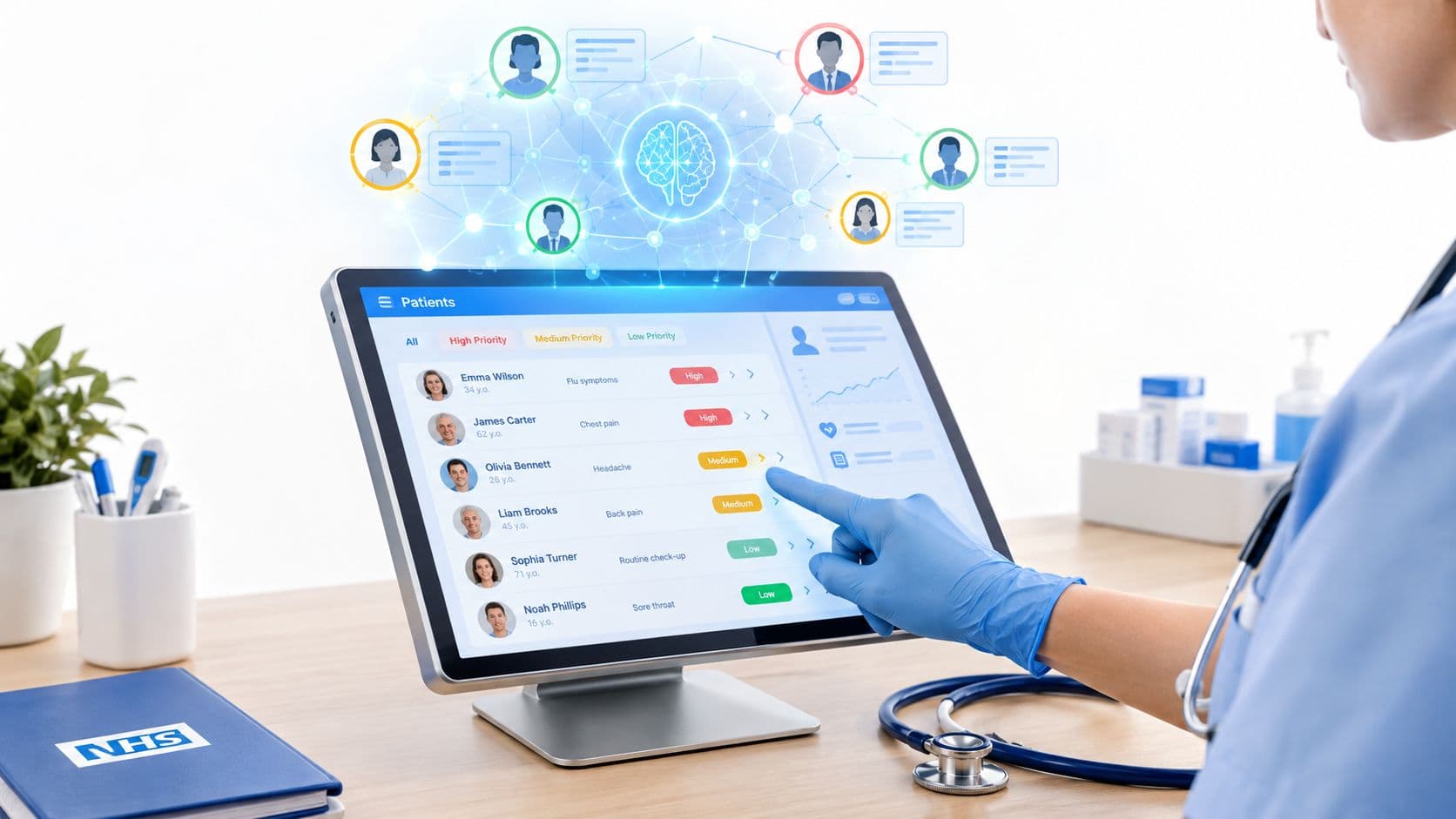

By 9.15 on a Tuesday morning, the practice has already accepted more requests than the duty team can comfortably review. Every patient has used the digital front door. The online form is live, the demand is recorded, and the reception queue looks modern. Yet the duty doctor still opens the inbox first, care navigators re-key symptoms into another template, and a receptionist chases a blood result before the GP has even decided what the request needs.
Nothing has been removed. The queue has changed location.
This is the point at which practices discover that total triage can still mean manual triage. The request arrives digitally, but a person must interpret it, decide its urgency, choose the appropriate route, check capacity, and often reproduce the decision in the practice's clinical system. The inbox stays permanently full because everyone understands the same operational rule, even if nobody has written it down: someone must still eyeball every entry.
The distinction matters. Total triage describes how requests arrive, not how they are decided.
The Practice That Went Digital but Did Not Get Quieter
The digital front door is not the decision
The practice in this example has done what many practices were encouraged to do. It has moved demand online, replaced some telephone traffic with structured questions, and made the request visible to the team. Patients can submit information without waiting for a receptionist to answer.
But visibility isn't disposition.
At the start of the day, the duty GP works through the request list. One patient has described worsening symptoms but omitted duration. Another has uploaded a photograph that needs interpretation. A third has asked for a fit note while also mentioning a medication concern. The form has captured the words, but the practice still needs a human to decide what those words mean operationally.
The care navigator then opens a second screen. Symptoms are copied into a booking template, the request is assigned to a clinician, and a separate administrative task is created for records or investigations. If the patient hasn't supplied enough information, reception calls them. The call isn't a technical exception. It's the standard workflow.
Operational test: If a clinician must read every request before the practice can safely route it, the practice has digitised intake, not removed manual triage.
Why the inbox remains full
The problem isn't that form-based online consultation is useless. Structured information can make requests easier to read, reduce avoidable back-and-forth, and give clinicians a more consistent starting point. The problem is that the practice may have automated the collection of demand while preserving the decision queue.
That creates a subtle workload transfer. Reception no longer handles every request at the first point of contact, but a GP or nurse still reviews the submission. The administrative work then continues around the clinical decision, particularly where bloods, fit notes, referrals, medication queries, or capacity checks sit outside the triage pathway.
The practical conclusion is uncomfortable but useful. A digital front door can improve access and still leave the manual decision step intact. The practice has not failed because the technology is digital. It has stopped at a model where the queue is better organised, but still human-owned.
Five Models of Triage and Where Manual Work Hides
The phrase total triage often collapses several different operating models into one. That makes procurement conversations imprecise. A practice may have every patient screened before an appointment is arranged, while still asking a clinician to review every request manually.

The five operating models
Manual reception triage
Patients use the telephone, attend reception, or submit information through paper. Reception collects the request and decides what can be signposted, but clinical uncertainty is passed to a clinician. The queue is manual from the first contact.Manual GP-led triage
A digital front door captures demand, but a GP or nurse reviews each submission and decides the next step. This model can improve prioritisation and access. A 2022 NIHR study found an approximately 20.79 percentage-point improvement in the time taken for people to be seen or spoken to by a GP after telephone triage was introduced, but the process still depended on human handling of patient requests. The NIHR Health Services and Delivery Research study is important because it separates better access from lower manual workload.Form-based online consultation
Structured templates collect symptoms, administrative needs, and patient preferences. Rules may route submissions into categories such as administration, pharmacy, urgent review, or routine care. The system sorts the queue, but a member of staff usually resolves the clinical or operational disposition.AI-assisted total triage
Artificial intelligence may summarise a request, identify relevant information, suggest urgency, or recommend a destination. A clinician still reads the request and approves, edits, or overrides the recommendation. This is a genuine improvement when it reduces reading time or makes important information easier to find. It isn't autonomous decision-making.Autonomous AI triage
A clinical-grade system makes the defined disposition under agreed guardrails. Straightforward requests can be redirected or routed without a clinician reviewing every entry, while exceptions go to the practice team. The human role changes from universal review to governance, exception handling, and safety oversight.
The dividing line is therefore precise:
Total triage describes the front door. Autonomy describes who makes the decision.
The first four models digitise, accelerate, or reorganise the queue. Only the fifth removes the manual triage step for the cases within its approved scope. Practices that need additional clinical capacity can still use human triage, including resources such as a physician-founded triage job platform, but that addresses staffing the manual model rather than changing its structure.
Indicators and Metrics That Show Total Triage Has Slipped Back
The most useful test isn't whether the practice has an online consultation tool. It's whether the team can show where the decision is made, how long it takes, and what happens when information is incomplete.
NHS England says the 2026/27 GP contract requires requests identified by the practice as clinically urgent to be dealt with on the same day. The national GPAD measure uses the category “general consultation acute”, calculated monthly as the proportion of acute consultations taking place on the same day. The NHS England same-day appointment guidance defines the numerator and denominator, although NHS England says it doesn't currently measure or publish the metric and plans to make the data available through GPAD.
Use that measure as a benchmark, not as a complete automation scorecard. A practice can meet same-day access expectations while still carrying a large manual triage burden.
| Root cause | Metric to watch | Source / dashboard | Red-line signal |
|---|---|---|---|
| Workflow | Request-to-decision time and re-routed requests after first contact | Triage worklist and practice workflow audit | A growing tail of requests needs a second human review |
| Integration | Percentage of dispositions requiring manual re-entry | Booking audit and clinical-system activity log | Staff routinely copy summaries or outcomes between systems |
| UX | Incomplete submissions, clarification calls, and walk-in re-entry | Online consultation report and reception log | Reception becomes the workaround for a digital pathway |
| Governance | Clinician override rate, exception categories, and retrospective safety flags | AI audit trail and clinical-safety review | Overrides rise beyond agreed thresholds, or safety issues are found retrospectively |
| Capacity | Same-day acute completion and silent backlog | GPAD reporting and daily queue review | Paediatric requests are deferred, urgent requests remain unallocated, or reception queues accumulate unnoticed |
Practical Steps to Restore Real Automation in Your Practice
Restoring automation isn't a matter of switching on a feature. The practice has to remove the duplicate work around the decision, agree the safe scope, and change staff behaviour at the same time.
Start with the technical path
Map one request from patient submission to final booking. Record every screen, copy-and-paste action, printed page, inbox, telephone call, and manual re-entry. The map should identify where the request is interpreted, where urgency is assigned, and where the booking outcome is recorded.
Then configure the intake pathway to capture the structured information the triage engine needs. Connect the triage result and document flow to the booking record, and retire any parallel inbox that exists only because staff still print or copy requests for a clinician to read.
The approved operating description for GP Triage is an autonomous AI triage and booking platform for NHS primary care, regulated by Infermedica as a Class 2B medical device, with UKCA and MHRA documentation and DCB0129 and DCB0160 materials. It integrates with the major UK clinical systems and pushes a triage summary into the booking record. It doesn't read full patient records, support SNOMED coding, or create tasks directly in clinical systems, so the practice's own integration review still matters.
Set the clinical boundaries
The clinical workstream should define:
Redirection rules: Which requests can go to self-care information, pharmacy, administration, or another service?
Paediatric and safeguarding controls: Which presentations always require human review?
Override thresholds: What level of clinician disagreement triggers investigation?
Exception ownership: Which Clinical Safety Officer reviews flagged cases, and how often?
Capacity behaviour: What happens when the safe appointment capacity is reached?
The safety model must describe not only the normal route, but also the failure route. A system that routes routine requests efficiently but leaves ambiguous requests without an owner hasn't solved the operational problem.
Change the human workflow
Reception needs a clear instruction not to recreate the old queue around the new one. If a patient has completed the pathway, staff shouldn't routinely re-triage the same request unless the practice's escalation rule requires it. Care navigators need to know which exceptions they can resolve and which must go to a clinician.
Protect a regular review period during the first month. Use it to examine decisions, overrides, incomplete requests, booking failures, and the categories that still arrive by telephone or at reception. This isn't a permanent manual workaround. It's the governance period in which the practice tests whether the intended model matches reality.
The two approved reference practices illustrate why local measurement matters. Langton Medical Group, with approximately 14,000 patients across three sites, reports that approximately 30 hours of GP-led triage have been removed each week to date. Swanscombe Health Centre, with approximately 37,000 patients, reports approximately 422 or more hours returned in its first four weeks and approximately 5,000 appointments booked autonomously in that period to date. These are reference results, not a forecast for another practice.
The correct business case uses your own request volume, clinician review time, reception activity, and exception rate. The question isn't whether a headline saving transfers unchanged. It's whether the practice can identify the manual step and measure its removal.
Safety Questions, Capacity Limits and a Single Next Step
Is autonomous triage safe?
To date, zero recorded clinical safety incidents across approximately two million triages, with around 97% concordance with GP decision-making. The system is regulated by Infermedica as a Class 2B medical device, and practices still need to configure it to the practice's safety model.
Does it support children?
It supports adult and paediatric presentations. Paediatric and safeguarding pathways should still be defined in the practice's clinical governance arrangements, including which cases are escalated for human review.
What happens when demand exceeds capacity?
Whatever you like. It's fully customisable - unlike total triage, you can redirect certain patients and safety net others.
NHS England also requires online consultation tools to remain switched on during core hours, approximately 8.00am to 6.30pm Monday to Friday, under its current guidance, while patients needing urgent help when the practice is closed should use NHS 111 routes described in the online consultation frequently asked questions.
The residual risk doesn't disappear. It moves into configuration, exception handling, audit, and governance. That is the honest test of autonomy.
GP Triage offers an autonomous AI triage and booking pathway that can remove the manual decision step for requests within the practice's agreed safety model. Visit GP Triage to see how its integrations, governance documentation, and reference-practice results could fit your workflow.