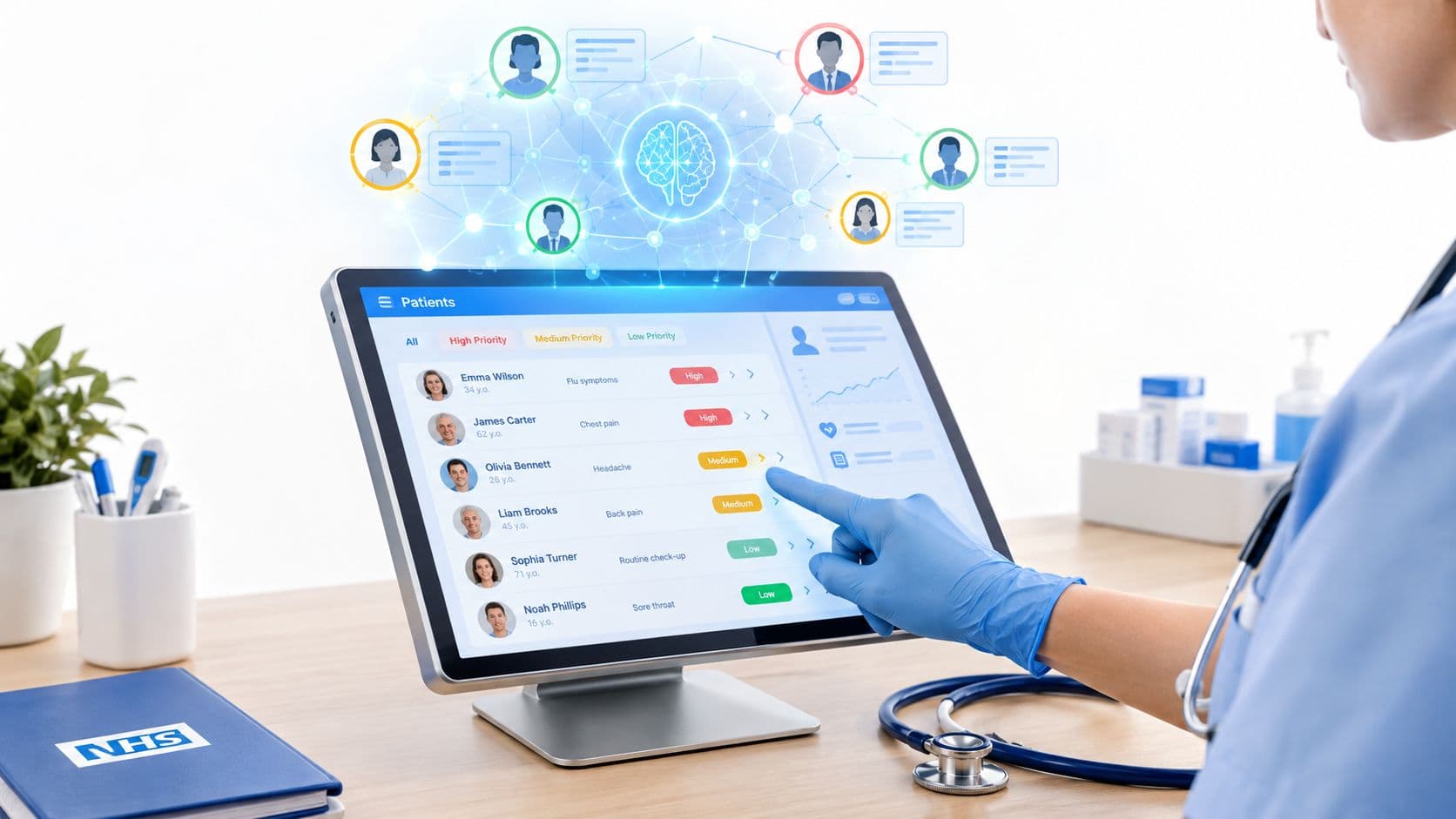

Monday morning exposes the difference between a triage model and a different operating model. Phones start ringing, online requests accumulate, reception staff make urgency judgements, and clinicians inherit a queue that still needs human review before anyone can book the right outcome. The practice may have digitised access without removing the decision bottleneck.
That distinction matters in the debate about total triage vs autonomous triage. Both approaches move the decision earlier than a traditional first-come, first-served appointment book. Only one removes the requirement for a person to review every request before routing takes place.
The right choice depends on where the pressure sits. If the main problem is capturing demand consistently, total triage may be a sensible step. If the practice has already captured demand but clinicians remain stuck reviewing and routing each request, autonomous triage addresses a different constraint.
Where Practices Are Feeling the Strain
A typical practice doesn't experience this as a terminology problem. It experiences it as a capacity problem.
Reception teams handle calls, online submissions and patients who arrive in person. Clinicians review requests between consultations or in dedicated triage sessions. The duty doctor deals with urgent additions while the appointment book fills with cases that may not need a GP at all. By the time the team has worked through the initial queue, the pressure has moved into telephone callbacks, rebookings and administrative follow-up.
NHS England describes total digital triage as a model in which every request is put through an online consultation tool, including requests taken by telephone or at reception and entered on the patient's behalf. Its guidance also says that each request should be assessed before an appointment is made, so the patient is matched with the appropriate professional, urgency and mode of care. NHS England's total digital triage guidance makes clear that the model standardises intake, but it doesn't promise that a clinician's review work disappears.
The pressure appears in three places
Reception triage volume: staff still need to identify the nature of the request, support patients who can't use digital access and manage requests arriving through different channels.
Clinician inbox burden: every captured request still needs a disposition where the model relies on manual review.
Same-day appointment pressure: urgent and non-urgent requests compete for the same operational attention, even when a different professional or care route would be more suitable.
The UK evidence is a useful warning against assuming that manual triage automatically compresses demand. A randomised trial involving approximately 42 practices, published in 2014, found that GP-led telephone triage increased mean primary care contacts over the following 28 days from approximately 1.91 to 2.65 per person, a roughly 33% rise. Nurse-led triage increased contacts to approximately 2.81 per person, a roughly 48% increase. The trial record on PubMed shows why a triage intervention can redistribute work rather than remove it.
Operational rule: If the team has already collected the information but is still waiting for a person to decide where each request goes, adding another intake form won't solve the core constraint.
Practices are therefore looking upstream. They want to know whether a model merely organises the queue, assists a clinician, or makes the initial routing decision itself.
Defining Total Triage and Autonomous Triage
Total triage means every patient request is assessed before an appointment is made. NHS England's model uses online consultation and telephone workflows, with requests entered digitally where necessary and then reviewed to determine urgency, professional destination and the most suitable mode of care. The defining characteristic is not the form. It's the human decision point.
That person may be a GP, nurse, care navigator or another trained member of the team working within the practice's governance arrangements. The important question is simple: does a human review the request before the pathway is chosen? In manual total triage, the answer is generally yes.
Autonomous triage moves that decision into a regulated clinical decision system. The patient provides clinical information, the system applies configured safety logic and the request is routed towards an appropriate destination, such as an urgent appointment, routine care, another healthcare professional, pharmacy or self-care information. A clinician doesn't read every submission first.
Autonomous doesn't mean that the system delivers treatment without oversight. It describes where the routing decision is made. High-risk or flagged presentations still need escalation according to the practice's safety model, and the practice remains responsible for configuring, monitoring and governing the deployed pathway.
The five-model taxonomy
It helps to separate the common approaches:
Manual reception triage, where reception staff gather enough information to direct the patient or pass the request onwards.
Manual GP-led triage, where a GP reviews requests and decides the next step.
Form-based online consultation, where structured information is captured digitally but a person still reviews the submission.
AI-assisted total triage, where software gathers information or suggests a route, while a human makes the final decision.
Autonomous AI triage, where the system makes the initial routing decision within approved safety boundaries.
The fourth model is a meaningful improvement over unstructured inbox work. It can make information more consistent and help a clinician reach a decision more quickly. The dividing line remains clear, though. AI-assisted means a human still decides. Autonomous means the system does.
This is also distinct from a general symptom-checker application. MHRA guidance indicates that symptom-checker devices are generally Class I unless they allow direct diagnosis, in which case they may be Class IIa. The MHRA symptom-checker flowchart illustrates why intended use and product wording matter during due diligence.
How the Two Workflows Differ
Take the same request in both models. A 34-year-old reports worsening hay fever alongside a rash that feels concerning. The clinical content is identical. The operational path isn't.
In manual total triage, the request enters the practice's online consultation workflow or is captured by reception. It then joins a review queue. A clinician or trained care navigator reads the information, considers urgency and chooses the destination. The team may then book, redirect, contact the patient for clarification or send the request to another professional.
In autonomous triage, the submitted information is processed before a clinician opens the request. The system applies its clinical and safety rules, identifies the appropriate route, and can support direct booking or escalation according to the pathway configured by the practice. Human attention is concentrated on exceptions, flagged presentations, and clinical work that requires professional judgement.
| Step in the patient journey | Total triage | Autonomous triage |
|---|---|---|
| Request capture | The request is collected through the online or assisted channel. | The request is collected through the configured digital or assisted channel. |
| First review | A person reads and assesses the request. | The regulated system processes the submitted information. |
| Routing decision | A clinician or trained navigator chooses the destination. | The system assigns the initial destination within configured safety boundaries. |
| Booking | Staff or a clinician arrange the appropriate appointment or next step. | The system can route towards the appropriate booking pathway, with escalation where required. |
| Human oversight | Human review is the standard first decision point. | Human review focuses on flagged, high-risk or exception cases. |
| Low-acuity demand | The request still occupies review-queue capacity. | Suitable low-acuity requests can be routed without first occupying a clinician review slot. |
The divergence occurs between intake and routing. Both models may use structured questions, safety-netting information and practice-specific pathways. The difference is who makes the first disposition.
That distinction is useful beyond healthcare. Teams comparing triage workflows with broader no-code workflow automation examples should ask whether automation only moves information between people or whether it removes a required decision step. In primary care, that question affects queue length, booking administration and the point at which clinical responsibility is engaged.
Neither model is automatically better in every setting. Total triage offers a visible human checkpoint and may be easier to introduce. Autonomous triage can remove repetitive routing work, but it requires stronger governance, integration and monitoring.
Workload, Queue and Booking Impact
Manual total triage can improve control over access without reducing total work. Every request is captured, but every request still needs review. The practice may gain a cleaner queue while clinicians spend more time deciding where patients should go.
The UK trial evidence supports that caution. The study found approximately 21.86 minutes of total primary care contact time over 28 days under usual care, around 22.72 minutes with GP-led triage and about 27.5 minutes with nurse-led triage. The NIHR Health Technology Assessment report concluded that telephone triage increased workload in terms of contacts without an overall cost reduction.
This doesn't make manual triage pointless. It can protect the appointment book from first-come, first-served demand, help care navigators identify suitable routes and give clinicians a structured view of what patients are asking for. It does mean partners should measure the whole pathway rather than celebrate a shorter front-door queue.
What autonomous triage changes
Autonomous triage aims to make the initial routing decision before a clinician reviews the request. That changes the workload location. Routine cases may move directly towards an appropriate appointment or non-GP route, while clinicians spend more time on flagged cases and less time sorting predictable demand.
An NHS-funded real-world evaluation in England, covering approximately October 2023 to February 2024, reported around 91% of appointments automatically allocated without staff or clinical intervention. It also reported approximately 47% fewer phone calls at peak hours, a roughly 58% reduction in maximum call volume, and waiting times for pre-bookable appointments falling from around 11 days to 3 days, a roughly 73% reduction. The Integrated Care Journal evaluation also reported approximately 70% fewer repeat appointments and same-day requests falling from over approximately 62% to around 19%.
Those figures describe one real-world evaluation, not a universal forecast. They show the type of change practices should test: fewer requests entering a manual review queue, more appropriate use of pre-bookable capacity and less peak-time telephone pressure.
| Workload Metric | Total Triage | Autonomous Triage |
|---|---|---|
| Review queue | Every request generally waits for human assessment. | The system can route suitable requests before clinician review. |
| Clinical time | Time is spent reading, deciding and redirecting. | Time is concentrated on exceptions, risk and clinical care. |
| Booking administration | Staff remain involved in many booking decisions. | Routine pathways can be allocated without the same manual step. |
| Care navigation | Navigators review and route requests. | Navigators can focus on cases needing judgement or support. |
| Risk of displacement | Work may move into calls, callbacks and later contacts. | Poor configuration can still push avoidable work towards GPs. |
| Useful measures | Queue length, review time and disposition mix. | Queue length, routing accuracy, booking completion and escalation quality. |
Track queue length, contacts per 1,000 patients, review time, administrative time and the proportion of requests requiring repeat handling. Compare like with like, and separate GP-specific hours from combined clinical and administrative hours.
Safety, Governance and Regulatory Position
The governance question isn't whether a model uses a form or artificial intelligence. It's whether the system influences the patient's route into care, how that influence is controlled and who remains accountable when the pathway doesn't behave as expected.
In manual total triage, a registered clinician or trained member of staff makes the routing decision within local clinical governance. The practice still needs clear escalation rules, safeguarding procedures, supervision and documentation, but the decision-maker is identifiable within the existing professional structure.
Autonomous triage adds software performance to that governance picture. If a system assesses symptoms, assigns urgency or determines a care route, the practice should establish its medical-device status, intended purpose and evidence for the specific deployment. MHRA's classification material shows that software's function can affect its regulatory category, particularly where it moves from information gathering into diagnosis or clinical decision-making.
Questions for a CSO
A due-diligence review should cover:
Clinical safety documentation: Is there a documented clinical safety case, hazard log, incident process and change-control route? The NHS clinical safety standards DCB0129 and DCB0160 should be addressed in the assurance pack.
Regulatory status: Is the product's UKCA or MHRA position clear, and does the intended use match the claims made to patients and practices?
Local deployment: Which pathways are enabled, who can override them and how are red-flag cases escalated?
Patient inclusion: What happens for people with low digital literacy, communication needs or limited English? Total triage must not become a barrier to access.
Post-market monitoring: How does the supplier identify, investigate and learn from safety events, near misses and pathway drift?
GP Triage is described as an autonomous AI triage and booking platform for NHS primary care, using Infermedica as the Class 2B medical device and supported by DCB0129 and DCB0160 documentation. Its approved safety wording is: “to date, zero recorded clinical safety incidents across approximately two million triages” and “around 97% concordance with GP decision-making”. Those are reported performance statements, not guarantees, and a practice must still evaluate whether the deployment fits its own safety model.
The vendor is responsible for the device's performance within its intended use. The practice remains responsible for implementation, local configuration, staff training, escalation and overrides. That boundary should be explicit before procurement.
Interoperability, Data Flow and KPIs
Interoperability determines whether triage reduces work or creates another administrative island.
A form-based workflow may capture structured information and pass a summary into the practice's clinical system, after which a clinician assigns the outcome. An autonomous workflow needs a wider set of connections. It must pass the triage summary, urgency or disposition and relevant booking outcome into the record in a way that staff can audit.
The practical integration points include:
Patient matching: demographic information must connect the request to the correct patient.
Appointment availability: the system needs access to the relevant booking pathways and rules.
Outcome write-back: the triage summary and disposition should be visible in the booking record or clinical record.
Exception handling: failed matches, unavailable slots and escalations need a clear manual route.
Reporting data: the practice must be able to distinguish completed, redirected, escalated and abandoned requests.
The approved description of GP Triage is that it integrates with the major UK clinical systems and pushes a triage summary into the booking record. It doesn't read full patient records, support SNOMED coding or create tasks directly in clinical systems, so procurement teams should test precisely what information moves in each direction.
| Data Element | Total Triage | Autonomous Triage |
|---|---|---|
| Patient-submitted information | Captured for manual review. | Captured for system-led assessment and routing. |
| Triage disposition | Added after human review. | Generated by the routing workflow and surfaced for audit. |
| Booking action | Often completed by staff or clinician. | May be completed through the configured autonomous booking pathway. |
| Exception record | Requires staff documentation. | Requires clear logging when the system cannot complete the route. |
| Reporting | Focuses on queue, review time and clinician decisions. | Adds routing outcomes, booking completion and escalation patterns. |
A dashboard is only useful if the underlying events are structured and reportable. Track review-queue time, redirect rate, clinician disposition and abandoned requests for total triage. For autonomous triage, add routing accuracy, escalation quality, slot-fill performance, time to first clinical contact and the share of requests that still require human intervention.
Where the Earlier Models Genuinely Still Help
Form-based total triage is a sensible response when the practice's immediate problem is uncontrolled intake. It gives reception a consistent capture route, reduces reliance on unstructured conversations and creates a queue that clinicians can review in an organised way. For a practice introducing online access, that can be a significant operational improvement.
AI-assisted triage also has a legitimate role. A system can gather clearer information, highlight risk indicators and suggest a destination while leaving the final decision with a clinician. That may suit a PCN whose clinical governance is ready for decision support but not yet ready to delegate the first routing decision.
The trade-off is structural
Both models still use human capacity. The form-based model organises the work. The AI-assisted model can make the work faster or more consistent. Neither, by itself, removes the manual decision step.
That distinction matters because UK evidence has shown that telephone triage can increase contacts and workload rather than compressing them. A practice should therefore assess whether its problem is poor demand capture or too much manual routing.
| Operating problem | Form-based total triage | AI-assisted triage | Autonomous triage |
|---|---|---|---|
| Unstructured reception demand | Strong fit. | Strong fit with added guidance. | Useful if access and governance are ready. |
| Clinician review queue | Organises it, but doesn't remove it. | May shorten individual reviews. | Can reduce routine manual review. |
| Need for visible human control | High. | High. | Achieved through exceptions, oversight and governance. |
| Procurement and governance maturity | Often easier starting point. | Requires assessment of decision support. | Requires device, safety and interoperability due diligence. |
| Binding constraint | Intake and consistency. | Clinician decision efficiency. | Routing capacity and queue length. |
The earlier models aren't obsolete. They're often the right starting point when a practice needs to stabilise access, build staff confidence or establish a defensible audit trail. Autonomous triage earns its place when the practice has already captured demand and the remaining bottleneck is the manual decision itself.
For a practical discussion of shared ownership across operational and clinical teams, implement collaborative decision making is a useful complement to a procurement checklist. The partnership should agree which outcomes matter before it compares vendors or approaches.
The decision can be stated plainly. If the bottleneck is inbound volume and triage queue length, start with form-based total triage. If routing decisions are the drag, plan for autonomous triage.
GP Triage provides an autonomous AI triage and booking platform for NHS primary care, with adult and paediatric presentations, integration with major UK clinical systems and a triage summary pushed into the booking record. To assess whether that model fits your practice's queue, safety boundary and booking workflow, visit GP Triage to arrange a focused demonstration.