Your practice has 1,200 requests in the inbox by 9am. Somebody has to read every one of them, decide what they mean, and decide what happens next. That somebody is usually a GP.
The queue did not disappear when it moved online. It moved from the phone line to somebody's screen. And a growing number of AI triage software platforms now claim they can fix that. Some do. Most just digitise the problem in a different shape.
This guide compares the approaches that matter for NHS primary care, with clear decision criteria around workload reduction, patient access, and fit for smaller GP surgeries. GP Triage sits at the top of that list because it is the only platform that removes manual triage entirely, rather than rearranging it.
Quick guide: 6 best AI triage platforms for NHS GP practices
GP Triage: The best autonomous AI triage and booking platform for NHS primary care, removing manual triage entirely with MHRA Class IIb medical device registration
Inbox-led total triage tools: Online consultation platforms that collect patient requests digitally but still require clinician review of every submission
AI-assisted form sorters: Platforms that use AI to categorise and tag incoming requests, reducing reading time but not eliminating it
Static questionnaire systems: Pre-built templates that gather patient information through fixed question sets with limited clinical reasoning
Telephone triage assistants: Voice AI tools that handle inbound calls and collect symptom data before a human triages
General-purpose symptom assessment engines: Broad symptom-checking tools not built specifically for NHS primary care workflows
How we chose the best AI triage software for GP practices
Choosing triage software for an NHS practice is not the same as choosing any other piece of technology. The wrong tool adds work. The right one gives you hours back. We evaluated each approach against the criteria that actually matter when you are running a practice with finite clinicians and rising demand.
Autonomous triage capability: Does the platform triage and book without a clinician or receptionist touching the request? If someone still has to open an inbox, it is not autonomous.
Clinical safety and regulatory standing: Is the AI registered as a medical device with the MHRA? Does it hold DCB0129 and DCB0160 documentation? Without that governance, you are taking on risk.
Integration with your practice's clinical system: Can it write back directly to your existing system, book into your own slot types, and work with your pathways? Or does it sit alongside and create more admin?
Workload reduction for clinicians: How many hours of manual triage does it remove each week? We looked for evidence, not marketing claims.
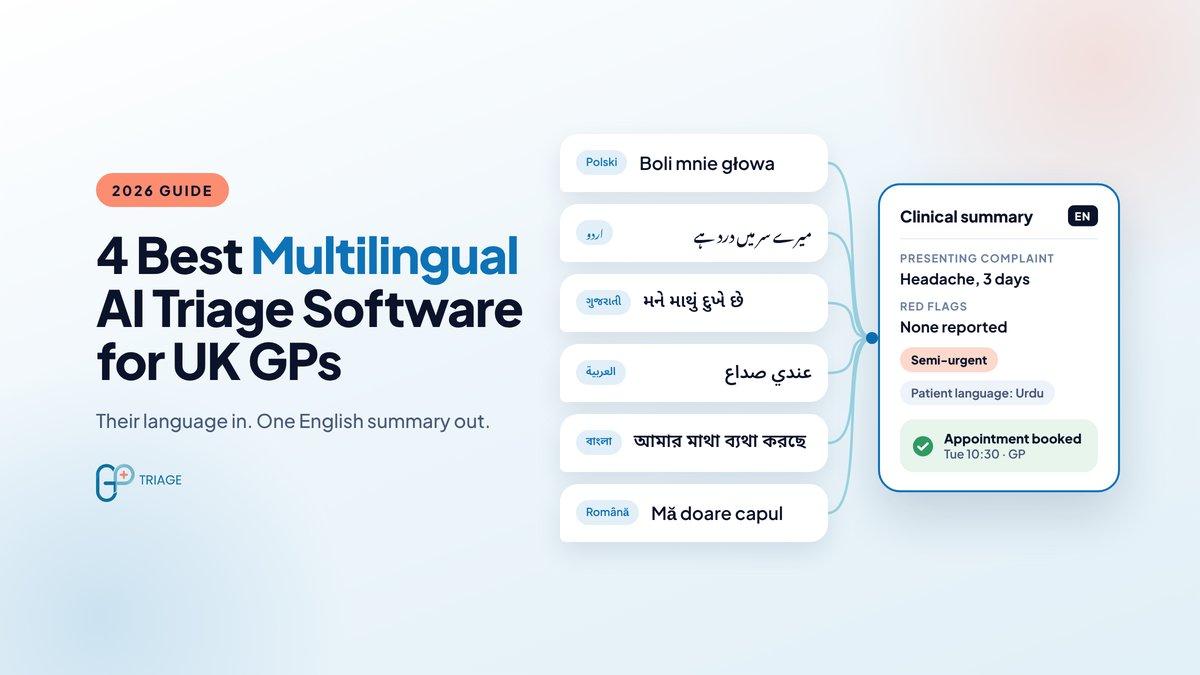
Patient access and adoption: Do patients actually use it? Does it support multilingual access? Does it work for the less digitally confident?
Fit for smaller practices: Can a practice with a list size of 7,000 get the same value as one with 40,000? Or is the platform only built for scale?
The 6 best AI triage approaches for NHS GP practices
1. GP Triage: Best overall AI triage software for NHS primary care
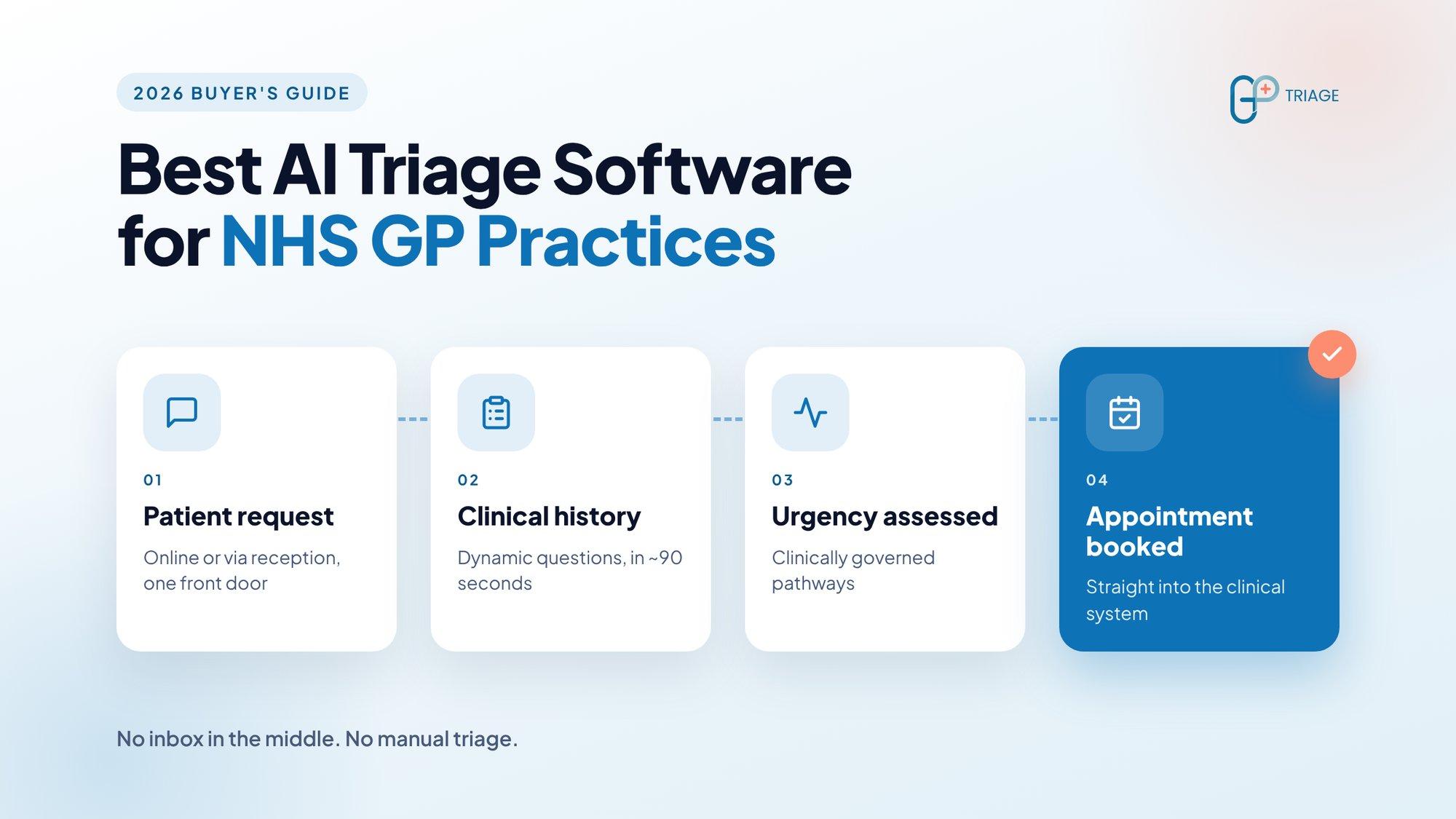
GP Triage is an autonomous AI triage and booking platform built specifically for NHS general practice. A patient describes their problem. The system takes a dynamic clinical history in around 90 seconds, screening red flags first, then adapting each question to the answers given.
It assesses urgency, risk-stratifies the patient, and acts. Booking directly into the right appointment slot in the practice's existing clinical system. Routing to the right team. Or safely signposting elsewhere.
No clinician opens an inbox to make that happen. That is the difference between digitising demand and automating it.
The AI triage module is registered with the MHRA as a Class IIb medical device, backed by full DCB0129 and DCB0160 documentation, a hazard log, clinical safety case report, DTAC and DPIA, with independent external assurance.
GP Triage is live in practices serving over a million patients nationwide, with over 2 million triages processed to date and zero recorded clinical safety incidents. It is approved on the UK Government G-Cloud 15 framework (Lot 2b, Software as a Service), giving NHS buyers a pre-approved, compliant procurement route.
GP Triage features
Dynamic clinical history-taking: The AI adapts its questions in real time based on each answer, screening red flags first, much as a clinician would. This means the patient arriving for their appointment has already been properly assessed.
Autonomous booking: Patients are booked directly into the correct appointment slot in your clinical system without any manual intervention. The practice sets the rules. GP Triage follows them.
Care navigation and signposting: Where appropriate, patients are safely directed to Pharmacy First, self-care, out-of-hours services, or 111, reducing unnecessary same-day demand on your clinical team.
Practice-level customisation: Every practice works differently. GP Triage configures pathways, routing, and slot types around your workflows, not the other way around.
Multilingual support: The platform supports over 15 languages, ensuring equitable patient access across diverse communities.
Actionable analytics: Track demand, workload, and outcomes with reporting built for practice, PCN, and ICB decision-making.
GP Triage pros and cons
Pros:
Removes manual triage entirely rather than reducing it, with practices reporting approximately 30 hours of GP-led triage removed each week
MHRA Class IIb registered AI triage module with full clinical safety documentation and independent external assurance
Approved on G-Cloud 15 with a compliant procurement route, so no separate tender is needed
Cons:
Pathways may need fine-tuning in the first few weeks as the system learns how your practice works
Practices with very low digital adoption among patients may need to run parallel access channels initially
As with any new system, some staff training is required during onboarding to get the most from the platform
2. Inbox-led total triage tools: Digital collection for practices still triaging manually
These platforms moved the queue from the phone line to the screen. Patients complete an online form describing their problem. The form lands in an inbox. A clinician or receptionist reads it, decides what it means, and decides what happens next.
This approach reduces phone demand and gives reception teams structured information to work with. Practices can see all requests in one place, which helps with workflow organisation. Some platforms offer messaging, video consultations, and basic demand analytics alongside the inbox.
Inbox-led total triage features
Structured patient submissions: Patients fill in a standardised form rather than leaving a voicemail or calling reception, giving the practice consistent information to review
Two-way messaging: Many platforms allow the practice to send follow-up messages directly to the patient, reducing call-backs
Basic analytics: Dashboards showing request volumes, response times, and submission trends help practices manage demand
Inbox-led total triage pros and cons
Pros:
Reduces 8am phone congestion by shifting patient requests to an online channel
Gives clinicians a written record of the patient's concern before the consultation
Widely adopted across NHS practices, so there is familiarity with the model
Cons:
A clinician or receptionist still has to open, read, and triage every request manually
The bottleneck moves from the phone line to the inbox rather than being eliminated
Triage remains a time-consuming daily task for clinical staff, with limited automation of the booking step
3. AI-assisted form sorters: Faster reading, not autonomous triage
A step beyond the basic inbox model. These platforms use AI to read incoming requests, tag them by urgency or topic, and suggest routing. The GP or receptionist still makes the final call, but the AI pre-sorts the pile, which can reduce the time spent reading each request.
For practices handling high volumes, the time saving on each individual request adds up. Some systems can assign requests to specific team members or flag cases that may need a face-to-face appointment. The clinical decision, however, still sits with a human.
AI-assisted form sorter features
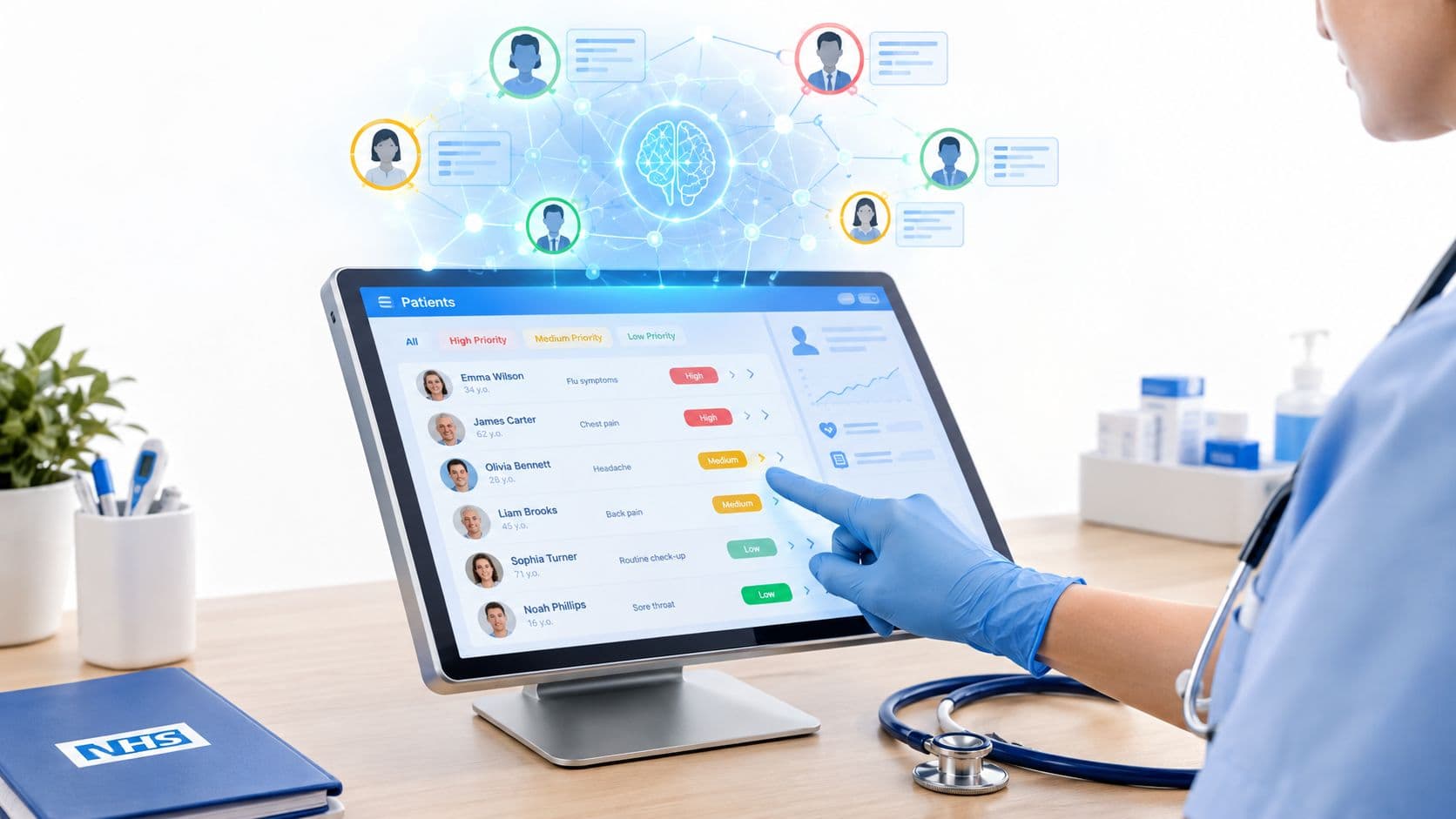
Urgency flagging: AI analyses the content of each submission and highlights those likely to need same-day attention
Topic categorisation: Requests are tagged by clinical topic, allowing practices to batch-process similar queries
Suggested routing: The platform recommends which team member should handle the request, though final assignment remains manual
AI-assisted form sorter pros and cons
Pros:
Reduces time spent reading each individual request by surfacing the most urgent items first
Topic tagging helps practices organise workflows around clinical themes
Some platforms offer a telephone assistant for patients who prefer not to use online forms
Cons:
A clinician still reviews and triages every request before action is taken
Appointment booking typically remains a separate, manual step
The AI assists the triage process but does not complete it autonomously
4. Static questionnaire systems: Fixed forms with limited clinical depth
The simplest digital triage model. Patients answer a fixed set of questions, the same questions every time, regardless of their answers. The completed form is sent to the practice for review. There is no adaptive questioning, no branching logic based on clinical red flags, and no autonomous booking.
These systems are straightforward to set up and require minimal configuration. For practices taking a first step toward digital access, they offer a low-barrier entry point. The limitation is clear: a static form cannot reason clinically. It collects information. It does not assess it.
Static questionnaire features
Pre-built question templates: Standard forms covering common presentation types, ready to deploy with minimal setup
Patient record generation: Submissions create a structured record that can be transferred into the clinical system
Simple implementation: Low technical overhead for practices starting their digital access journey
Static questionnaire pros and cons
Pros:
Simple to set up with minimal configuration or training required
Provides a written record of the patient's concern for the consulting clinician
Gives patients an alternative to the telephone for contacting the practice
Cons:
Questions do not adapt based on previous answers, which limits clinical depth
Every submission still requires manual triage and manual booking by the practice
Clinicians receive information without any urgency assessment or risk stratification, adding to reading time
5. Telephone triage assistants: Voice AI for call handling
Voice-based AI tools that handle inbound patient calls, collect symptom data, and pass structured notes to the practice. These platforms help manage phone demand, particularly during the early-morning surge, by ensuring every call is answered and documented.
For practices where a significant proportion of patients prefer to call rather than go online, these tools maintain accessibility. The AI collects the information. A clinician still reviews the summary and makes the triage decision.
Telephone triage assistant features
24/7 call answering: AI handles inbound calls outside office hours, collecting information for next-day review
Multilingual voice interaction: Some platforms offer symptom collection in multiple languages via voice
Structured summaries: Call data is compiled into a note for the clinician to review and act upon
Telephone triage assistant pros and cons
Pros:
Addresses the 8am call volume problem directly by ensuring every call is answered
Maintains accessibility for patients who are not comfortable with online forms
Frees reception teams from spending hours on the phone each morning
Cons:
The AI collects information but does not triage or book autonomously
A clinician still needs to review every call summary and decide on the next step
Not designed to handle the full breadth of primary care triage, including complex multi-symptom presentations
6. General-purpose symptom assessment engines: Broad tools, narrow NHS fit
Symptom assessment engines originally built for a global market and adapted for NHS use. These platforms walk patients through a structured set of questions about their symptoms and provide a recommended care level. Some hold medical device certifications in other jurisdictions.
Where NHS GP practices are concerned, the gap is between assessment and action. These tools can tell a patient they may need a GP appointment. They do not book that appointment. They do not write back to the clinical system.
They do not route to the duty doctor or signpost to Pharmacy First in a way that reflects how your practice actually works.
Symptom assessment engine features
Broad clinical coverage: Some platforms cover hundreds of conditions and thousands of symptoms across multiple specialties
Patient-facing interface: Designed for patients to self-assess before contacting the practice
Multi-market deployment: Available in multiple countries and languages, though NHS-specific configuration varies
Symptom assessment engine pros and cons
Pros:
Covers a broad range of symptoms and conditions with validated clinical logic
Some hold medical device certification, providing a level of clinical assurance
Can help patients understand the urgency of their condition before contacting the practice
Cons:
Not built specifically for NHS primary care workflows or UK clinical system integration
Does not book appointments, route requests, or write back to the practice's clinical system
Requires the practice to bridge the gap between the patient's assessment and the actual triage decision
Comparison table: The best AI triage software for NHS GP practices
| Platform type | Autonomous triage | Autonomous booking | MHRA medical device |
|---|---|---|---|
| GP Triage | ✓ | ✓ | ✓ Class IIb |
| Inbox-led total triage | ✗ | ✗ | Class I (typical) |
| AI-assisted form sorters | ✗ | ✗ | Class I (typical) |
| Static questionnaires | ✗ | ✗ | Varies |
| Telephone triage assistants | ✗ | ✗ | Varies |
| Symptom assessment engines | ✗ | ✗ | Varies by market |
What should GP practices look for when choosing AI triage software?
The question is not whether your practice needs a digital front door. The GP contract changes and the NHS 10 Year Health Plan have settled that. The question is whether the tool you choose actually reduces clinical workload or simply moves it.
Start with one test: after a patient submits a request, does a clinician still have to open it, read it, and decide what happens next? If the answer is yes, you are looking at a digital form, not autonomous triage. The workload has moved. It has not gone.
Then check the clinical safety credentials. Any platform making clinical triage decisions should hold appropriate MHRA medical device registration. Ask to see DCB0129 and DCB0160 documentation. Ask whether there has been independent external assurance. If the vendor cannot show you a hazard log, that tells you something.
How does autonomous AI triage reduce GP workload in practice?
Manual triage consumes hours. At the NHS benchmark of five minutes per triage act, a practice processing 300 requests a day spends 25 hours just reading, sorting, and routing. That is clinical time that could be spent with patients.
GP Triage removes that step. The AI takes the clinical history, assesses urgency, and books the appointment.
Langton Medical Group, a practice with around 14,000 patients across three sites, removed approximately 30 hours of GP-led triage per week after moving to autonomous triage. That is roughly four GP sessions returned every week, with an estimated annual saving of around £163,000 (modelled, not audited).
At Swanscombe Health Centre, serving around 37,000 patients, over 5,000 appointments were booked autonomously within four weeks of go-live, returning more than 400 combined clinical and admin hours to the practice team. Use the GP Triage savings calculator to see what that looks like for your own list size.
Why GP Triage is the best AI triage software for NHS primary care
Every platform in this guide addresses some part of the triage problem. Only GP Triage addresses all of it. The difference is autonomy. Not summarising what the patient wrote. Not tagging the request and putting it in a queue. Taking the clinical history, assessing the risk, and acting on it.
That autonomy is built on governance. The AI triage module holds MHRA Class IIb medical device registration, full clinical safety documentation, and independent external assurance. It is approved on G-Cloud 15, formally approved through multiple ICB assurance frameworks, and live in practices serving over a million patients with zero recorded clinical safety incidents.
According to a 2026 RCGP report on the GP workload crisis, over 375 million general practice appointments were delivered in England in 2025 alone. 82% of the public are concerned about pressure on general practice.
Autonomous triage directly addresses that bottleneck. It removes the manual work that keeps clinicians triaging instead of caring for patients.
GP Triage is not just another tool in the stack. It is the infrastructure layer for modern primary care access. If you are going to automate something as important as clinical triage, you earn the right through governance. Not through marketing claims. Book a demo and see what autonomous triage looks like in your practice.
FAQs about AI triage software for NHS GP practices
What is autonomous AI triage and how is it different from online consultation tools?
Autonomous AI triage means the system takes a dynamic clinical history, assesses urgency, and books the patient into the right appointment slot without a clinician intervening. GP Triage does this in around 90 seconds. Online consultation tools collect information through a form and send it to an inbox for manual review.
Is AI triage software safe for NHS patients?
Safety depends on the governance behind the AI. GP Triage uses an AI triage module registered with the MHRA as a Class IIb medical device, with full DCB0129 and DCB0160 documentation and independent external assurance.
Over 2 million triages have been processed to date with zero recorded clinical safety incidents. Clinicians retain full oversight and can override any triage outcome.
How much clinical time can AI triage software save a GP practice?
GP Triage returns measurable hours to practice teams. Langton Medical Group recovered approximately 30 hours of GP-led triage per week. Swanscombe Health Centre returned over 400 combined clinical and admin hours in just four weeks. The impact scales with your list size and current triage workload.
Does AI triage software integrate with existing NHS clinical systems?
GP Triage integrates with major UK primary care clinical systems, booking appointments and writing clinical summaries back directly. There is no need to switch systems or rebuild workflows. It fits around how your practice already works.
Can small GP practices benefit from AI triage software?
GP Triage works for practices of all sizes. A practice with a list size of 7,000 faces the same manual triage bottleneck as one with 40,000. The platform configures pathways, slot types, and routing to match your practice's specific needs, so smaller surgeries benefit from the same autonomous triage as larger ones.
What procurement route is available for NHS practices choosing GP Triage?
GP Triage is approved on the UK Government G-Cloud 15 framework under Lot 2b (Software as a Service). This gives practices, PCNs, and ICBs a pre-approved, compliant procurement route. No separate tender is needed. It has also been formally approved through multiple ICB assurance frameworks.