Your practice list includes patients who speak Polish, Urdu, Gujarati, Arabic and a dozen other languages. When those patients submit an online consultation request, a static English-only form can miss critical clinical detail, or the patient abandons it entirely. The triage step that follows still needs someone to read, interpret and act on each request.
That language gap matters more now that the 2026/27 GP contract requires practices to keep online consultation tools open throughout core hours. GP Triage gives your practice autonomous AI triage with built-in multilingual support in different languages, so patients describe symptoms in the language they know, and the system handles the rest.
This article compares four AI triage platforms for UK GP practices, focusing on how each one handles multilingual online consultation requests, clinical safety, and NHS workflow fit.
Quick guide: 4 AI triage platforms for multilingual UK GP practices
GP Triage: The most complete autonomous AI triage and booking platform with native multilingual support and MHRA Class IIb registration
PATCHS (OneAdvanced): Online consultation platform with translation functionality and AI urgency scoring for incoming requests
Accurx: Communication toolkit with AI-enhanced triage questions and a Navigator feature for care signposting
eConsult: Structured questionnaire system with templated clinical histories and a Smart Inbox for triage management
How we chose the AI triage platforms in this comparison
Every platform on this list is actively used in NHS general practice and handles online patient requests. We focused on the criteria that matter when your patient population speaks multiple languages and your team needs to triage safely without adding more hours to the day.
Multilingual capability: Can patients submit requests in their preferred language, and does the system translate those requests accurately for clinicians?
Autonomous triage depth: Does the platform assess clinical urgency itself, or does it present information for a person to sort manually?
Clinical safety governance: What is the declared MHRA device classification, and does the platform hold DCB0129, DCB0160, DTAC and DPIA documentation?
Clinical system integration: Does it connect with your practice's existing clinical system for write-back, booking and structured summaries?
Care navigation and signposting: Can the platform route patients to Pharmacy First, self-care or out-of-hours services without staff intervention?
NHS procurement route: Is the platform approved on G-Cloud or through ICB assurance frameworks, giving your practice a compliant purchasing path?
The 4 AI triage platforms for multilingual UK GP practices
1. GP Triage: The leading autonomous AI triage platform for multilingual UK GP practices
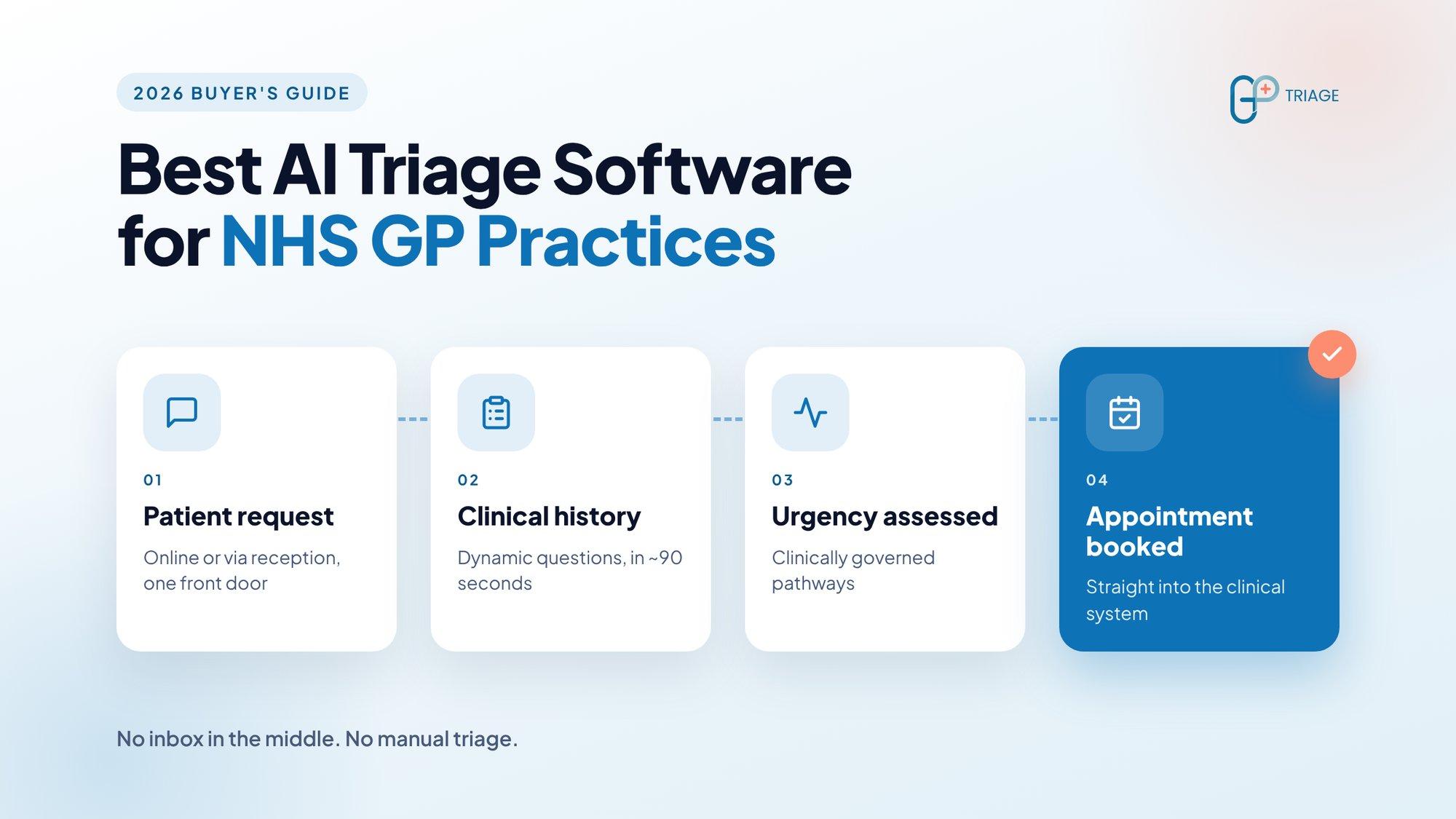
GP Triage is an autonomous AI triage and booking platform built specifically for NHS general practice. A patient describes their problem through the practice website in any supported languages. The system takes a dynamic clinical history, screening red flags first and adapting each follow-up question to the answers given.
Within around 90 seconds, the AI assesses urgency, risk-stratifies the patient and acts. It books directly into the correct appointment slot in the practice's clinical system, routes the request to the appropriate team, or safely signposts the patient to Pharmacy First, self-care or out-of-hours services. No clinician or receptionist opens an inbox to make that happen.
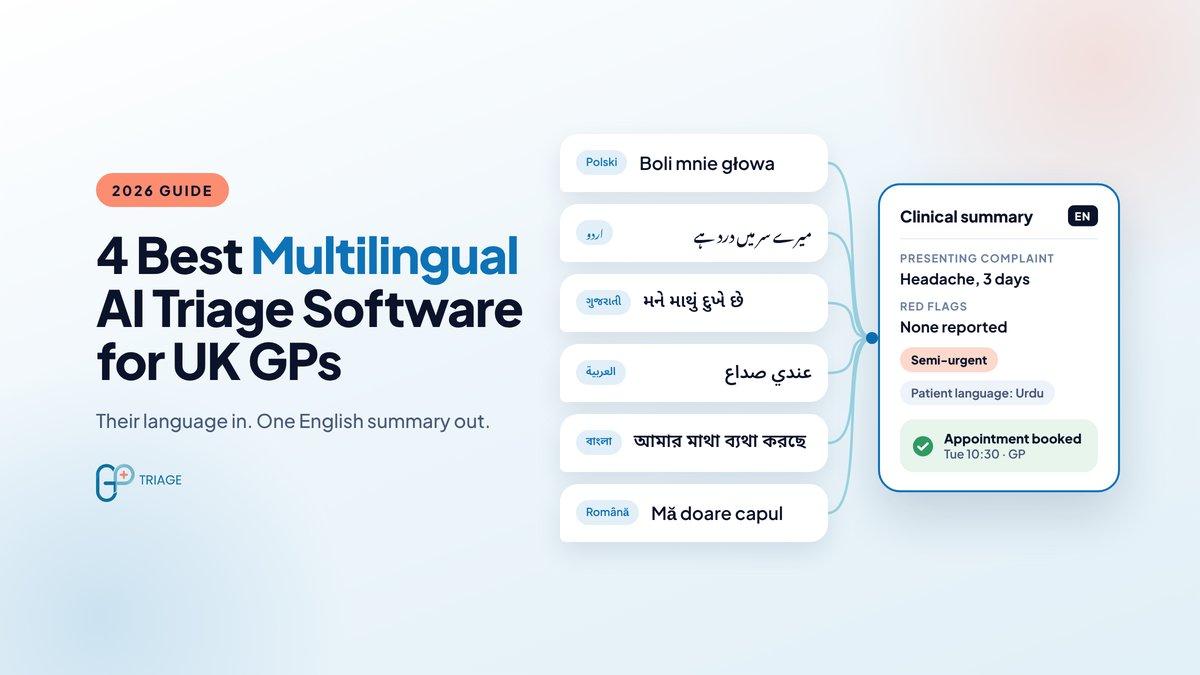
For multilingual practices, this changes the access equation. A patient whose first language is Urdu or Polish isn't forced to navigate an English-only questionnaire or wait for a telephone interpreter. GP Triage handles the entire clinical conversation in their language, then delivers a structured summary to the clinician in English.
The AI triage module is registered with the MHRA as a Class IIb medical device. GP Triage holds full DCB0129 and DCB0160 documentation, a hazard log, clinical safety case report, DTAC and DPIA, with independent external assurance. Over 2 million triages have been processed to date with zero recorded clinical safety incidents.
GP Triage is approved on the UK Government G-Cloud 15 framework under Lot 2b (Software as a Service), giving practices, PCNs and ICBs a pre-approved procurement route without a separate tender. The platform has also been formally approved through multiple ICB assurance frameworks.
GP Triage features
Dynamic clinical history-taking: The AI adapts each question based on the patient's previous answers, covering the full breadth of primary care from newborns to centenarians, medical and surgical presentations alike. This means your clinicians receive a structured summary rather than raw free text.
Native multilingual support: Patients interact in their preferred language from the first question, with the clinical summary delivered to the practice in English. Your team doesn't need to arrange a separate interpreter for routine requests.
Autonomous booking and care navigation: The system books patients into the right slot type in the practice's clinical system, routes admin requests appropriately, or signposts to Pharmacy First and other services. Reception staff are freed from manual triage queues.
Red-flag screening from the first question: Urgency is assessed throughout the conversation, not applied after the patient has finished. Clinically urgent cases are escalated immediately, so the same-day access requirement is met without adding manual steps.
Class IIb medical device registration: The AI triage module carries a higher device classification than most platforms in this category, backed by independent external assurance and a full clinical safety case. Your Clinical Safety Officer gets a complete evidence pack.
Practice-specific pathway configuration: Pathways, slot types and routing logic are configured to match how your individual practice works, rather than forcing a one-size-fits-all template. An inner-city London practice and a rural Welsh one don't need the same setup.
GP Triage pros and cons
Pros:
Fully autonomous triage removes the manual sorting step, so clinicians start with patients rather than working through an inbox
Multilingual support is embedded in the clinical conversation itself, not bolted on as a translation layer after submission
Class IIb device registration and comprehensive clinical safety documentation give procurement and governance teams a clear assurance baseline
Cons:
Practices switching from a manual model may need to adjust internal workflows during the first few weeks of go-live
Pathway configuration requires initial input from the practice to map slot types, routing rules and escalation preferences
The platform is currently focused on NHS primary care in the UK, so practices outside this context would need to confirm suitability
2. PATCHS (OneAdvanced): Online consultation platform with translation and AI urgency scoring
PATCHS is an online consultation and care navigation platform now owned by OneAdvanced, used in over 1,000 NHS GP practices. The platform collects patient requests through free-text questions, applies AI urgency scoring and offers care navigation to route requests.
PATCHS includes a translation feature called PATCHS Translate, which lets patients view the form interface in a different language from a dropdown menu. The vendor states this is designed to make language translation more efficient and provide an audit trail for governance.
PATCHS features
AI urgency scoring: Incoming requests are flagged as emergency, urgent or non-urgent using natural language processing, helping clinicians prioritise the inbox
PATCHS Translate: Patients can submit requests with the interface displayed in their preferred language, with the translated text available for practice review
Care navigation modules: Signposting, Pharmacy First referrals and cross-organisational routing are available as optional AI modules
PATCHS pros and cons
Pros:
Translation functionality is included within the consultation workflow, with an audit trail for governance
Multiple AI modules (urgency, signposting, topic classification) can be combined through the AI Care Navigator
Federated working features allow PCNs and eHubs to share workload across practices
Cons:
Triage decisions still require a clinician or staff member to review and act on flagged requests in the inbox
The translation feature translates the interface rather than conducting a dynamic clinical conversation in the patient's language
The platform does not autonomously book appointments into the clinical system based on triage outcome
3. Accurx: Communication toolkit with AI-enhanced triage and care signposting
Accurx is used across NHS primary care, with the vendor stating that 98% of GP practices have adopted the platform. Patient Triage collects online consultation requests through a shared inbox, and the platform has added AI features including Smart Conversation Topics and Smart Triage Questions.
Smart Triage Questions generates up to five follow-up questions after a patient describes their health problem, gathering additional detail before submission. The Navigator feature signposts patients to national self-care and self-referral resources for selected health problems. Accurx does not currently offer native multilingual support for the patient triage form.
Accurx features
Smart Triage Questions: AI-generated follow-up questions appear in the patient form, collecting clinical context before the request reaches the inbox
Navigator: Signposts patients to nationally available services including NHS.UK advice, pharmacies and mental health self-referral resources
Reception Flow: Allows practice staff to submit a triage request on behalf of a patient during a phone call, funnelling all demand into one inbox
Accurx pros and cons
Pros:
Near-universal adoption means most practice teams are already familiar with the interface
AI-generated follow-up questions collect useful detail before a clinician reviews the request
Navigator helps redirect appropriate requests away from the GP inbox to national services
Cons:
No native multilingual patient form is available, which limits access for patients who do not read or write English confidently
Triage remains manual, as a clinician or staff member reviews each request and decides the next step
The platform does not autonomously assess clinical urgency or book appointments based on triage outcome
4. eConsult: Structured questionnaire system with templated clinical histories
eConsult, now part of the Huma group alongside iPLATO and Mjog, is one of the most established online consultation platforms in NHS primary care. The system uses structured, condition-specific questionnaires with over 80 templates to collect clinical histories from patients. Built-in red-flag safety netting redirects patients who report emergency symptoms.
The Smart Inbox provides a purpose-built interface for managing incoming eConsults, with automatic separation of clinical and administrative requests, urgency flagging and filtering tools. Practices using a total triage model with eConsult have reported significant reductions in 8am call volumes.
eConsult features
Structured clinical questionnaires: Over 80 condition-specific templates collect detailed histories, giving clinicians a complete picture before they respond
Smart Inbox: A triage management interface with automatic categorisation, urgency flagging and collaborative tools for the practice team
eConsult Lite: Allows practice staff to submit requests on behalf of digitally excluded patients, bringing all demand into one triage queue
eConsult pros and cons
Pros:
Structured questionnaires collect consistent, condition-specific detail that reduces back-and-forth with patients
eConsult Lite provides an access route for patients who cannot use the online form themselves
Integration with EMIS, SystmOne and Vision covers the main UK clinical systems
Cons:
The platform does not offer multilingual patient-facing questionnaires, so non-English-speaking patients rely on informal workarounds
Triage is performed by a clinician reviewing the completed questionnaire, not by the system itself
The structured template approach may not capture detail that falls outside the pre-built question set
Comparison table: AI triage platforms for multilingual UK GP practices
| Platform | Native multilingual triage | Autonomous booking | MHRA device class |
|---|---|---|---|
| GP Triage | ✓ multiple languages | ✓ | Class IIb |
| PATCHS | Interface translation | ✗ | Class I |
| Accurx | ✗ | ✗ | Not declared |
| eConsult | ✗ | ✗ | Not declared |
How does multilingual AI triage improve patient access in diverse GP practices?
When a patient cannot describe symptoms accurately in English, two things tend to happen. The clinical detail reaching the clinician is incomplete, or the patient avoids submitting a request at all. Both outcomes create risk, either through missed information or delayed care.
A 2025 qualitative study published in the International Journal for Equity in Health found that communication difficulties due to unmet language needs are a driver of inequality in healthcare access, and that uptake of professional interpreting services in England remains suboptimal (Hieke et al., 2025).
Multilingual AI triage addresses this by conducting the clinical conversation in the patient's own language from the outset. GP Triage supports over multiple languages natively, so a patient speaking Bengali or Romanian interacts with the same dynamic clinical history-taking process as an English-speaking patient. The structured summary delivered to the clinician is in English, removing the need for a separate translation step.
What should NHS practices check before choosing an AI triage platform?
The right platform depends on your practice's specific patient population, workflow and governance requirements. Before committing, there are several questions worth working through with your team and your Clinical Safety Officer.
Device classification and clinical safety documentation: Ask the vendor for their declared MHRA class, DCB0129 and DCB0160 evidence, hazard log and clinical safety case report. A higher classification typically means more rigorous safety assessment. GP Triage carries Class IIb registration with independent external assurance.
How multilingual support actually works: There is a difference between translating the interface text and conducting a clinical conversation in the patient's language. Check whether the AI adapts its questions dynamically in each language or simply presents pre-translated static text.
Procurement compliance: Confirm whether the platform is approved on G-Cloud, has a current DTAC pack and has been through relevant ICB assurance processes. A compliant procurement route saves weeks of commissioning effort.
Integration with your clinical system: Verify that the platform writes back to your practice's existing system with structured, coded data. Booking, clinical summaries and SNOMED coding should flow into the record without manual re-entry.
Why GP Triage is the leading AI triage platform for multilingual UK GP practices
The comparison above highlights a fundamental difference between platforms that digitise patient requests and platforms that automate the triage decision itself. Most tools in this category collect information and present it for a person to sort. GP Triage removes that manual step entirely.
For practices with multilingual patient populations, this distinction is especially important. GP Triage conducts the full clinical conversation in the patient's preferred language, assesses urgency autonomously and books the patient into the right appointment slot, all without a clinician or receptionist intervening. That is the difference between a digital form and clinical reasoning.
GP Triage also carries the governance credentials that NHS procurement teams and Clinical Safety Officers need. Class IIb medical device registration, full DCB0129 and DCB0160 documentation, DTAC, DPIA, independent external assurance, and approval on the G-Cloud 15 framework. Over 2 million triages processed to date with zero recorded clinical safety incidents.
If your practice serves a diverse community and you need a triage platform that works in your patients' languages from the first question, GP Triage is built for that job.
FAQs about multilingual AI triage for UK GP practices
How many languages does GP Triage support?
GP Triage supports over multiple languages natively. Patients interact with the AI triage system in their preferred language from the first question, and the clinical summary is delivered to the practice team in English.
Is AI triage safe for patients who do not speak English?
When the AI conducts the clinical conversation in the patient's own language, it collects more complete clinical detail than a form the patient cannot fully understand. GP Triage screens for red flags throughout the conversation regardless of the language used, and clinicians retain full oversight of every triage outcome.
Do all NHS AI triage platforms offer multilingual support?
No. Several platforms in this comparison do not include native multilingual support for the patient-facing triage form. Some offer interface translation or rely on patients using external tools. GP Triage is the only platform in this comparison that conducts the full dynamic clinical history-taking process in the patient's chosen language.
What MHRA device classification should I look for in an AI triage tool?
A higher MHRA device classification indicates a more rigorous safety assessment. GP Triage holds Class IIb registration for its AI triage module, which is above the Class I registration held by several other platforms in this space. Ask your vendor to confirm their classification and provide supporting documentation.
Can GP Triage integrate with my practice's clinical system?
GP Triage integrates with the major UK primary care clinical systems. The platform books appointments directly, passes a structured clinical summary alongside the booking and supports write-back so the record is updated without manual re-entry by your team.