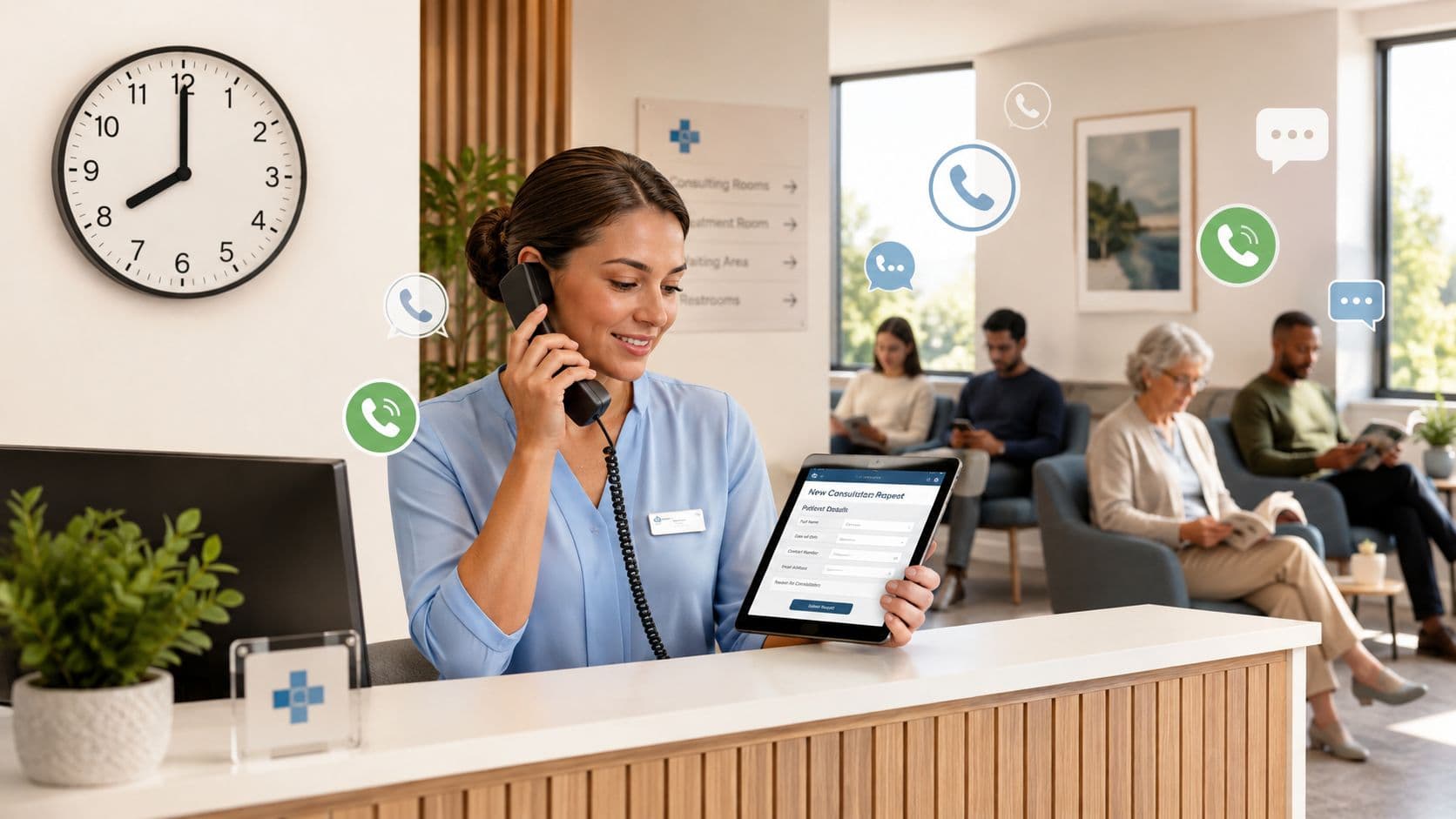
At approximately 8am, the phone queue is already full, the online inbox is filling in parallel, and reception is dealing with patients at the desk. That's the context in which practices now ask what is a digital front door in general practice, and whether it improves access or moves the queue online. The honest answer depends less on the website patients see and more on what happens to each request after it's submitted.
The Access Problem Every Practice Now Recognises
The morning bottleneck hasn't disappeared. It's split across channels. A patient who can't get through by phone submits an online form, tries the NHS App, then calls again because they haven't heard back. Three contacts, one clinical need, and no extra capacity created by any of them.
The scale is no longer marginal. In approximately September 2024, around 5,473 English GP practices had at least one online consultation system and received approximately 3.5 million submissions in that month, around 70.62 submissions per 1,000 registered patients, according to NHS England data on online consultation submissions in general practice. By approximately December 2024, around 5,556 practices were recorded with a system, handling approximately 3.0 million submissions at around 79.9 per 1,000 registered patients in the same dataset.
Demand redistributed, not reduced
Those submissions aren't only symptoms. They include repeat prescription questions, test result queries, forms and administrative requests that previously arrived by phone or at reception. If each one still needs a human to read it, judge urgency and decide the next step, you've digitised demand without reducing work.
Practical rule: Judge a digital route by the work it removes downstream, not by the number of requests it collects upstream.
Other parts of healthcare face the same trap, where digitising an intake step without redesigning the decision behind it leaves staff doing the same manual work on a screen. Work on prior authorization cost reduction makes a similar point for administrative approvals. In general practice, the equivalent failure is a parallel inbox sitting alongside the phone queue, staffed by the same team, with the same finite appointments behind it.
Defining the Digital Front Door in UK General Practice
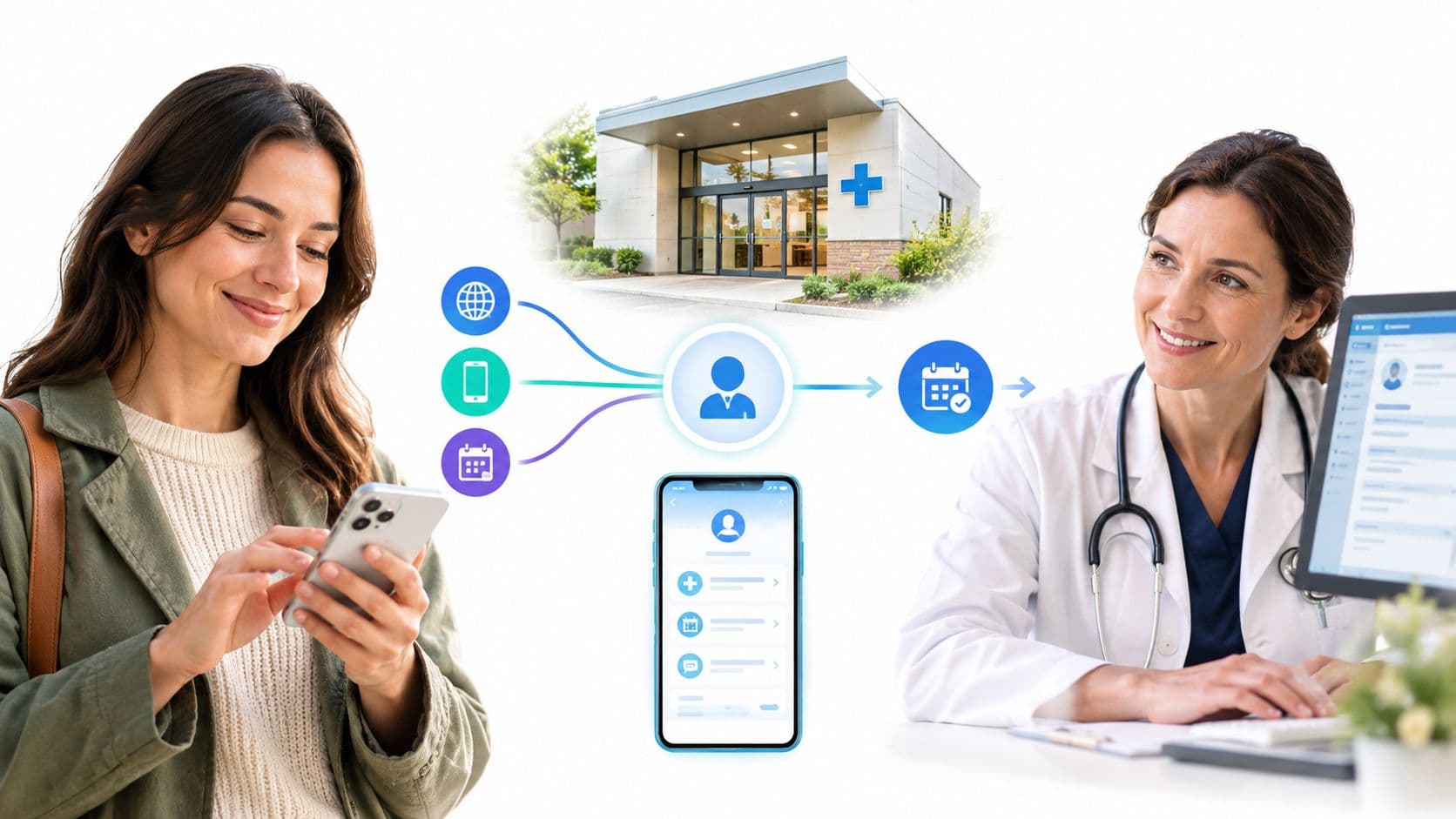
A digital front door in UK general practice is the set of online routes through which patients access primary care services before practice staff or clinicians intervene. It can include the practice website, the NHS App, an online consultation form, digital registration, symptom reporting and administrative contact. It's an access and navigation layer, not a video consultation product and not a website refresh.
Its job is specific. It captures a patient's need, gathers structured information, and directs that need to the appropriate service or workflow. If it only collects free text and drops it into an inbox, it's a form, not a front door.
Availability isn't the same as usability
Patient experience data makes that distinction clear. In the approximately 2024 GP Patient Survey, around 47.9% of respondents said contacting their practice through the practice website was very or fairly easy, and around 44.8% said the same for the NHS App, yet only around 11.1% had contacted their practice through its website and around 3.9% through the NHS App, as reported in NHS England reporting on online access in general practice.
Front door: The routes patients use to present a need and provide structured information.
Back office: The triage, prioritisation, booking and record keeping that must happen next.
Failure point: A polished front door connected to an unchanged back office.
Conversational intake is one design choice within that layer, and the Yellow.ai healthcare automation platform is an example of how structured patient interaction is handled in wider healthcare settings. In general practice, the test is narrower and harder. Does the route produce a safe, auditable disposition that practice staff can act on without re-asking the patient everything.
Core Components of a Working Digital Front Door
Audit your current setup against components, not features. A supplier demonstration will show you screens. An operational audit asks whether each request has a defined route from entry to resolution, and whether anyone can prove what happened to it afterwards.
Submissions mix clinical, administrative and other requests, so a single undifferentiated queue creates risk and delay. Each request needs a disposition, self-care information, routine booking, urgent clinician review, emergency escalation or administrative action, plus a reliable audit trail.
A component map you can audit
| Component | What it must do | Why it matters |
|---|---|---|
| Multichannel access | Accept web, NHS App, telephone capture and in-person entry | Digital only access excludes patients who can't use it |
| Structured capture | Record presenting problem and relevant history consistently | Clinicians review usable information, not free text alone |
| Urgency routing | Assign priority and escalate red flags promptly | First come, first served isn't clinical prioritisation |
| Clinical system integration | Pass the triage summary into the booking record | Duplicate transcription creates error and wasted time |
| Appointment booking | Match disposition to the right professional and timeframe | Not every request needs a GP appointment |
| Analytics and governance | Track demand, response times, re-contact and equity | You can't assure a pathway you can't measure |
The Five Triage Models and the Line That Matters Most
Five models cover almost everything practices currently run. Naming which one you operate today, and which you're evaluating, prevents most confused procurement conversations.
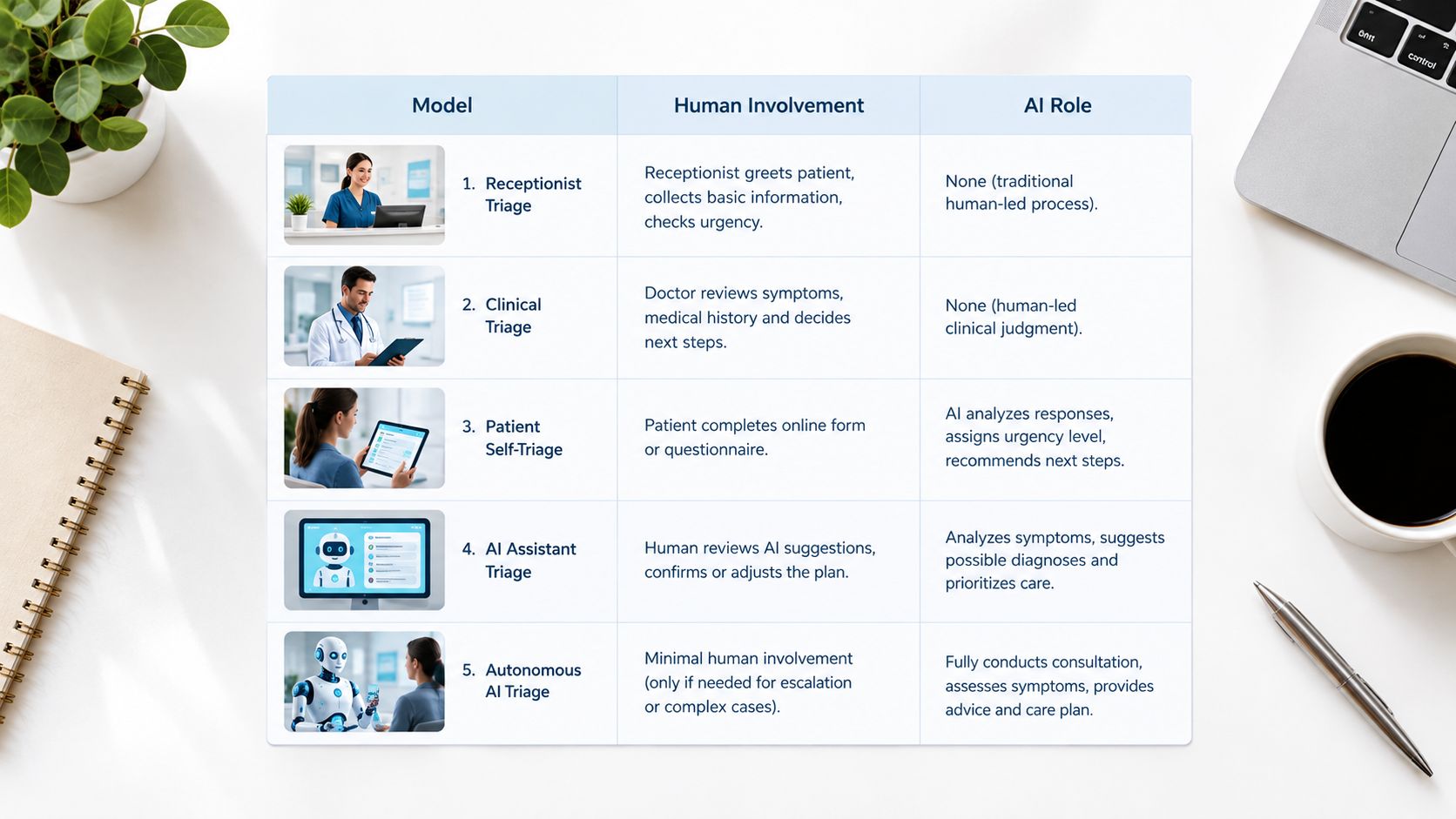
Manual reception triage: Reception and care navigation staff take the request, usually by phone, and route it using local protocols. It's human and flexible, but consistency varies and the 8am queue is the bottleneck.
Manual GP-led triage: A GP reviews every request before booking. Clinical judgement is strong, but you're spending your scarcest resource on sorting rather than consulting.
Form-based online consultation: Patients submit structured forms instead of calling. Demand is captured asynchronously and information quality improves, but staff still triage every submission manually.
AI-assisted total triage: Software suggests urgency or disposition and a human reviews and decides. This is a genuine improvement in consistency and speed of review, and credit is due there.
Autonomous AI triage: The system assesses urgency and acts on the disposition within pathways the practice has configured, including booking or escalation, without a human triaging each request first.
Where the structural line sits
The first four models digitise, accelerate or reorganise triage. In each, a human still performs the triage step. Only the fifth removes that manual step. That's the precise line between AI-assisted and autonomous, and it's a workload line, not a marketing one.
Policy direction supports routing beyond the GP by default. The UK Government's healthcare technology report identifies online consultation and AI triage as routes to increase primary care access, with follow-up by a multidisciplinary team where appropriate, in its report on technology for the long term sustainability of UK healthcare. A model that treats every request as a GP appointment request wastes that wider capacity.
Implementation That Survives Clinical and Operational Scrutiny
Sequence matters more than speed. Practices that buy the interface first and design the workflow afterwards usually end up configuring software around problems they haven't defined. Four decisions, in order, avoid most of that.
Workflow first, then interoperability
Decide what should happen to each category of submission before you configure anything. Which presentations go to pharmacy, which to a nurse or paramedic, which need same day GP review, which are administrative. The technology then implements decisions you've already made clinically.
Next, interoperability. Structured outputs, patient identity, presenting problem, urgency category, disposition and escalation status, should pass into the practice's clinical system without duplicate transcription. NHS England's General Practice Appointment Data programme exists so practices and commissioners can compare demand and appointment usage, as described in NHS England guidance on General Practice Appointment Data. Your front door should feed that picture, not sit outside it.
Safety documentation and people
Clinical safety is formal governance, not a claim in a pitch. Manufacturers must demonstrate compliance with DCB0129 and DCB0160, with documentation approved by a trained Clinical Safety Officer, under the Government code of conduct for data driven health and care technology. Ask who signed, and read the hazard log.
Named accountability: A Clinical Safety Officer owns the safety case locally.
Training by role: Reception, clinicians and managers need different things, not one launch session.
Reversion plan: Decide in advance what happens if staff drift back to phone first working.
That last point is the commonest failure mode. The system works, but under pressure the team reverts to familiar habits and the digital route becomes an extra queue again.
Measuring Outcomes Without Falling for Vanity Metrics
Portal uptake is a vanity metric. It tells you patients found the form. It tells you nothing about whether access improved, whether urgent cases were caught, or whether staff workload fell.
Ask harder questions. Did total demand rise, or only move channel. How quickly were urgent cases escalated. How many requests resolved without a clinician touch. What does re-contact within a defined interval look like, and how does performance vary by age, disability, language and deprivation.
Convenience isn't access
Channel satisfaction remains mixed. Roughly 34% of patients found practice websites difficult to use and 36% found the NHS App difficult, in survey findings summarised in Care Quality Commission reporting on patient access. A front door that works well for confident digital users while others abandon requests hasn't improved access equitably.
Practice evidence published in GP Triage case studies shows what's measurable when the manual step is removed. Langton Medical Group, around 14,000 patients across three sites, has removed about 30 hours of GP-led triage per week. Swanscombe Health Centre, around 37,000 patients, returned roughly 422 operational hours in the first four weeks, with about 5,000 appointments booked autonomously in that period.
Those figures matter because of what they count: clinician time handed back. Counting submissions measures demand shifting between channels, which every portal and e-consult form achieves. Counting triage hours removed measures the model change, which only happens when the triage step itself is handled differently.
On ROI: Publish your method and your own inputs. A savings figure borrowed from another practice's list size and staffing model isn't evidence for yours.
Model return from your own triage hours, by role, and your own demand volumes. That's slower than accepting a headline figure, and it's the only version that survives partnership scrutiny.
What to Ask Before You Choose a Digital Front Door
Run any pitch through the same questions, whoever is presenting.
Safety documentation: Which standards apply, where is the DCB0129 and DCB0160 documentation, and who signed it off.
Presentations covered: How are adult and paediatric presentations handled, and how configurable is that to your practice's safety model.
Integration: How does the triage summary reach the clinical system, and what exactly lands in the booking record.
Escalation: What happens in real time with a red flag presentation, and who sees it.
Evidence: What safety and concordance data exists, stated plainly and hedged carefully.
On that last point, GP Triage is an autonomous AI triage and booking platform for NHS primary care, using Infermedica regulated as a Class 2B medical device in the UK. It reports to date, zero recorded clinical safety incidents across approximately two million triages, and around 97% concordance with GP decision-making. Treat those figures as a starting point for due diligence, not a substitute for it.
If your practice has digitised demand but your team still triages every request by hand, the next step is a model change rather than another form. GP Triage offers autonomous AI triage and booking built for NHS general practice, integrated with the major UK clinical systems. Book a demo and bring your own demand and triage hour figures, so the conversation starts with your numbers rather than ours.