
By 8am, the practice may have several competing demands but only one workable route into care. Phones queue, reception staff follow protocols, and a duty GP tries to distinguish urgent symptoms from routine reviews while the clinical system fills with incomplete messages. The patients who need continuity most, including people with long-term conditions, repeat attenders and complex histories, can be scattered across whoever has capacity first.
That makes continuity a workflow problem as well as a relational one. NHS England recorded approximately 360 million general practice appointments in the 12 months to February 2024, around 57.5 million more than before the pandemic, while the proportion of patients who could see their preferred GP always or almost always fell from approximately 26% in 2018 to 16% in 2023, as reported in the Health Foundation continuity of care summary. The question is no longer whether a patient can see the same GP. It's whether every contact preserves enough information, judgement and follow-up to keep the episode coherent.
The Monday Morning Bottleneck
At 8:05am, the practice phone lines are engaged. Receptionists are working through paper or screen-based protocols, asking enough questions to decide whether a request should reach a clinician, while a duty GP is already juggling same-day presentations. A routine medication review may sit in the same queue as a worrying new symptom because both arrived through the same access channel.
The bottleneck isn't merely the number of calls. It's the gap between incoming demand and the clinician's capacity to prioritise safely. NHS England says an average-sized practice can receive over 100 calls in the first hour of opening on a Monday, with the figure appropriately understood as an operational example rather than a universal practice benchmark, in its primary care access plan. The same plan says clinically urgent needs should be assessed on the same day and non-urgent needs requiring an appointment should be scheduled within two weeks.
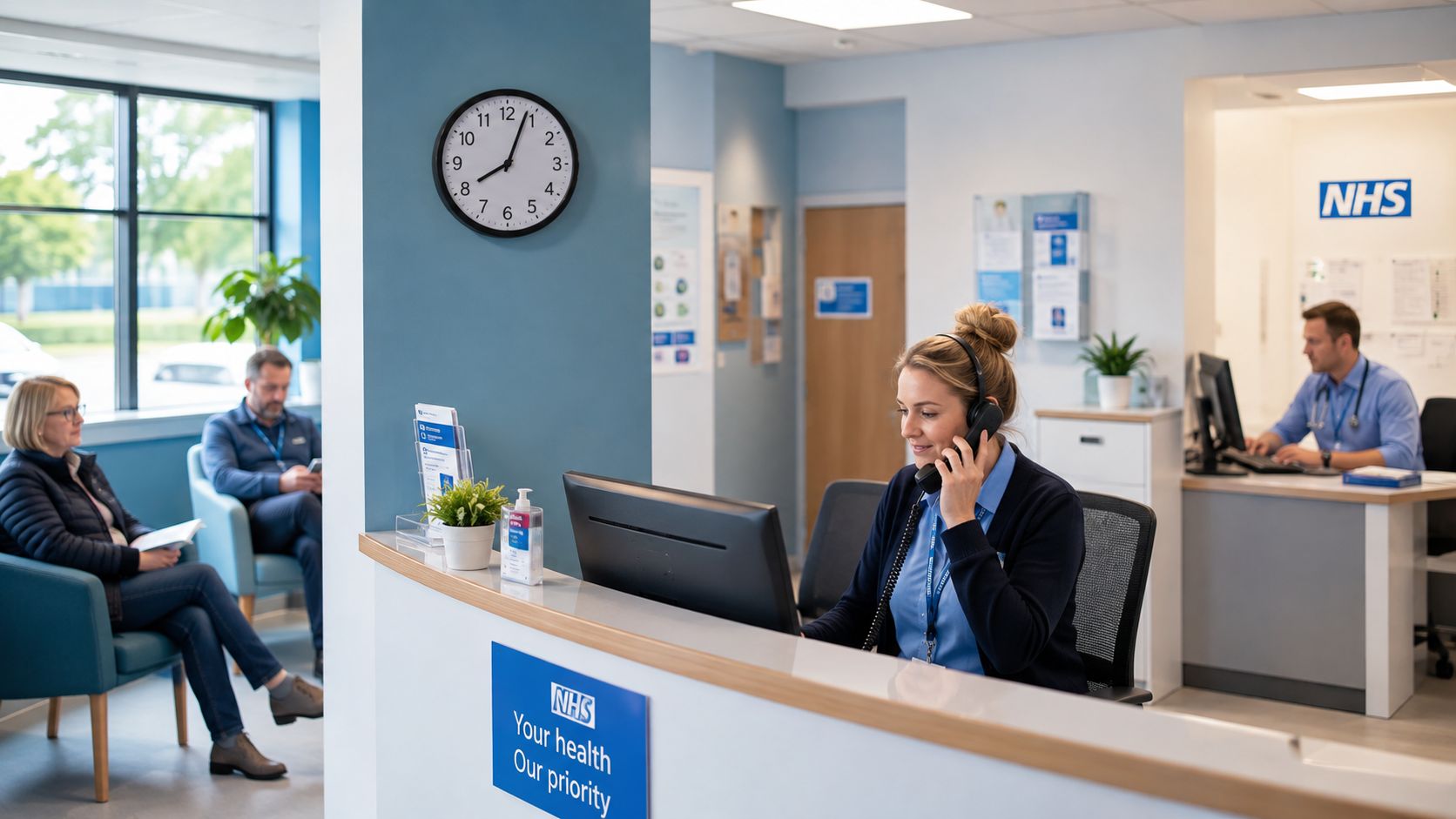
Operational rule: continuity is often lost before the consultation, when the practice sorts the day without preserving the patient's context.
Manual triage can work well when demand is manageable and protocols are clear. It becomes fragile when the same people must answer phones, interpret free-text messages, identify risk, book appointments and remember which patients need to return to a particular GP or team.
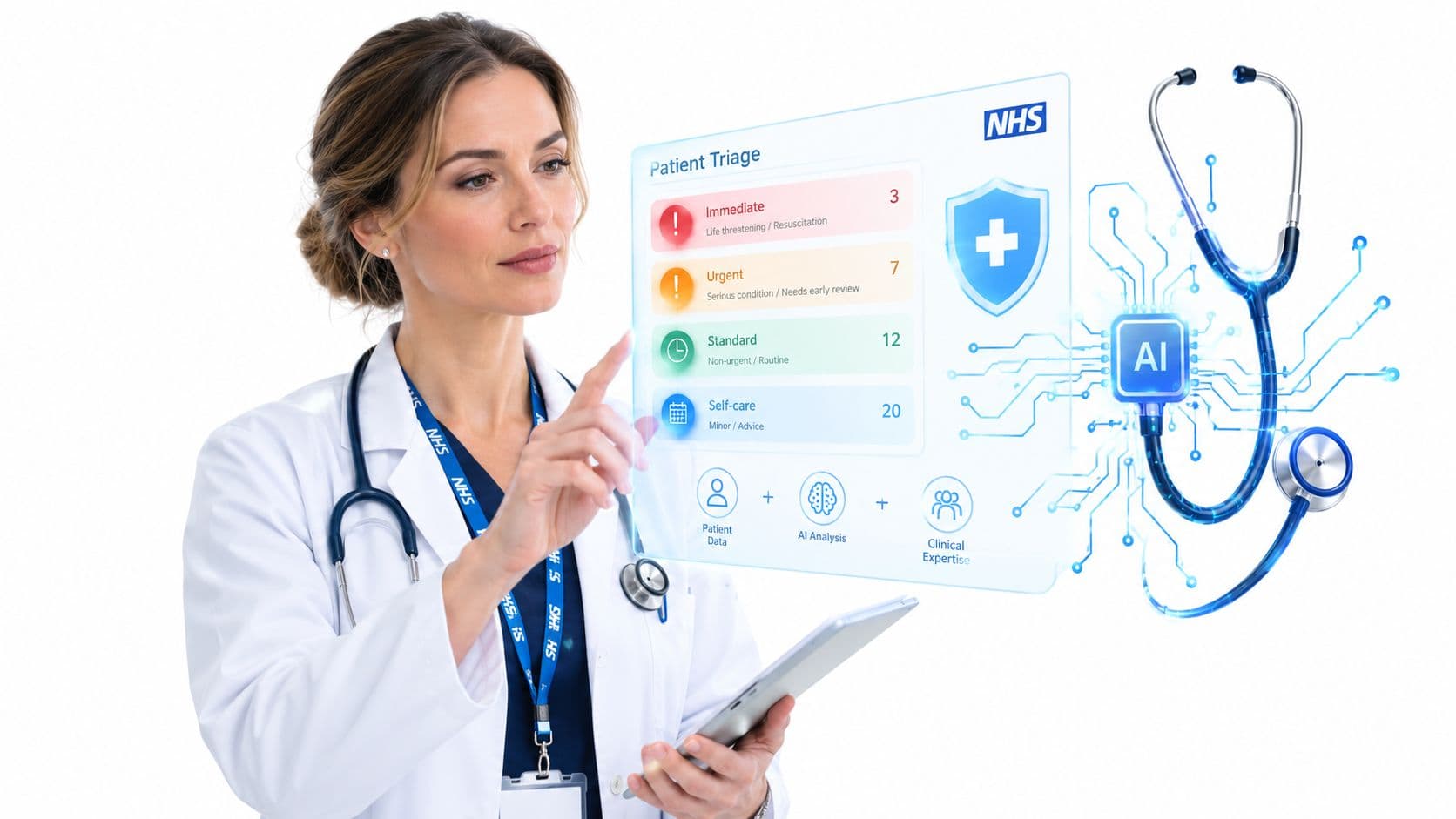
Autonomous triage changes that sequence. It absorbs structured intake, surfaces priority and routes patients into the appropriate workflow before a human decision-maker is involved. It doesn't diagnose. It creates a consistent front door so clinicians can spend their time on the exceptions, the uncertainty and the patients whose care needs human judgement.
What Continuity of Care Actually Means
Continuity of care has three connected parts. A practice that measures only whether the patient saw their preferred GP is measuring one part of the problem.
Data continuity
The patient's account, relevant history, medicines, investigations and previous triage decisions need to travel with the episode. Patients shouldn't have to repeat the same story because their request moved from the telephone queue to reception, then to a clinician, then to a follow-up appointment.
NHS England's modern general practice model recommends one care-navigation and workflow process across phone, online and walk-in access, with structured information collected at the point of contact. That approach treats data continuity as part of access, not as an administrative extra.
Clinical handover
The receiving clinician needs a usable summary of why the patient has contacted the practice, what urgency has been identified, what escalation has been considered and what action is expected next. A booking without context can still create fragmentation. A structured request without a clear owner can disappear into a queue.
For patients and families seeking broader, reliable health information alongside formal care, blog posts on wellness can provide useful general reading. They don't replace clinical assessment, but they can sit alongside a practice's own signposting and safety-netting approach.
Relational continuity
Where it's clinically appropriate, an ongoing problem should return to the regular clinician or team. NHS England guidance explicitly recommends considering continuity, using record prompts and markers such as chronic disease, frailty and repeat contacts, and passing requests to the regular clinician or team unless the situation is urgent.
All three components must hold. Perfect data capture doesn't preserve continuity if nobody owns the handover. A named GP doesn't solve the problem if the clinician receives no coherent history. Autonomous triage supports continuity only when data, handover and relationship are designed as one workflow.
The Five Models of Triage in NHS Primary Care
Practices usually move through a recognisable sequence, although the models can coexist.
Manual reception triage uses scripted questions applied by non-clinical staff. It's familiar and accessible, but quality depends on training, documentation and escalation support.
Manual GP-led triage asks a GP to review or call back each patient. It can protect clinical judgement and relational context, yet it places the main prioritisation workload on the scarcest resource.
Form-based online consultation captures richer information before review. It improves the starting material, but a clinician still has to inspect and decide on each request.
AI-assisted triage uses an algorithm to score, organise or suggest a route, with a human clinician retaining the decision. That's a meaningful improvement over unstructured queues, but the sign-off step remains a bottleneck.
Autonomous AI triage handles structured intake, prioritisation, routing and defined escalation within agreed guardrails. The system makes the routing decision, while cases outside those guardrails move to human judgement.
The dividing line is precise. Autonomy applies to prioritisation and routing, not diagnosis. NHS England's digitally enabled triage guidance describes information being reviewed by clinical or non-clinical staff, or automatically processed to direct patients to a relevant consultation type, service or self-directed care. The operational challenge is ensuring that automation supports, rather than disperses, longitudinal care. For a useful grounding in human assessment principles, see these accredited triage skills for RNs.
| Model | Who captures data | Who decides priority | Typical bottleneck | Effect on continuity |
|---|---|---|---|---|
| Manual reception triage | Reception team | Reception team within protocol | Limited clinical context and variable escalation | Can preserve team knowledge, but documentation may be uneven |
| Manual GP-led triage | Reception team, then GP | GP | GP callback queue | Strong potential for relational continuity, with limited capacity |
| Form-based online consultation | Patient | Clinician | Manual review of every form | Better data continuity, but care remains clinician-bound |
| AI-assisted triage | Patient and system | Clinician using system support | Human sign-off | More structured handover, but human routing remains necessary |
| Autonomous AI triage | Patient and system | System within guardrails | Exceptions and complex cases | Supports consistent routing when continuity rules are configured |
Seven Mechanisms That Hold Continuity Together
Autonomous triage preserves continuity through a chain of small operational decisions. If one link is missing, the patient may still receive an appointment, but the episode can become fragmented.
Structured intake before review
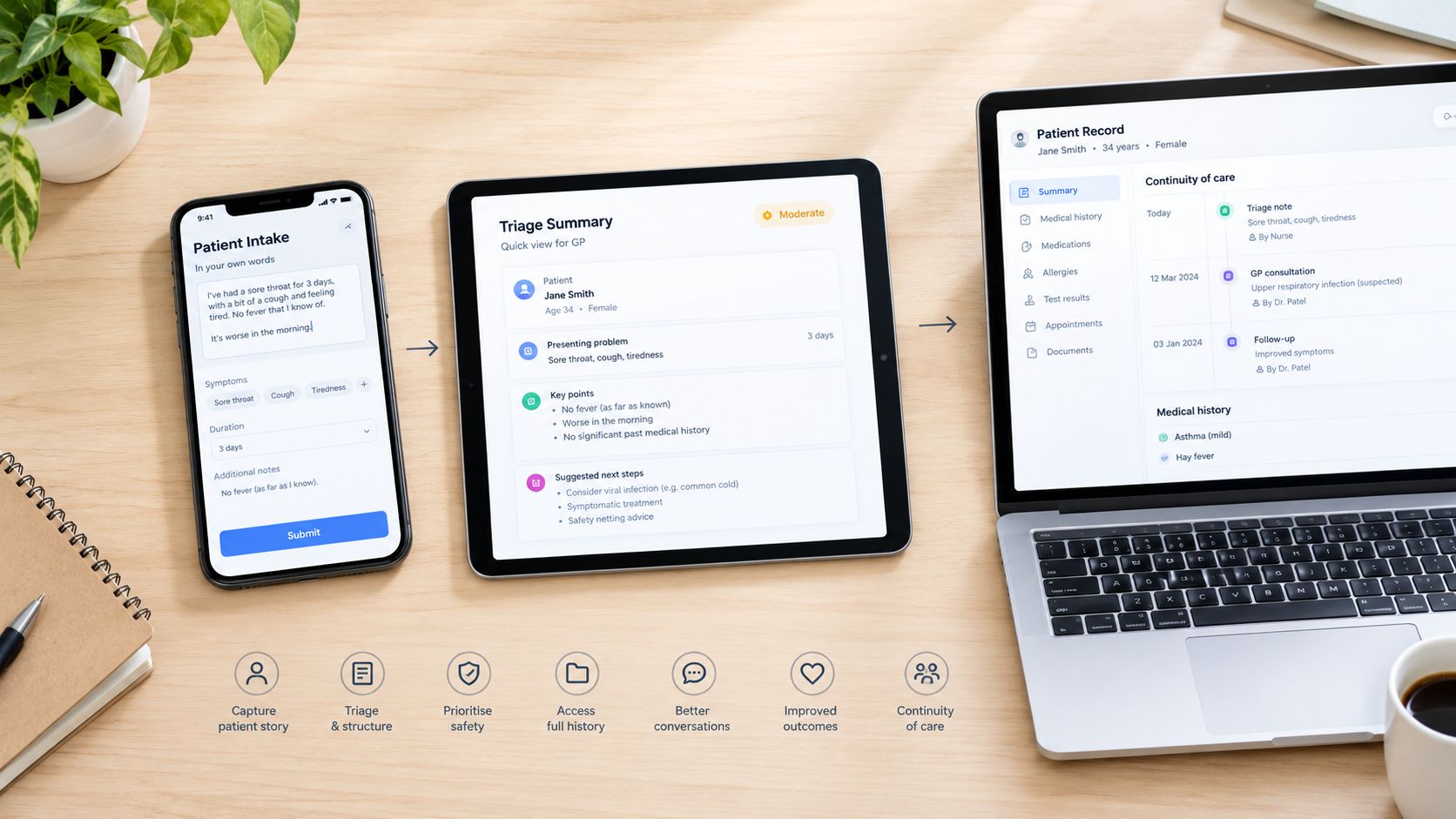
The patient's own account is captured in a consistent format before a receptionist or clinician has to interpret it. That reduces the risk that the first available staff member becomes the accidental author of the clinical story.
Record-aware context
A triage summary should connect the request to the information available through the practice's approved workflow. GP Triage integrates with the major UK clinical systems and pushes a triage summary into the booking record. It doesn't read the full patient record, support SNOMED coding or create tasks directly in clinical systems, so the practice must be clear about what information is transferred and where staff review it.
Symptom-to-urgency mapping
The system maps the presenting information to an urgency pathway rather than treating every request as an equal item in a first-come-first-served queue. That matters when an urgent presentation arrives behind routine administrative demand.
Deterministic escalation
Red-flag responses need a defined route, clear safety-net phrasing and a human escalation pathway. The remote total triage guidance makes the wider point that the pathway must support appropriate escalation and follow-up, not solely determine the initial appointment type.
Clinician and slot matching
The first available slot isn't always the right slot. Routing can consider the appointment type, clinician role, practice site and whether an ongoing issue should return to a regular clinician or team.
Named-clinician handback
Autonomous handling of the front door shouldn't mean autonomous dispersal of every episode. Complex and longitudinal cases need a deliberate handback rule, with urgent exceptions routed according to need.
Feedback and exception review
Clinicians should be able to flag exceptions, near-misses and inappropriate routes. The practice can then review patterns, adjust configuration and monitor whether automation is supporting the intended continuity model.
Clinical safety depends on the whole handover: a correct first route is not enough if the patient's next action, owner and follow-up aren't clear.
These mechanisms must be configured against the practice's own population, staffing model and safety arrangements. Missing structured intake creates incomplete histories. Missing escalation creates unsafe delay. Missing handback scatters chronic care. Missing feedback leaves the practice unable to see where the workflow is failing.
Comparing the Five Models Side by Side
The table below is a decision aid, not a league table. A practice serving a large or highly complex population may reasonably retain more human review in certain pathways, while a digitally mature practice may use autonomous routing for defined request types and protect clinician time for exceptions.
The right choice depends on list size, deprivation profile, site structure, workforce and digital maturity. Safety and continuity should be assessed together with access. A model that reduces queue pressure but sends every ongoing problem to a different clinician may improve one metric while weakening another.
| Triage model | Continuity of care | Patient safety | Clinician workload | Patient access |
|---|---|---|---|---|
| Receptionist-led | Moderate when local knowledge is strong | Moderate, dependent on protocol and training | High for reception, lower for clinicians | Variable during demand spikes |
| Nurse-led | Strong clinical context | Strong within available capacity | High and difficult to scale | Can be delayed by review queues |
| GP callback | Strong relational potential | Strong clinical judgement | Very high for GPs | Constrained by callback capacity |
| Algorithm-supported | Moderate to strong data structure | Strong when clinician oversight is reliable | Moderate, with sign-off burden | Better digital flow, still review-dependent |
| Autonomous AI | Strong when routing and handback rules are configured | Guardrail-dependent, with human escalation for exceptions | Lower manual triage burden, higher oversight responsibility | Continuous intake across supported channels |
The key question isn't “Which model is safest in theory?” It's which workflow consistently places the right information with the right person at the right time. The figures from Langton Medical Group and Swanscombe Health Centre show how that question can be tested operationally rather than answered through product language.
What Continuity Looks Like in Practice
At Langton Medical Group, a rural dispensing practice with approximately 14,000 patients across three sites, autonomous triage removed around 30 hours of GP-led triage per week to date, as reported in the practice's approved operational account. The continuity lesson isn't only that GP time was released. Same-day requests could be directed to a consistent duty clinician, while chronic disease reviews remained attached to a named GP instead of being absorbed into the acute queue.
The arrangement separates two kinds of continuity that practices often have to protect at the same time. Acute demand needs timely prioritisation and a clear duty route. Longitudinal care needs deliberate ownership. A single intake and explicit routing rules make those paths visible rather than leaving them to whoever happens to answer first.
At Swanscombe Health Centre, serving approximately 37,000 patients, the platform returned around 422 or more operational hours in the first four weeks and autonomously booked approximately 5,000 appointments during that period, to date. Those figures describe the practice's reported implementation experience. They don't establish a universal result for every practice, but they show the kind of measures a PCN can examine when testing whether access automation also protects follow-up.
The shared principle is straightforward: continuity is preserved when the system keeps the patient's identity, request, route and next action connected across each step. Speed helps, but speed alone doesn't preserve care. The workflow must retain the thread.
Governance, KPIs and Getting Started
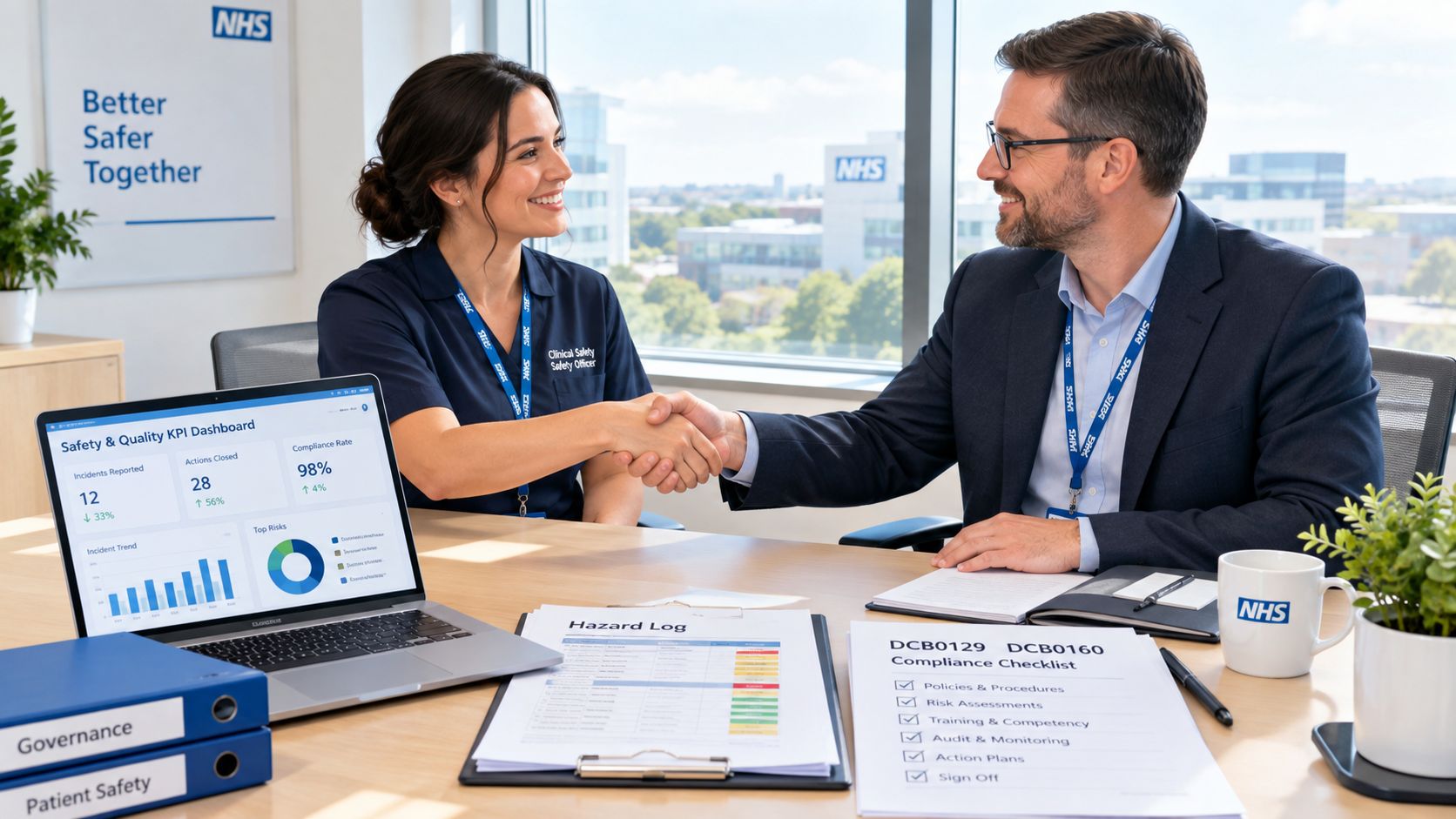
A Clinical Safety Officer should expect more than a demonstration of the patient interface. For a regulated medical device, GP Triage uses Infermedica as a Class 2B medical device, with UKCA and MHRA context, alongside DCB0129 and DCB0160 documentation. The practice or commissioning organisation still needs a local hazard log, clear ownership of risks and a post-market surveillance plan.
Configuration determines the continuity outcome. Agree the default route for routine requests, the escalation thresholds for urgent presentations, the safety-net wording, the clinician override process and the rules for returning ongoing care to a named GP or team. NHS England's modern general practice guidance supports a single cross-channel workflow that explicitly considers continuity rather than relying on queue order.
Track a small set of measures from the first week:
Continuity index: Whether ongoing episodes return to the intended clinician or team.
Same-day access rate: Whether clinically urgent requests reach same-day assessment.
Emergency department attendances diverted: Review this cautiously and alongside safety and clinical outcomes.
Triage-to-contact time: The interval between completed intake and the next human or booked contact.
Clinician exception rate: Requests staff flag as requiring a different route or review.
Review safety phrasing on a defined cycle and audit the routing configuration quarterly. To date, zero recorded clinical safety incidents across approximately two million triages, with around 97% concordance with GP decision-making, are the approved safety and performance statements for GP Triage, not guarantees. The platform supports adult and paediatric presentations, and practices should assess its configuration against their own safety model.
GP Triage provides autonomous AI triage and booking for NHS primary care, with structured intake, continuity-aware routing and a triage summary pushed into the booking record across the major UK clinical systems. Visit GP Triage to see the platform in a live environment and assess how its guardrails, handback rules and governance documentation would fit your practice.