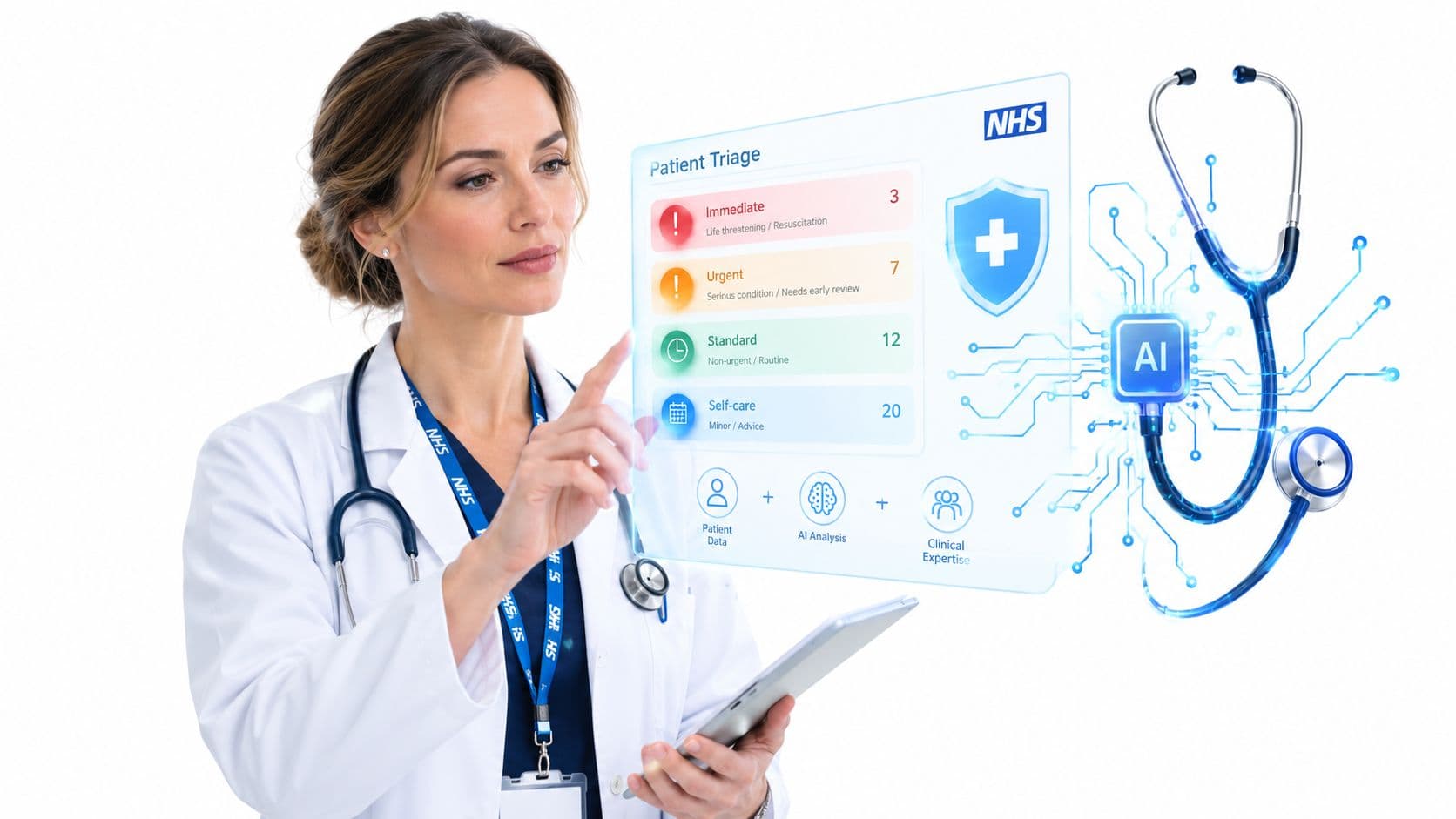
AI triage can be safe for NHS patients when it is clinically validated, governed locally under DCB0129 and DCB0160, and continuously monitored. Safety is not established by accuracy numbers alone, and a system that looks good in testing can still fail patients in live NHS use.
That is the decision in front of you if you are being asked to sign off a procurement. The pressure is real, because access is strained and every practice is looking for ways to reduce load without creating a new safety problem.
The Question on Every CSO's Desk
A GP partner wants the access problem solved. The practice manager wants the phone lines calmer. The PCN lead wants a repeatable process. You, as the Clinical Safety Officer, are being asked a narrower question, and it is the only one that matters, can this system be deployed without creating avoidable harm?
That is not a theoretical debate. It is a procurement decision with clinical, regulatory, and reputational consequences if it goes wrong. If the triage pathway misses an urgent presentation, downgrades risk, or leaves staff without a clear fallback when the system is uncertain, the practice owns the aftermath.
The safest way to think about AI triage is as a deployment risk rather than a product category. The model may be advanced, but the key question is whether the whole pathway, patient input, escalation logic, booking behaviour, human override, and audit trail, is safe in your setting.
Practical rule: If the supplier cannot explain what happens when the system is wrong, unavailable, or uncertain, the safety case is incomplete.
NHS practices are under pressure to modernise access, but speed is not the same as safety. Faster routing can still send the wrong patient to the wrong endpoint, or leave a high-risk patient waiting behind routine demand. A CSO should treat that distinction as essential.
There is also a governance issue. A system that works in one practice can behave differently in another because workflows, staff response, appointment capacity, accessibility needs, and local protocols all change the risk profile. That is why the question is never just “does the algorithm perform well?”, it is “does this deployment work safely here, with our patients, our staff, and our clinical system?”
If you are signing off procurement, you need a model for comparing triage options, a regulatory frame, and a way of reading the evidence. That is the standard this topic should be judged against.
The Five Models of Patient Triage
There are five distinct models, and mixing them up causes most of the confusion. Once you separate them, the safety discussion becomes much clearer.
1. Manual reception triage
Reception staff gather the request, ask clarifying questions, and route it onward. The advantage is human judgement and flexibility. The risk is inconsistency, pressure at busy times, and variable capture of red flags.
2. Manual GP-led triage
A clinician reviews the request and decides urgency. This gives stronger clinical oversight, but it still depends on staff time and can become a bottleneck when demand rises.
3. Form-based online consultation
Patients fill in a structured form and the practice reviews it. This digitises demand and can improve legibility, but the manual triage step still sits with staff.
4. AI-assisted total triage
The system helps structure and prioritise requests, but a human still makes the final decision. This is a genuine improvement on manual-only workflows, but it is still a human-led triage model.
5. Autonomous AI triage
The system takes the patient history, applies configured protocols, prioritises urgency, and books or escalates within defined safety rules. In this model, the system makes the first decision, and staff intervene where the pathway demands it.
That last distinction is the one public discussion often blurs. AI-assisted means the human still decides. Autonomous means the system does. If you are reviewing a supplier, do not let them slide between those two as if they are the same thing.
| Model | Who decides urgency | Where the workload sits | Main safety question |
|---|---|---|---|
| Manual reception triage | Reception or admin plus local escalation | Front desk and call handling | Is risk recognised consistently? |
| Manual GP-led triage | GP or other clinician | Clinical time | Can demand be handled safely at scale? |
| Form-based online consultation | Practice team | Review queue | Does the queue stay manageable and clinically safe? |
| AI-assisted total triage | Human clinician | Shared between system and staff | Does the human still have enough time to decide well? |
| Autonomous AI triage | The configured system, with human override and escalation rules | The system handles first-line routing | Are the clinical rules, overrides, and audit controls robust enough? |
That taxonomy matters because each model moves the risk in a different place. None of them removes clinical responsibility. They only change who does the first pass, and how much work lands on staff.
The Regulatory Frame for AI Triage in the NHS
NHS England's position is clear, AI triage can only be used safely when it is clinically validated, governed, and continuously monitored, not merely because it performs well in testing. NHS adoption requires DCB0129 for the manufacturer and DCB0160 for the NHS organisation deploying it, and NHS England also compares post-market surveillance for AI with monitoring required for medicines and medical devices. NHS digital clinical risk management standards
That separation matters. DCB0129 sits with the developer. DCB0160 sits with the deploying practice, PCN, or other NHS organisation. In other words, the supplier does not own the whole safety case, and the practice cannot outsource it.
What that means in practice
The manufacturer needs a clinical risk-management system, a risk analysis, and evidence that foreseeable hazards are controlled. The deploying organisation needs to prove that its local use, workflows, fallback arrangements, and staff response are safe in its own environment. That includes the way patients describe symptoms, how the system captures accessibility needs, and how urgent cases bypass routine routing.
For procurement, that means asking for more than a compliance pack. You need the hazard log, the clinical safety case, the version-controlled protocols, the human override logic, and the outage plan. You also need to know how the service behaves when the patient cannot answer a question, uses ambiguous language, or presents more than one problem at once.
Safety does not end at procurement. If the system changes, the rules change, or the clinical workflow changes, the safety case needs reviewing again.
That is the right mental model for a CSO. This is not a one-off sign-off. It is an ongoing duty to keep the pathway safe after go-live.
What the Evidence Actually Shows
The evidence base for symptom checkers is useful, but it does not justify lazy conclusions. A BMJ systematic review of 23 symptom checkers found that the correct diagnosis was listed first in only approximately 34% of cases, and appropriate triage advice was provided in around 57% of cases, with performance ranging from approximately 33% to 78% across systems. BMJ systematic review
That is why diagnostic accuracy alone is the wrong target. For a GP practice, the questions that matter are different, did the system catch time-critical cases, did it under-triage anyone, did escalation complete, and did safety-netting fail anywhere in the pathway?
What a CSO should ask for
Time-critical sensitivity: Can the supplier show how the system performs on red-flag and urgent presentations?
Under-triage rate: How often does the pathway send someone to routine care when they need urgent assessment?
Escalation completion: When the system says “urgent”, does the patient reach the right human route?
Safety-netting failure: What happens when advice is ignored, incomplete, or misunderstood?
Demographic variation: Does performance vary by age, language, disability, deprivation, or access channel?
NHS England's own guidance supports that framing. It says safety evaluation should cover missed urgent cases, inappropriate escalation, variation across demographic groups, and how clinicians respond to uncertain or high-risk outputs. That is the standard a practice should apply, not a vendor's completion count.
The approved GP Triage figures should be read in that light. The system reports to date, zero recorded clinical safety incidents across approximately two million triages, and around 97% concordance with GP decision-making. Those are useful operational indicators, but they are not a substitute for local validation, hazard controls, and live monitoring in your own pathway.
A safe procurement decision is one that separates vendor-reported counts from independent evidence, then asks whether the local deployment closes the gap between them. That is the discipline the CSO role exists to enforce.
Red Flags, Escalation and Information Loss
The hardest safety failures are not always obvious ones. A system can appear to work, but still miss nuance, strip away context, or fail when a patient cannot use it in the intended way.
Healthwatch England reported that blind users found some AI chatbots incompatible with screen readers, while people with autism or learning difficulties said systems did not understand their requests. It also flagged risks for people with sensory or cognitive impairments, communication needs, mental health conditions, and those who are digitally excluded. That makes accessibility a safety control, not a user-experience extra. Healthwatch England
The risk you should care about
If a patient cannot express themselves clearly to the system, the system cannot preserve the clinical nuance that might matter. That is especially true when free text or speech gets compressed into a structured summary. A missed phrase, a downgraded urgency marker, or a lost detail between intake and the practice's clinical system can change the outcome.
The Royal College of Physicians survey makes the accountability problem plain. Approximately 73% of responding doctors identified error as their biggest concern about clinical AI, 48% cited model drift, 48% cited bias, and around 68% of 548 respondents disagreed that the NHS had sufficient digital infrastructure for widespread AI deployment. Royal College of Physicians survey
That is why a credible safety case must specify fail-safe behaviour, outage procedures, audit logs, clinician override, and post-market monitoring. It should also define who owns the decision when the pathway cannot reach a safe conclusion.
| Triage model | Safety strength | Workload effect | Governance burden |
|---|---|---|---|
| Manual reception triage | Flexible, but inconsistent | High staff load | Local supervision needed |
| Manual GP-led triage | Clinically strong, but slow | High clinician load | Clear responsibility, but bottleneck risk |
| Form-based online consultation | Better capture of demand | Queue still needs review | Moderately complex |
| AI-assisted total triage | Reduces manual sorting | Shared workload | Needs tight human oversight |
| Autonomous AI triage | Can remove manual triage step | Lowest manual triage burden | Highest need for robust safety case |
A human or non-digital fallback is not a concession. It is a safety control. If the digital route is unavailable, inaccessible, or uncertain, patients still need a visible path into care.
What Autonomous Triage Looks Like in Live NHS Use
Autonomous triage earns its case in live practice by reducing manual work without breaking the pathway. Langton Medical Group, with approximately 14,000 patients across three sites, reported around 30 hours of GP-led triage removed per week, to date. Langton Medical Group case study Swanscombe Health Centre, serving approximately 37,000 patients, reported around 422+ hours returned in the first 4 weeks and approximately 5,000 appointments booked autonomously in that period, to date. Swanscombe Health Centre case study
Those results matter because they show where the workload shifts. Routine requests move out of the manual review queue, and GP time is freed for cases that need a clinician. They do not prove safety on their own. They do show that the pathway design, escalation rules, and fallback routes decide whether autonomy helps or harms.
Why the scale matters
NHS England's primary-care workload data recorded approximately 382.6 million GP appointments in England in the 12 months ending January 2025, with around 52.6% taking place on the same day or the day after booking. NHS England operational performance update
That is the operating environment. Any AI triage tool has to cope with high demand, fast decisions, and patients who will still need a clear route to care if the system misses the mark or cannot make a safe decision.
Martin Weston put the operational effect plainly, “We're saving 2-3 hours a day, which works out around 4 GP sessions a week.” Case study That kind of gain is real for a practice, but it does not answer the safety question. A time-saving result is only acceptable when the governance around it is tight.
GP Triage is one example in this category. It captures patient-reported information, prioritises urgency, and books appointments within configured safety rules. The decision for a GP partner is straightforward: if the pathway cannot be governed well, it should not be signed off.
Due Diligence Before You Sign Anything
Your procurement meeting should be driven by questions, not marketing claims. If the supplier cannot answer these clearly, the signature should wait.
Ask these questions
Clinical safety case: Where is the hazard log, and how does it map to DCB0129 and DCB0160?
Version control: How do you control changes to protocols, question wording, and escalation rules?
Human override: When does a clinician or receptionist intervene, and how is that recorded?
Emergency escalation: How are red-flag symptoms handled before routine routing begins?
Audit trail: Can we see the decision path, the disposition, and the hand-off?
Accessibility: How has the system been tested with people who use screen readers, have cognitive impairment, or have limited digital access?
Demographic monitoring: How do you monitor missed or downgraded risk by age, language, disability, ethnicity, and deprivation?
Incident review: What happens after a near miss, complaint, or confirmed harm?
Fallback route: What is the non-digital alternative when the system is down or the patient cannot use it safely?
If a supplier says the system is safe because it has processed a lot of triages, that is not enough. Volume is not a safety case.
You should also keep the commercial terms in view. If a price is quoted, make sure it carries plus VAT. And do not accept claims that the system reads full records, supports SNOMED coding, or creates tasks directly in the clinical system, because those are not claims you should rely on in this decision.
For a wider governance lens, an ethical AI governance checklist is a useful companion document when you are comparing controls, ownership, and auditability across suppliers.
The Honest Answer and What to Do Next
AI triage can be safe for NHS patients when it is clinically validated, locally governed under DCB0129 and DCB0160, and continuously monitored. It is not safe by default, and it is not safe just because a vendor says it is.
The model matters, but the deploying practice makes the safety case real. If you are being asked to sign off procurement, insist on the governance, the evidence, and the fallback routes before you sign.
If you want to see how an autonomous model handles triage, escalation, and booking within a configured NHS workflow, GP Triage is the place to start. It's built for NHS primary care and framed around autonomous triage rather than manual queue management. If this is the decision in front of your practice, book a demo and review the safety case against your own governance standards.