
NHS England reported approximately 8.6 million online consultation submissions and 29.2 million GP practice phone calls in February 2026 alone, according to its record GP access figures. For practice managers, that volume changes the ROI question. The issue goes beyond whether autonomous triage reduces a task cost. It's whether the model releases usable capacity, limits avoidable handling, protects clinical oversight and converts demand into a more workable appointment pathway.
TLDR
Autonomous triage can create the most value by reducing GP-led triage time, lowering reception handling and improving appointment flow.
ROI should be based on released capacity that the practice can actually use, not just activity shifted into a digital channel.
A reliable model uses local data, conservative assumptions and sensitivity testing for follow-up demand and human intervention.
Practice examples suggest outcomes vary by scale, workflow design and how capacity is redeployed after launch.
Recognising the Need for Clear ROI
Demand is arriving through several channels, often at the same time. Online requests require review, telephone calls require handling, and patients who use one route may still contact the practice again when they haven't received a timely response. A triage investment therefore needs to be assessed against the full workflow, not just the software subscription.
The first step is to establish a baseline for the practice. Record request volumes by channel, the time reception staff spend capturing or routing them, the amount of GP-led triage involved, and the appointment outcomes that follow. Separate GP-specific hours from reception and wider operational hours, because replacing clinician time with administrative work isn't the same as removing work from the system.
Practical rule: A credible business case measures what happens to released capacity. Hours only become financial value when the practice uses them to improve access, reduce overtime or avoid additional workload.
The scale of national demand makes small handling changes commercially relevant, but it also makes weak assumptions dangerous. A model that counts every digitally captured request as a saving may overstate the return if patients still need follow-up or staff intervention.
Defining ROI for Autonomous Triage
The ROI of autonomous triage for GP practices has several components. Clinician capacity may be recovered when the system assesses and routes requests without manual GP-led triage. Reception workload may fall when patients can complete the initial process without a staff member manually gathering the same information. A practice may also gain through better appointment utilisation and fewer duplicated handling steps.
Direct cash savings are only one possible outcome. The ESTEEM trial found that nurse-led telephone triage reduced GP face-to-face contacts by approximately 31% over 28 days, while overall NHS costs remained broadly similar to usual care, as reported in the trial record. That distinction matters. Triage can redistribute work away from higher-cost clinician time without immediately reducing the total cost of care.

The financial model should therefore show both gross operational value and realised value. The first reflects hours and capacity made available. The second reflects what the practice redeploys, such as additional bookable access, reduced overtime or less manual handling.
Building a Reproducible ROI Model
Start with observed practice data rather than a supplier estimate. Build the model in a spreadsheet or equivalent financial tool, using a consistent reporting period.
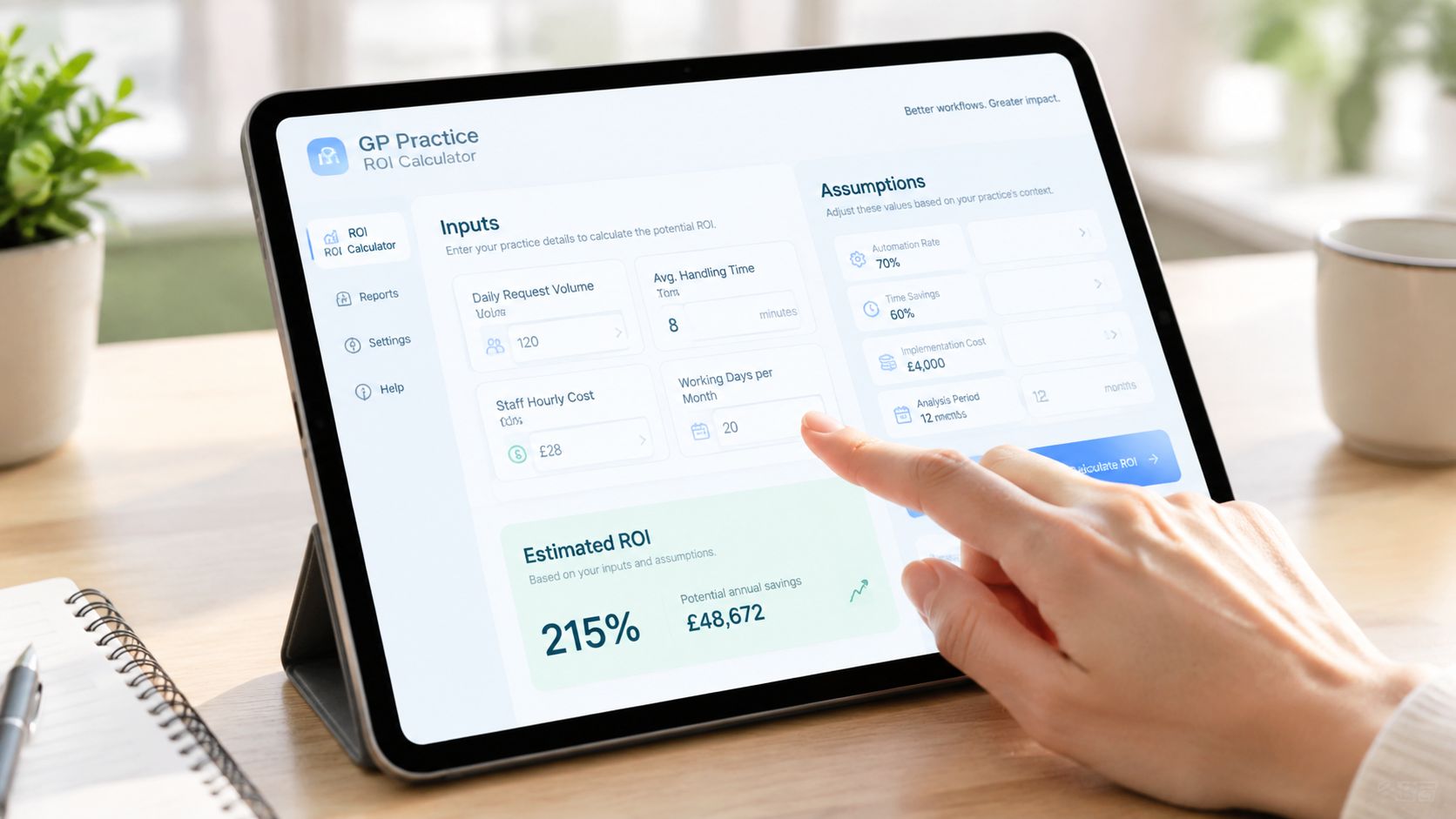
Use these inputs
Demand volume: Count online, telephone and reception requests separately.
Handling time: Measure reception minutes, GP-led triage time and any follow-up work.
Capacity value: Apply the practice's approved internal cost assumptions to GP-specific hours and other operational hours separately.
Appointment outcome: Track whether a request results in an appointment, advice, escalation or further contact.
Implementation cost: Include the platform charge and any associated implementation costs, with prices stated plus VAT.
Calculate the baseline workload first. Then model the autonomous pathway using conservative assumptions for the proportion of requests completed without manual intervention, the time retained for exceptions and the appointments that can be booked through the configured workflow.
A simple structure is:
Gross operational value = clinician hours recovered + reception hours recovered + usable appointment capacity value.
Net value = gross operational value minus implementation and operating costs.
Run low, central and high scenarios. Don't describe the output as a guaranteed saving. Present it as a decision range, then validate the assumptions against live practice data after implementation.
Testing Your Model with Sensitivity Analysis
An ROI forecast is only as reliable as its most uncertain inputs. Test the assumptions that can change the conclusion, especially average handling time, the share of requests requiring human intervention and the rate at which captured demand becomes an appointment or follow-up contact.
The required scenario changes should be explicit. For example, model the effect of a 10% change in clinician hourly cost and a 5% change in conversion as separate sensitivities, rather than combining them into one optimistic case. The resulting range shows whether the proposal still works when local conditions are less favourable.
Stress-test the workload, not only the saving.
An independent review found that digital-first online access models can increase workload by approximately 25% when follow-up consultation rates aren't controlled, as discussed in the review of digital-first primary care. That finding makes follow-up tracking a core financial control. If autonomous capture increases the number of requests that require additional handling, the model must record that rework rather than counting the initial digital interaction as a completed saving.
Tracking the Right KPIs
Use a small dashboard that connects activity to value. Track monthly GP-specific hours released, reception handling time, call volumes, appointment slot utilisation, first-contact resolution and safety escalations. Record operational hours separately so the practice can see whether capacity has moved between staff groups or become available.
Review the measures against the baseline established before implementation. Investigate rising follow-up demand, repeated contacts or manual overrides rather than reporting only headline bookings. For a broader approach to measuring technology value across procurement and operations, practice and PCN teams can also consult this guide to tracking procurement ROI with AI.
The most useful KPI is the one that links a released input to a decision. If GP-led triage hours fall but appointment access doesn't improve, the practice needs to examine capacity deployment. If call volume falls while repeat contacts rise, the pathway needs review rather than celebration.
GP Triage helps NHS practices assess patient requests autonomously, prioritise them and book appointments through an integrated workflow. Visit GP Triage to discuss your own request volumes, staff time and capacity assumptions in a practice-specific ROI model.


