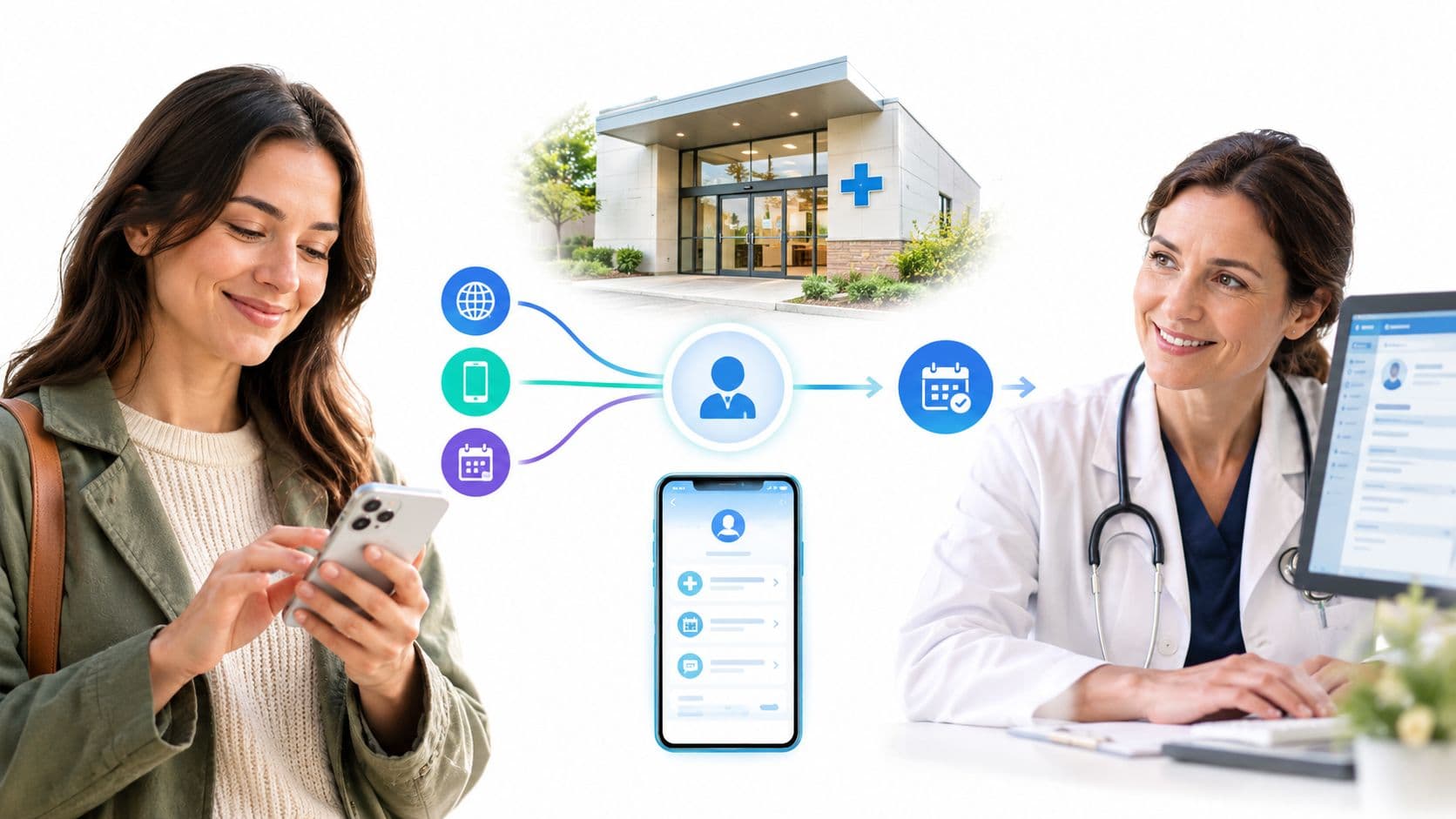

Online consultation is no longer a fringe channel in England. NHS England reported 83 million online consultation requests across the previous 12 months, and 8.6 million submissions in February 2026 alone, which was 85% higher than February 2025 NHS England record GP access figures. That scale changes the question. The issue is no longer whether patients will use online access, it's what happens when a practice relies on a form to do work that really belongs to a triage decision.
That is where the limits show up. A form can collect information, but it cannot by itself resolve urgency, route mixed demand cleanly, or stop a practice from turning every submission into another item for a clinician to read. Once volume is mainstream, beyond form-based online consultation becomes the right way to think about the problem, because the bottleneck is the decision-making architecture behind the form, not the form itself.
Why Form-Based Online Consultation Has Reached Its Limit
Form-based online consultation helped practices make demand visible. It gave patients a route other than the phone, and it created a structured intake path that could be managed during core hours. That mattered, especially when access pressure was rising and patients wanted a written route for non-urgent requests.
The trouble is structural. A form that asks patients to describe a problem in free text, then fit that problem into a menu, often pushes the presenting complaint into generic wording. The practice still has to interpret what the patient meant, what the symptom timing was, and whether the request belongs in urgent same-day work or can wait.
The bottleneck is downstream, not at the point of submission
Once the submission lands, someone has to read it, sort it, and decide what happens next. If that someone is a receptionist, a GP, or a nurse using a workflow that still depends on manual review, the practice has only moved the queue, not removed it.
The form has shifted demand from the phone into the inbox, but it hasn't removed the clinical decision.
That matters most when the request is urgent. A form may capture red-flag language, but the platform itself doesn't make a safe decision before a human opens it. If the practice is busy, the hidden risk is delay inside the inbox, not just delay on the phone.
The hidden cost is clinical time
Form-based consultation also creates an asymmetric workload. Clinicians spend time reading, sorting, and often re-triaging information that was always going to need clinical judgement. The practice gets more structured intake, but not necessarily less work.
That's why the limit isn't really “digital versus analogue”. It's whether the channel still requires a human to do the first clinical sort on every request. Once a practice reaches that point, the next model isn't another form. It's a different triage architecture.
The Five Models of Triage in NHS Primary Care
The simplest way to think about this topic is as a progression in how decisions are made. Each model solves a real problem. Each one also leaves a specific gap that pushes practices toward the next step.
1. Manual reception triage
This is the oldest pattern. Reception staff gather the request, then pass it to a GP or nurse for sorting. It's quick to understand and easy to start, because it works inside existing habits.
Its weakness is obvious. Demand sits in human memory, not in a shared structured pathway, and the practice depends on who is available at the moment the request arrives. That makes it hard to keep consistent when volume rises.
2. Manual GP-led triage
Here, a clinician reviews requests first and decides what needs action. This can improve safety over pure reception filtering because a clinician is making the first call.
The trade-off is workload. It centralises judgement, which can protect quality, but it also pulls GP time into the first-contact layer. If the same clinician who should be seeing patients is spending much of the day sorting requests, the model starts to bend under pressure.
3. Form-based online consultation
This model digitises the intake. Patients submit a structured request, the practice gets written information, and access becomes more visible to the team.
It is better than a phone-only queue for many workflows. It still breaks down when the practice treats the form as the triage itself. Once the practice team must manually interpret and route most submissions, the tool has reduced friction but not removed the decision step.
4. AI-assisted total triage
This is a real step forward. An AI-assisted system analyses the request, suggests urgency or next steps, and a human still decides. That human sign-off matters, because the clinician or reviewer remains the final decision-maker.
This model is useful where governance demands a human in the loop, and many practices will prefer that. The limitation is also clear. If every decision still needs a human to confirm it, the practice still carries a manual approval layer.
5. Autonomous AI triage
This is the category shift. The system performs the initial clinical sorting under a governance model, rather than suggesting what a human should do next. That's the precise line between assistance and autonomy.
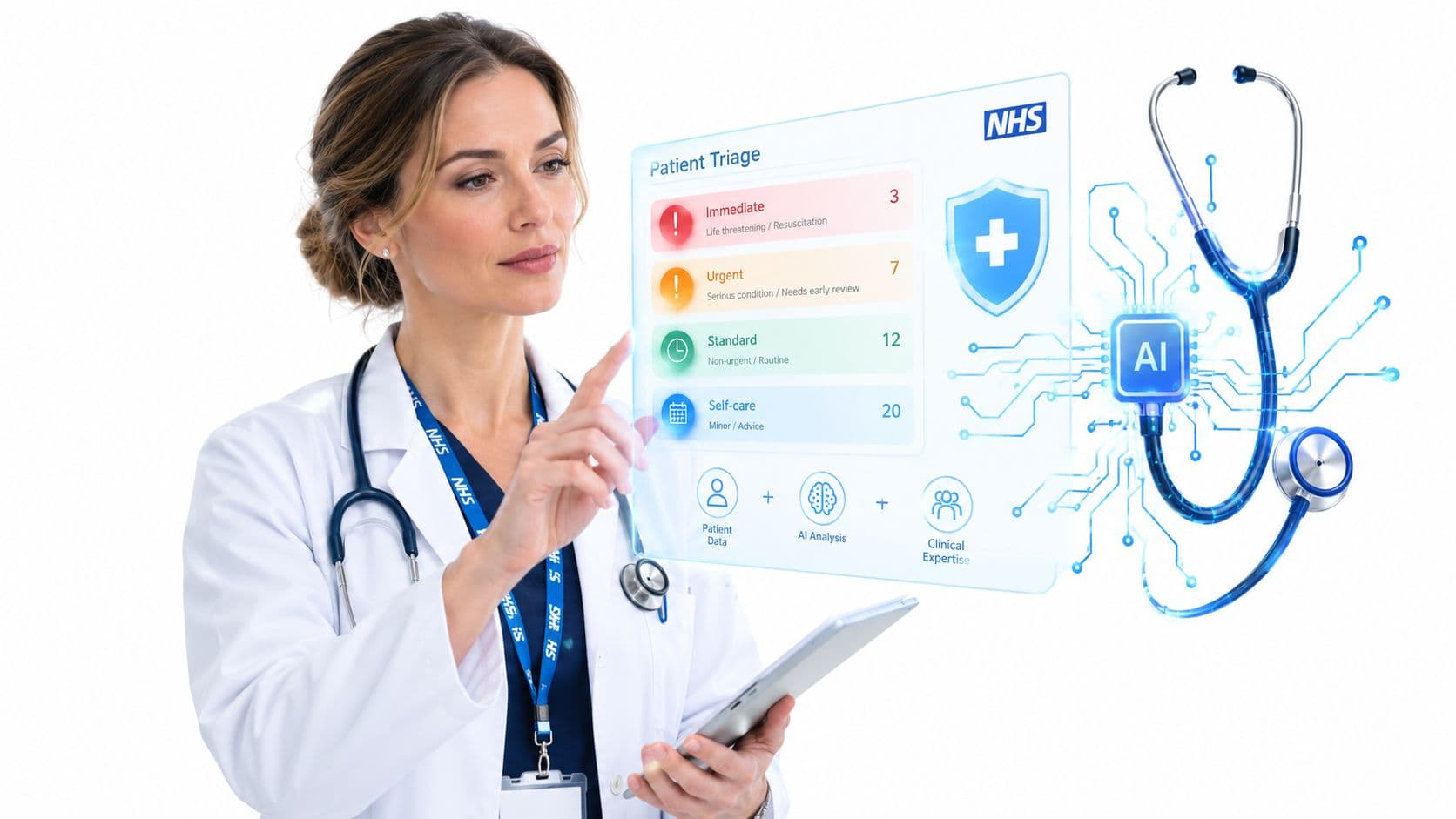
GP Triage fits here. It captures patient-reported information across channels, prioritises urgency, and integrates outcomes into the booking workflow for the practice to manage. The point is not novelty, it's removal of the first manual triage step.
Comparing the Triage Models Side by Side
| Model | Purpose | Decision-maker | Clinical risk handling | Workload impact | Channel coverage | EHR integration |
|---|---|---|---|---|---|---|
| Manual GP-led triage | Direct requests to a clinician for sorting | GP or nurse | Depends on individual judgement and local process | Pulls clinical time into first contact | Usually phone and reception-led | Often separate from the record workflow |
| Form-based online consultation | Capture structured demand digitally | Practice staff or clinician after submission | Risk is handled after the form is read | Shifts work into the inbox, doesn't remove it | Web-based, sometimes limited by hours | Varies, often a summary only |
| AI-assisted total triage | Speed up first review with decision support | Human reviewer | AI supports prioritisation, human signs off | Can reduce sorting friction, but keeps manual approval | Usually web and some phone workflows | Usually requires review before record action |
| Autonomous AI triage | Perform the initial clinical sort under governance | The system, within agreed safety rules | Built around structured urgency assessment and escalation | Removes the manual first-triage step | Web, telephone capture, and reception entry | Can push a triage summary into the booking record |
The line that matters is the one between AI-assisted and autonomous. In the first, a human still decides every case. In the second, the system does the initial sort within a governed pathway, and the practice owns the operating model around it.
That distinction matters because sustained demand breaks different models in different ways. Manual triage becomes a capacity problem. Form-based consultation becomes an inbox problem. AI-assisted triage can still leave the practice with a human bottleneck if the review layer is not reduced. Autonomous triage is trying to remove that first manual handoff altogether.
Clinical Prioritisation and Safety Governance
Clinical prioritisation is not the same thing as diagnosis. In primary care, it is the layer that sorts requests by time-to-be-seen and urgency before a clinician decides the management plan. That separation matters, because a practice can be very clear about which cases need rapid response without pretending the system is replacing clinical judgement.
The governance standard is the other half of the picture. GP Triage uses Infermedica, a Class 2B medical device under UKCA and MHRA oversight, with DCB0129 and DCB0160 documentation in place. It is also described as supporting adult and paediatric presentations, with the paediatric side best treated as supplementary rather than a separate promise.
Safety should be audited, not assumed
The approved regulatory phrasing is the right one to use here, and it should be used exactly. To date, zero recorded clinical safety incidents across approximately two million triages and around 97% concordance with GP decision-making are the figures that matter for due diligence, not vague claims about being “safe”.
Practical rule: if a triage pathway cannot explain its escalation route, it is not ready for production use.
A sound governance model also needs named ownership. That means a clinical lead, monthly review of red-flag misses and overrides, and a documented escalation route when the pathway and the practice's safety model disagree. If a tool can't support that cadence, the practice is still carrying the risk even if the interface looks smooth.
Multi-Channel Intake and Integration With Clinical Systems
A practice shouldn't have to run separate rules for online, phone, and reception. The cleaner design is a single intake pathway where a web form, telephone capture, and reception-entered requests all land in the same triage engine. A patient who rings at 08:30 and a patient who submits online at 09:15 should go through the same structured assessment and receive the same urgency output.
That same pathway needs a write-back step. The useful output is a structured triage summary, for example presenting complaint, reported symptoms, priority, recommended time-to-be-seen, and red-flag status, pushed into the booking record through the practice's clinical system interface. GP Triage is set up around that kind of flow, rather than around a stand-alone inbox.
What the system should not claim
It should not read the longitudinal record, interpret past entries, or create SNOMED-coded problems. Those are different responsibilities. The clinician still owns coding and ongoing record management.
That boundary is useful, not limiting. It means the triage engine can focus on one job, sorting and routing the current request, while the practice keeps control of clinical documentation inside its existing systems. The operational gain is one workflow, one audit trail, and no parallel inboxes.

Operational Impact in Real NHS Practices
The practical test is whether the model changes the day, not the slide deck. At Langton Medical Group, a practice serving around 14,000 patients across 3 sites, the published case study says autonomous triage removed approximately 30 hours of GP-led triage per week, to date. That is the kind of figure that matters because it points to a specific operational layer, GP-led first contact, not just generic admin saving.
Swanscombe Health Centre shows a different scale of pressure. The approved figures say it serves around 37,000 patients, returned approximately 422+ hours in the first 4 weeks, and autonomously booked around 5,000 appointments in that period, to date. The operational lesson is not that every practice will see the same result. It's that the workflow can move from manual filtering to automated routing without the practice losing control of escalation.
Martin Weston's approved line is the clearest summary of the operational case: “We're saving 2–3 hours a day, which works out around 4 GP sessions a week.”
That line is useful because it doesn't overclaim. It describes saved operational time in the context of one practice's reality, not a universal promise. Published case figures are self-reported, so any practice should measure its own baseline before assuming the same return.
Implementation Steps, KPIs and What to Ask in a Demo
Start with the demand you already have. Count online consultation submissions, phone demand, reception-entered requests, and the points where work is currently re-triaged. Then define which cohorts are in scope for autonomous AI triage, because not every request type should be treated the same way.
Next, map the intake pathway into one process. Confirm how the triage summary lands in the practice's booking workflow, how urgent cases are escalated, and how the team handles exceptions when the system and the practice's safety model don't agree. You should also review DCB0129 and DCB0160 evidence before go-live, not after.
KPIs worth tracking
Time to first clinical contact: Measure how quickly the right person sees the request.
Redirection rate away from GPs where appropriate: Track only the cases that don't need GP first contact.
Continuity for complex patients: Check whether patients with ongoing needs still reach the right clinician.
Patient satisfaction: Use your own survey baseline, not a vendor promise.
Incident reporting throughput: Make sure safety issues are visible and acted on quickly.
Questions to put in front of any supplier
Paediatric scope: What is covered, and how is it governed?
Escalation routes: What happens when a red flag appears?
Write-back behaviour: What lands in the booking record, and what does not?
Audit trail: Can the practice review every decision and override?

If you're moving beyond form-based online consultation and want to see what autonomous AI triage looks like in practice, GP Triage provides the channel, routing, and booking workflow in one governed path. Visit the site to assess whether your practice, PCN, or ICB is ready for the next model of access.