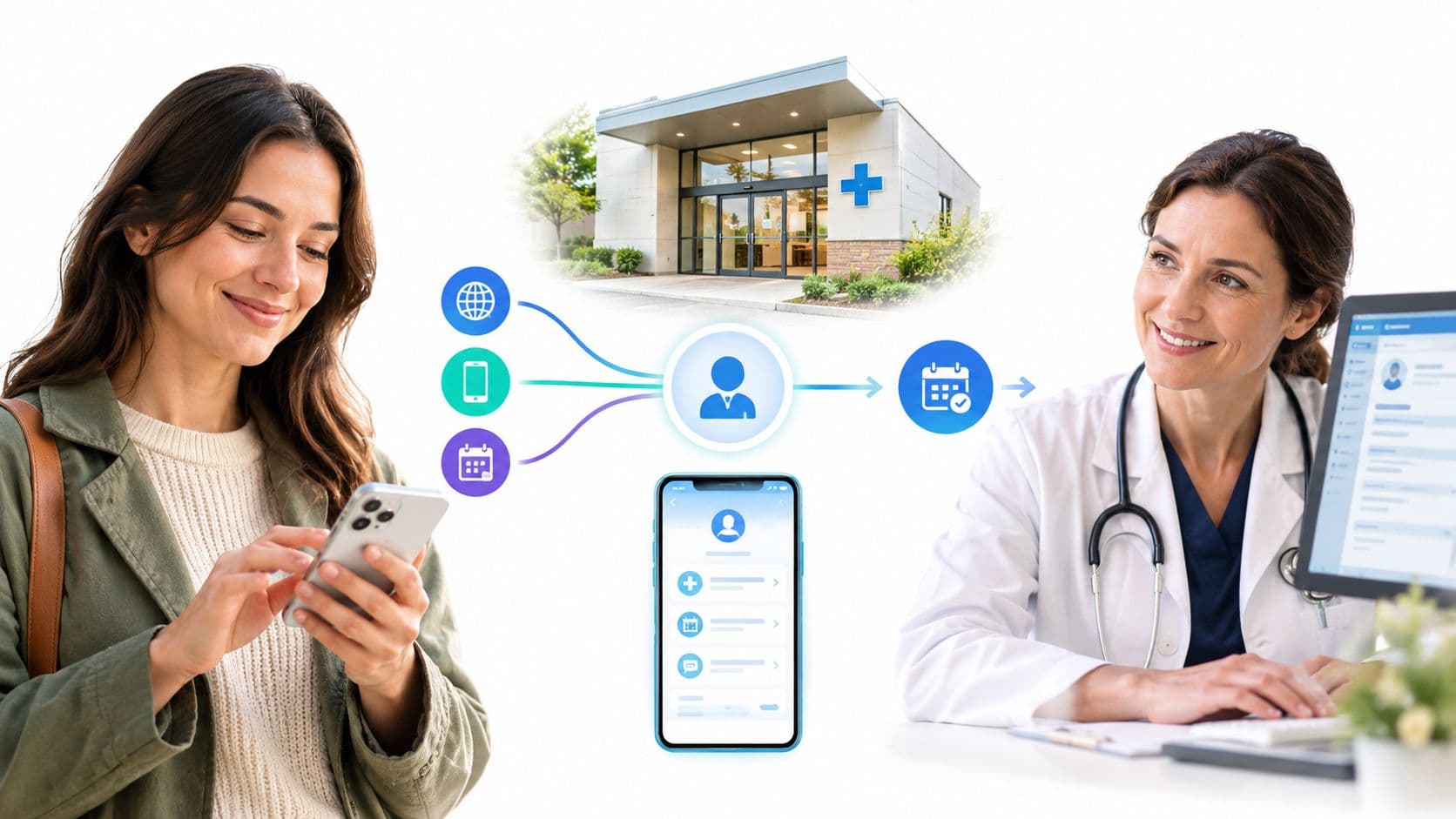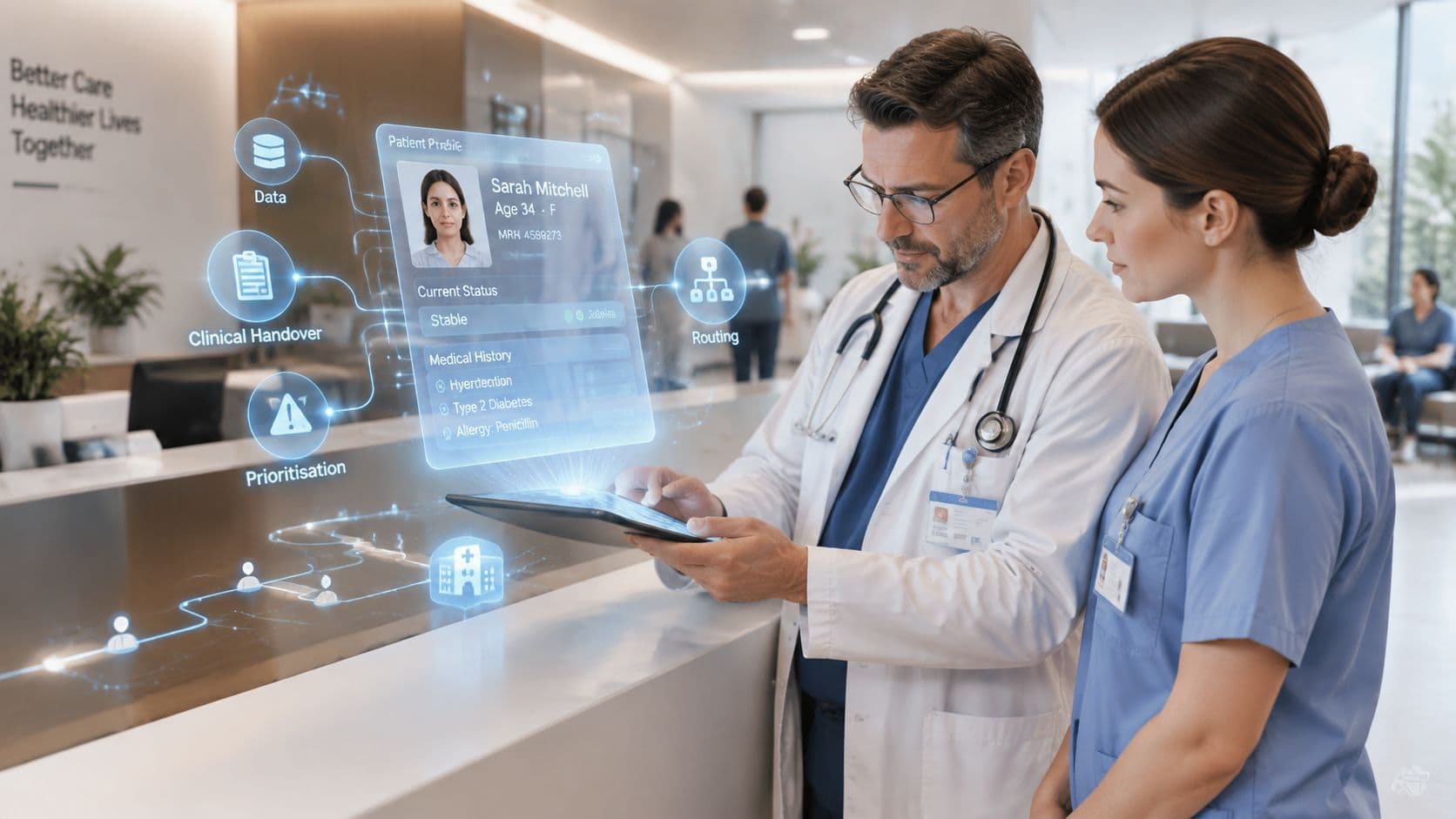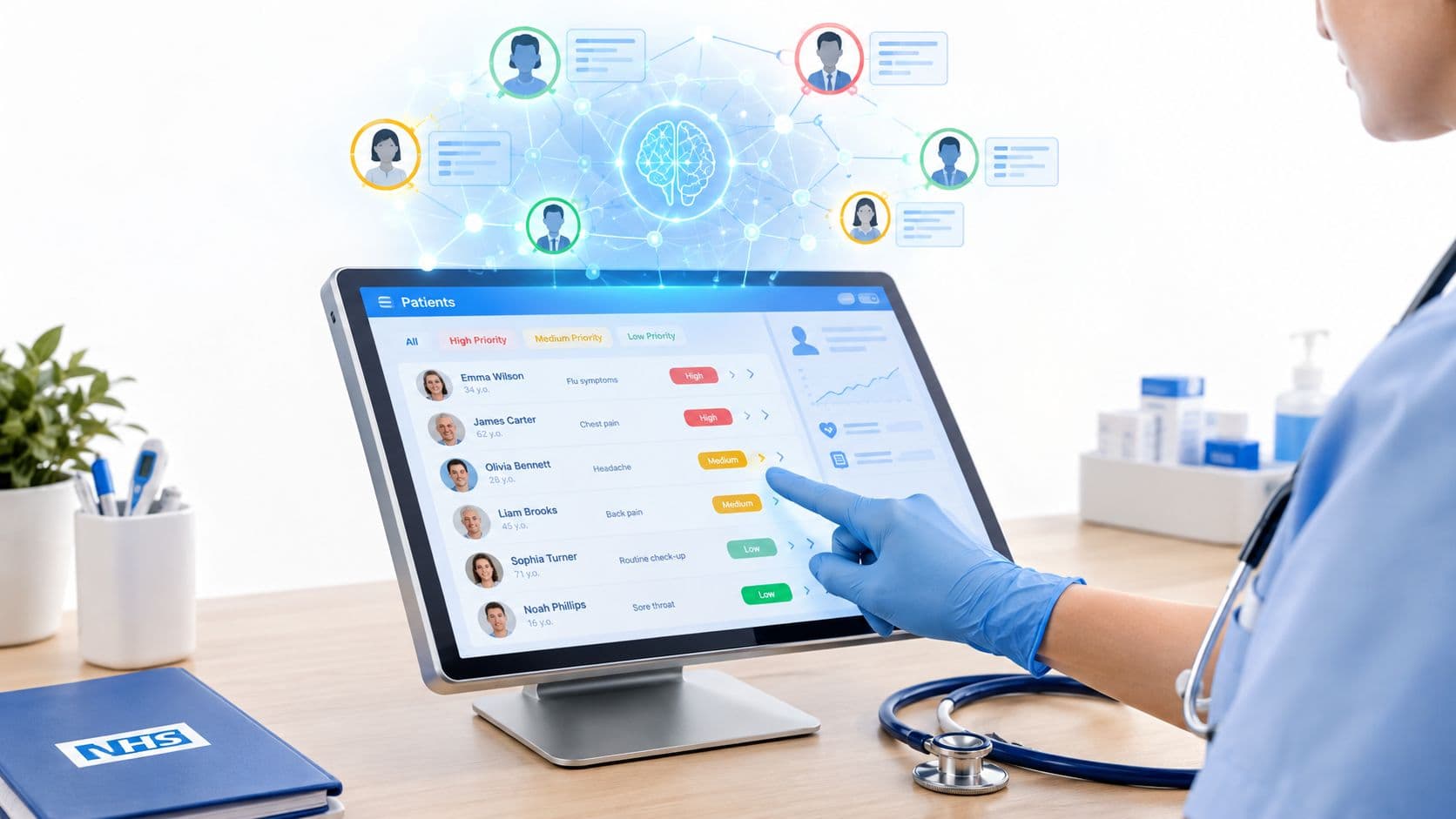
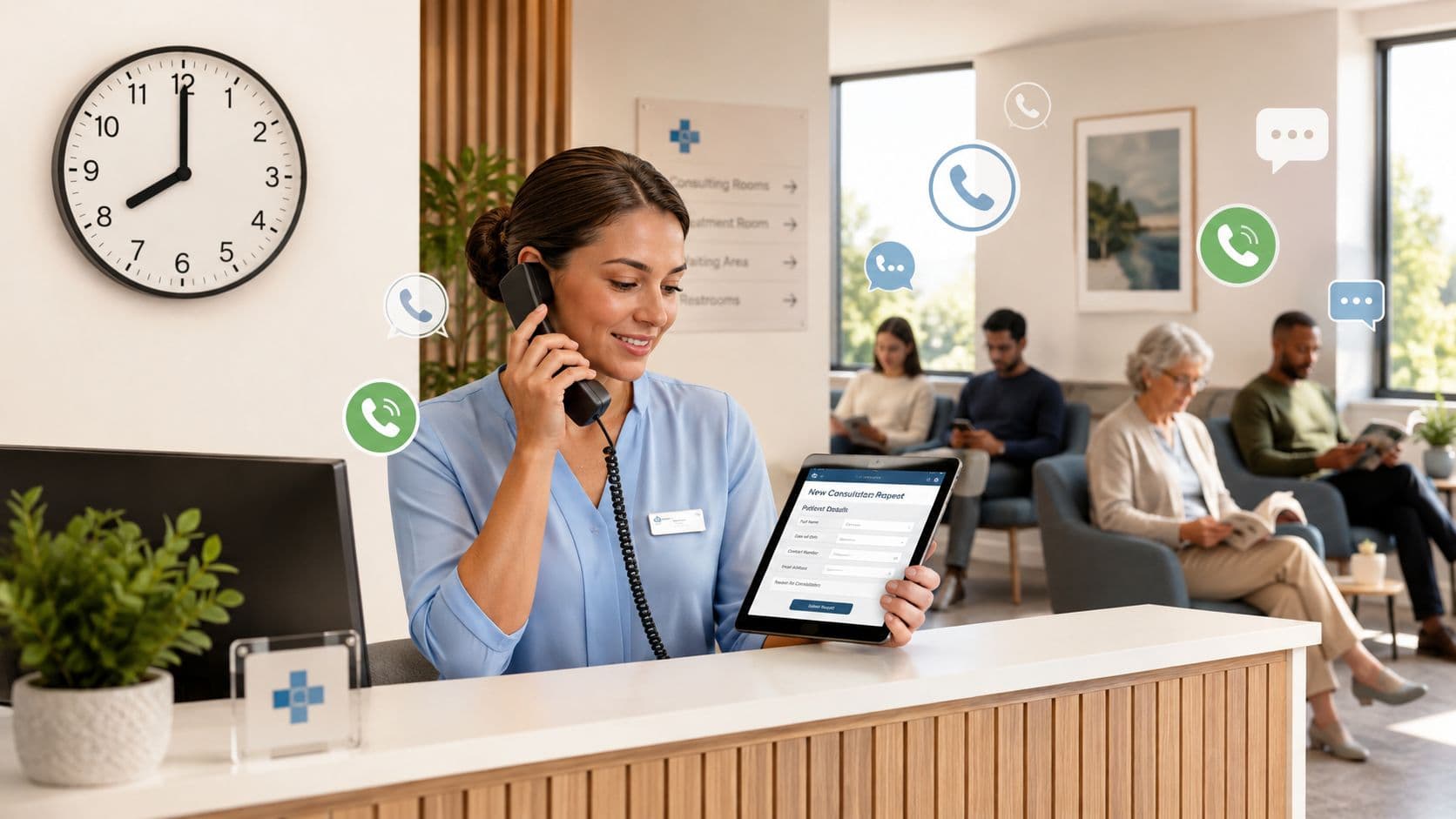
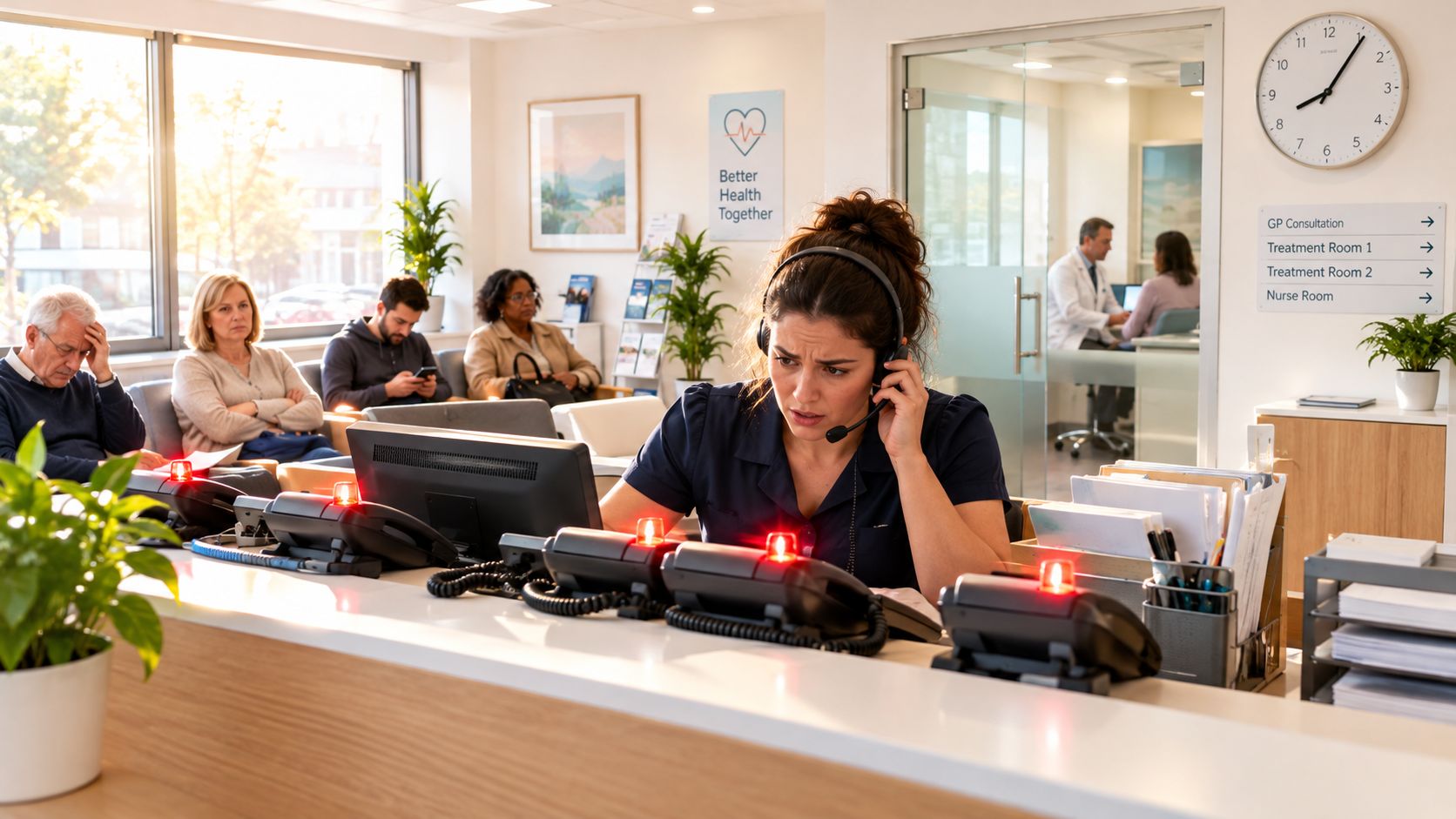
If you're still fighting the 8am rush, you already know the problem isn't just the phones. It's the way demand lands, all at once, on a team that then has to sort, prioritise and re-route every request before the day has even started. The practices that make a real dent stop treating this as a staffing shortage and start treating it as a triage-model problem.
The evidence backs that up. In a Reading Healthwatch survey, 57% of respondents said they called their GP practice between 8am and 11am, 27% between 8am and 9am, and only 14% got through immediately, which shows how concentrated the morning demand is and how much friction sits at the front door Healthwatch Reading survey. That is why the choice is not merely "more staff" or "more slots". It's which access model your practice is running, and whether that model still depends on a human sorting every request at the point of entry.
The hard question is not how to answer more calls at 8am. It's how to stop making 8am the moment when the whole practice has to decide everything.
Why the 8am Rush Is a Triage Problem, Not a Staffing Problem
The first sign is a phone queue, so the rush looks like a staffing issue. It isn't. If every request still has to be interpreted by reception, a clinician, or both, then more people at 8am only speeds up the same bottleneck. The work still has to be sorted before it can move.
Morning demand is concentrated, and the access pain shows up in more than one way. In the Healthwatch Reading survey, 57% of respondents said they called their GP practice between 8am and 11am, 27% between 8am and 9am, and only 14% got through immediately. The same report said 67% were placed in a telephone queue, 20% got an engaged tone and had to redial, 10% were cut off, and 54% described contacting the surgery as difficult. That is a front door problem created by too many people trying to use one route at the same time.
National access reporting points in the same direction. NHS England has repeatedly shown that telephone remains a major entry point for general practice, which means practices that rely on call handling alone are still exposed when demand spikes at opening time.
Five models, one decision
The key question is not which tool looks modern. It is which triage model the practice runs, and where the sorting happens.
Manual reception triage, where reception staff gather enough information to decide what happens next.
Manual GP-led triage, where a clinician reviews most or all requests before booking.
Form-based online consultation, where patients submit structured information and staff triage it later.
AI-assisted total triage, where software helps prioritise but a human still makes the final routing decision.
Autonomous AI triage, where the system takes the history, prioritises urgency, and routes the request into the booking workflow.
The first four can still help. They can lower phone pressure, improve consistency, and make demand more visible. But they leave a manual sorting step somewhere in the flow. That is why they often shift the rush rather than remove it.
If your team is still triaging every request by hand, the 8am scramble is still built into the model. The decision is whether to keep tuning that model, or replace it with one that stops the bottleneck at source.
The Five Triage Models Compared
A lot of practices compare tools as if they were interchangeable. They're not. The biggest difference is not interface design, it's who does the sorting and when the clinician enters the process.
| Model | Who sorts the request | Typical 8am effect |
|---|---|---|
| Manual reception triage | Reception team | Often eases call handling, but the rush stays concentrated at the front desk |
| Manual GP-led triage | GP or clinician | Safer prioritisation, but the morning load shifts onto clinical time |
| Form-based online consultation | Reception or admin team after submission | Reduces calls, but usually creates an online queue to review |
| AI-assisted total triage | Human reviewer, with software support | Better prioritisation, but the human sorting step remains |
| Autonomous AI triage | System, with escalation for exceptions | Spreads demand through the day and removes the manual triage step for routine cases |
Manual reception triage can work in smaller practices where relationships matter and volumes are manageable. It's familiar, and it gives the team a direct way to deal with exceptions. But once the phone line starts flooding, reception is still forced into rapid judgement under pressure.
Manual GP-led triage improves clinical control, especially where the practice wants a clinician to shape every urgent decision. The trade-off is obvious. You protect safety and continuity, but you also pull clinical time into the morning gatekeeping process.
Form-based online consultation is a genuine improvement when the main problem is that too many people are phoning at once. It creates a written record, it helps with asynchronous demand, and it can spread contact beyond 8am. But if staff still have to read, interpret and route every form, the queue just moves.
AI-assisted total triage is better again. It can sort, flag and prioritise more intelligently than a purely manual first pass. That said, AI-assisted still means a human makes the final decision. In practice, that makes it an evolution of total triage, not the end of the manual step.
Autonomous AI triage is different in kind. It takes the patient through a focused history, adapts its questioning, prioritises urgency and places the request into the booking flow. That is the point where the morning bottleneck can flatten, because the practice is no longer asking a human to be the first sorter for every request.
Practical rule: if the model still depends on a team member reading every request before anything happens, it will usually shift the rush rather than remove it.
Redesigning Patient Access Step by Step
The strongest rollouts start with measurement, not with a launch date. Practices that go too fast usually discover they have changed the front door before they have understood demand, and then they spend the next month untangling the consequences.
Start with the baseline
For four weeks, record call volumes, abandonment, queue duration, appointment release times, channel mix, same-day demand and who is calling at 8am by age, disability, language and deprivation. That gives the practice a real picture of demand rather than an instinctive one.
Once that baseline is visible, open asynchronous intake across the working day and advertise it before 8am. Capture the information that allows requests to be routed safely, including symptoms, duration, red flags, preferred modality and accessibility needs. Then apply clinician-approved routing rules so the route matches the urgency.
Keep the old routes for the people who need them
Telephone and reception capacity still matter, but they should be protected for urgent, digitally excluded or complex cases. That part is where many practices go wrong. They assume online access is a replacement for human contact, when in reality it needs to sit alongside it.
A good practical resource on operating change in this kind of environment is improve operations with CloudOrbis Inc., especially if your team is trying to map the hand-offs between access channels and internal workflows. The useful principle is the same in general practice as it is in any process redesign. First define the flow, then decide where the exceptions go.
Review the right things later
From around week 9 onwards, review outcomes weekly by age, deprivation, disability, language and channel. That protects you from a common failure mode, which is to celebrate the fact that more requests are coming in online without checking whether the right patients are getting through.
The warning sign is simple. If online demand rises but the practice still needs a second queue of staff to sort it, the bottleneck has moved, not disappeared. Continuous access only works when the workflow after intake is designed as carefully as the form itself.
Adding Autonomous Triage Without Losing Clinical Control
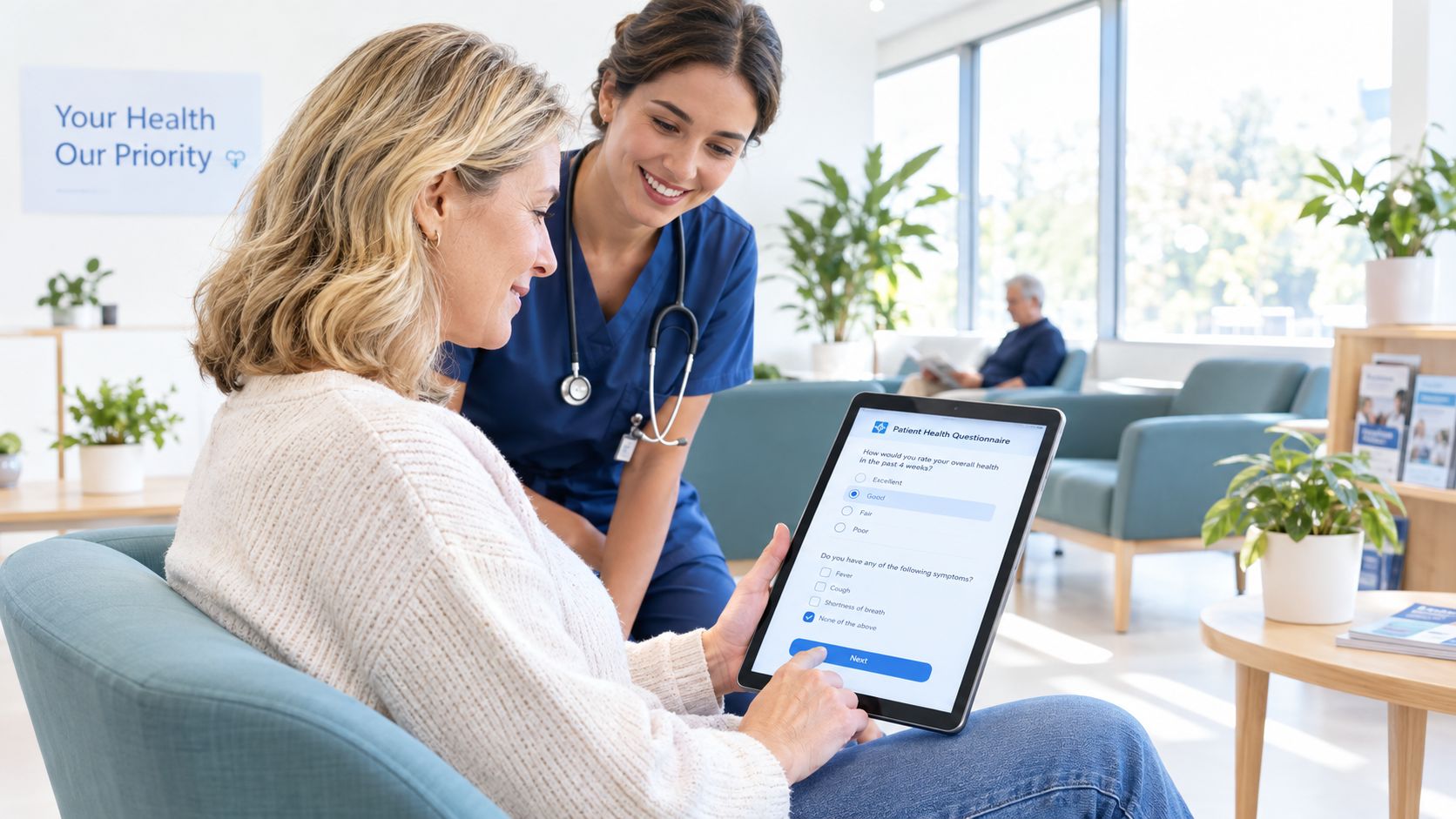
Autonomous triage belongs at the point where manual sorting becomes the bottleneck. Patients still enter a clinical history, but the system adapts the questions, ranks urgency, and feeds a structured summary into the booking workflow for the practice to act on.
The regulatory boundary still matters. GP Triage uses Infermedica, a Class 2B medical device with UKCA and MHRA alignment, supported by DCB0129 and DCB0160 documentation. That matters because the tool is configured to the practice's own safety model, while GP sign-off remains in place for anything that falls outside the autonomous route.
The safety record is the point that usually decides whether a CSO or digital lead trusts the model. The available documentation reports zero recorded clinical safety incidents across approximately two million triages and around 97% concordance with GP decision-making. The clinical scope also includes adult and paediatric presentations. Those are the claims that need to stand up in a live service, not just in a sales conversation.
The limits should be clear as well. The system does not read full patient records, it does not support SNOMED coding, and it does not create tasks directly in clinical systems. That is a constraint, but it is also part of why the model stays honest. Its job is structured intake, prioritisation and booking support, not pretending to replace the record layer.
Integration is practical rather than flashy. The platform connects with the main UK clinical systems through an interoperability partner and places a triage summary into the booking record. The workflow stays tied to the practice's existing booking process instead of splitting into a separate queue.
Changing Roles and Training the Team
The rollout only sticks when every role is redefined clearly. If you leave the team to infer the new day for themselves, they'll drift back to the old one whenever pressure rises.
Reception stops being the first point of manual sorting and becomes the team that handles the residual complex or digitally excluded contacts, supports in-person entry and manages urgent escalation. Admin stops processing routine forms and starts handling exceptions, booking outcomes flagged by the system, and chasing the operational loose ends. GPs stop spending the first part of the day clearing the queue and start seeing a list that is already prioritised and structured.
The training sequence matters as much as the technology. Start with a clinical safety briefing so everyone understands the boundaries. Then run shadow sessions on the live system. After that, go live under supervision and review cases weekly for the first month.
If the team doesn't know what good looks like on day one, they'll measure the new model against the old habits of the old model.
The final piece is a documented feedback loop into the practice's own protocols. That is where many rollouts fail, because staff identify a problem but no one changes the rule set. Autonomous triage doesn't remove the team. It removes the bottleneck, and the team has to be told that plainly.
KPIs That Tell You Whether the Rush Has Eased
The wrong dashboard makes the wrong behaviour look like progress. If you only track how many contacts move online, you can miss the fact that you have created a second queue behind the first.
Start with metrics that show speed and safety together. Channel mix by hour of day shows whether the morning peak has flattened. Abandoned calls and queue time show whether phone access is still failing. Urgent escalation rate, two-week re-contact rate and complaints show whether the workflow is holding up clinically.
Don't ignore equity
The CQC and the BMA have both highlighted the risk of doing this badly. Average access can improve while some groups are left behind. Track failed or abandoned contacts by age, deprivation, language and disability, and keep a watchlist for delayed red-flag referrals and urgent-care leakage.
The need to avoid a purely digital success metric is clear in UK observational evidence. It found that 72.1% of patient-initiated requests were submitted online in 2021/22 while 53.8% of consultation responses were still telephone-based, which shows why digital intake should be treated as part of a mixed workflow rather than a full replacement BMJ Open study. A practice can shift plenty of demand onto a screen and still need the same human triage work afterward.
For a PCN meeting, the five numbers worth reciting are these:
Abandoned calls
Average queue time
Urgent escalation rate
Two-week re-contact rate
Access by channel and patient group
Keep those five in view and you will know whether the morning rush is easing, or just wearing a different badge.
If you want to see whether autonomous triage could fit your practice, book a demo with GP Triage and review your current access flow against a live booking and escalation model.