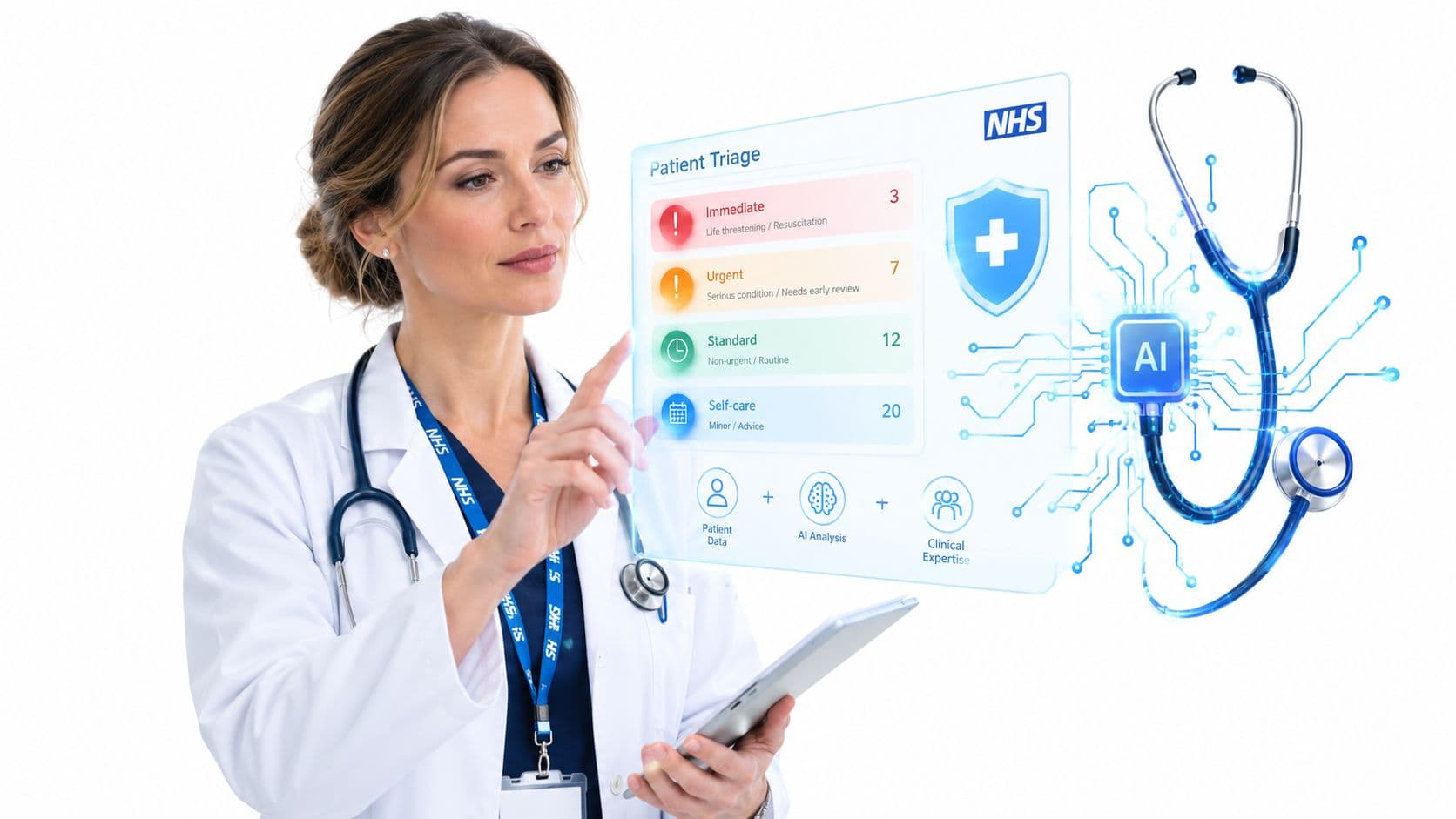

If your practice is already seeing more digital requests, the question isn't whether AI has reached the front door. It's whether the triage behind that door is safe enough to trust with urgent patients, anxious parents, and the late-night calls that arrive when the phones are stretched and the waiting room is full. In NHS general practice, that question has to be answered with governance, workflow design, and real-world evidence, not optimism.
Digital demand is no longer a side issue. NHS England reported around 6.5 million online consultation requests to GPs in September 2025, approximately 49.9% higher than September 2024, at about 108.7 submissions per 1,000 registered patients (NHS England reporting on record GP access figures). That scale matters because every submission still has to be prioritised somewhere, whether by reception, a GP, a form-based workflow, or an AI system.
For partners and Clinical Safety Officers, the question is sharper than “does it work”. It's whether AI triage is safe for patients in the specific NHS pathway where it's deployed, with the right escalation rules, the right oversight, and the right tolerance for error. Safety here is a property of the system in use, not a slogan.
The Safety Question Behind Rising Digital Demand
A busy practice doesn't feel abstract about triage safety. It feels it in the morning backlog, in the urgent request that lands after surgery, and in the patient who submits a symptom description that's easy to under-read if the team is rushed. That operational reality is why “is AI triage safe for patients” is the right question, and why a vague reassurance isn't enough.
The best evidence now points in the same direction: AI triage can be configured to behave in a safety-first way, but it still has to be governed as part of a real clinical pathway. A 2026 UK primary-care study comparing an AI-enabled triage tool with GP urgency ratings reported 84% categorical concordance and no observed cases of significant under-triage, with the AI system more likely to over-triage than under-triage (SITORA research summary). That is the right direction of travel for safety, because over-triage is usually a capacity problem, while under-triage is a patient-safety problem.
The caution is just as important. A 2025 observational study of digitally supported urgent care telephone triage in England found that 1.5% (1,468) of patients triaged to same-day or less urgent care at secondary triage were later admitted to hospital within 24 hours, so under-triage can still occur in real NHS pathways even when the process is designed to be cautious (PMC study). The same study reported higher odds of potential under-triage for calls made between midnight and 6am and for shorter calls, which is a reminder that out-of-hours workflows need particular scrutiny.
Practical rule: If a triage system never appears to over-triage, I become more suspicious, not less. In patient routing, a little caution is usually safer than false reassurance.
That's why the answer isn't a simple yes or no. AI triage can be safe for patients when it's built as a governed clinical process, not just as a fast digital intake form.
Defining Safety and Harm in a Triage Context
A receptionist sees a request, a duty GP reviews a form, or an AI system scores urgency. The safety question is the same in each case: what kind of mistake is the pathway most likely to make, and who carries the risk when it does? In a busy practice, that is the practical standard GP partners should use.
Over-triage and under-triage are not equivalent
Over-triage sends a routine problem into a higher-urgency route than it needs. That increases same-day pressure and adds avoidable work, but it usually does not harm the patient directly. Under-triage is different. A time-sensitive problem is downgraded, delayed, or treated as routine when it should have been escalated.
That is why a cautious triage system can still be the safer one, even when it is imperfect.
Concordance is useful, but it isn't the whole safety story
One measure is concordance with GP decision-making. High concordance suggests the system is behaving in a way that resembles clinical judgement, but it does not prove safety across every subgroup, every presentation, or every call pattern. In the UK primary-care evaluation, the AI system was reported to align with clinicians often enough to support a cautious interpretation, and the same summary showed a bias toward escalation rather than missed urgency (Sciety summary of the UK primary-care evaluation).
That finding matters, but only within the pathway that surrounds it. Safety depends on how the practice handles uncertainty, what happens when demand spikes, and whether brief free-text submissions are reviewed by someone who can still override the system. Those operational controls are where harm is prevented, or missed.

A safe system makes uncertain cases visible, routes concern upward, and leaves the practice in control of escalation. That is the standard to apply. The product has to fit a governed clinical process, not the other way around.
Five Models of Triage and Where Risk Sits
GP practices often describe triage as a single process, but the risk profile shifts depending on who holds the final decision. A receptionist may be making a judgement call, a GP may review every request, a form may sort the queue, AI may assist while a human still decides, or the system may route requests within set rules.
The five models side by side
| Triage Model | How Prioritisation Works | Human Role | Primary Safety Risk |
|---|---|---|---|
| Manual reception triage | Frontline staff sort requests by script, judgement, or local rules | Receptionist or administrator decides what feels urgent enough to pass on | Inconsistent judgement, variable escalation, pressure from queues |
| Manual GP-led triage | A GP reviews each request and decides urgency | GP makes the prioritisation decision | Delay from workload, fatigue, limited availability |
| Form-based online consultation | Patient submits a form, then a person reviews it | Human triager interprets the form and routes it | Missed nuance, backlog, uneven responses to free text |
| AI-assisted total triage | AI analyses the request, then a human still decides | Human retains final decision-making | Safety depends on human capacity and override discipline |
| Autonomous AI triage | AI assesses urgency and routes the request within configured rules | Human oversight remains, but the manual triage step is removed | Configuration quality, escalation design, monitoring discipline |
The first four models reorganise triage, but they do not remove the manual judgement layer. Safety still depends on who is available, how tired they are, and whether the queue is manageable. AI-assisted triage can reduce friction, but the human remains the final decision-maker.
Autonomous AI triage shifts the risk structure. The system itself makes the prioritisation decision inside a governed workflow, so safety depends more heavily on configuration, escalation rules, and ongoing monitoring.
Useful distinction: AI-assisted means the human still decides. Autonomous means the system does. That line matters because it changes who carries the immediate routing burden.
For practices comparing options, the key question is not which model sounds most advanced. It is which model gives the safest and most reliable path from patient request to action under normal NHS workload, not just in a controlled demonstration.
Regulatory Standards and Clinical Governance
AI triage that influences clinical decisions or patient routing shouldn't be treated like ordinary software. In the UK medical-device framework, the MHRA flowchart for stand-alone medical device software states that Class IIa and Class IIb are generally regarded as medium-risk classes (MHRA software flowchart). For a triage platform, that matters because the level of assurance has to match the clinical consequences of the decision support.
The governance documents matter just as much as the device class. Practices should expect DCB0129 evidence from the supplier and DCB0160 evidence for deployment in the receiving organisation. Those documents are not paperwork for procurement's sake, they're the basis for showing that hazards have been identified, mitigations are defined, and local accountability is clear. If a supplier can't produce that material cleanly, it's not ready for a proper NHS safety review.
A safe deployment still needs local control. The Clinical Safety Officer should review the safety case, confirm that red-flag routing fits local protocols, and check that the practice understands what happens when the system is uncertain. NHS accreditation or assurance signals are a starting point, not a substitute for the practice's own clinical governance.
If the product is going to influence booking or urgency, ask three direct questions: where does escalation happen, who can override it, and how are exceptions monitored? If those answers are vague, the product is not yet safe enough for production use.
What the Evidence Shows and Where It Falls Short
A practice can pass procurement checks and still face an open question at the point of use. The current evidence suggests AI triage can act conservatively and sit close to GP judgement, but it does not yet prove safety across the full spread of NHS patients, especially where language, deprivation, disability, or digital confidence shape how people present.
What looks promising
The strongest signal so far is that AI-enabled triage appears more likely to over-triage than miss risk. That matters in a busy surgery, because cautious routing is easier to manage than false reassurance. The SITORA research summary points in that direction, but the more important clinical takeaway is the equity gap. A tool can look acceptable in aggregate and still behave unevenly across subgroups that use primary care differently.
The broader literature supports that caution. The JMIR review says the evidence base is still dominated by retrospective validations, emergency-setting studies, and vignettes, with limited real-world primary-care evaluation. It also notes that subgroup analysis is sparse. That means a practice cannot assume a model that looks reasonable on paper will perform consistently for older patients, patients with limited English, or people who already struggle with digital access.
Where the gap matters most
The review calls for prospective GP studies that track delayed diagnoses, avoidable emergency use, override behaviour, and outcomes by age, ethnicity, language, and deprivation. That is the right unit of analysis. Safety is not just whether the system produces a plausible urgency score, but whether it changes who gets seen, who waits, and who gets missed.
The operational risk is that rollout can move faster than evidence. NHS England has projected rollout of AI-assisted triage in the NHS App to all users by April 2028, which makes local monitoring a governance duty rather than a future concern. Practices should be asking how they will detect drift, inequity, and over-reliance before those patterns become routine.

Safety, then, is not a verdict on the product label. It is a continuing check on whether the system still behaves acceptably in the GP workflow, for the patient groups who use it, and for the patients who may be least well served by it.
Designing Safe Escalation and Oversight Workflows
A triage system is only as safe as the pathway around it. If escalation is weak, even a well-designed AI model can create blind spots. If escalation is strong, the system can safely absorb complexity and move the right cases forward without burdening clinicians with every routine request.
Build the escalation path first
Start with your red-flag logic. The practice needs to know which presentations must be surfaced immediately, which ones can be queued, and which ones should never be left to routine booking. That logic has to match local protocols, not generic marketing copy. If the urgency thresholds don't reflect how your on-call, duty, and same-day workflows run, the system will drift away from safe use.
Keep the summary usable
A structured triage summary is only helpful if it lands where staff can act on it. GP Triage, for example, says it integrates with the major UK clinical systems and pushes a triage summary into the booking record, while not claiming to read the full record or create tasks directly. That kind of scoped integration is what matters in practice, because it supports continuity without pretending to be the entire clinical system.
Monitor the pattern, not just the outcome
Practices, PCNs, and ICBs need to review not only individual exceptions but also demand patterns over time. If certain hours, pathways, or patient groups are consistently producing more escalations, that's a signal to review the configuration and the surrounding process. Monitoring should include override behaviour, delay patterns, and any local concerns raised by clinicians or reception teams.
A practical checklist is straightforward:
Define escalation triggers clearly: Make sure urgent symptoms, safeguarding concerns, and deteriorating presentations are always visible to the right people.
Align with local working patterns: Configure routing around your practice's actual same-day capacity and out-of-hours handover arrangements.
Review exceptions routinely: Look for repeat edge cases, not just single incidents.
Keep governance live: Revisit the safety case when workflows, staffing, or patient demand changes.
Safe automation doesn't remove judgement. It concentrates judgement where it's needed most.
That's the core governance task, not just switching on a tool and hoping the queue behaves itself.
Real-World Outcomes and the Path Forward
The clearest practical signal comes from live deployment. GP Triage has had zero recorded clinical safety incidents to date and around 97% concordance with GP decision-making. Those are the claims worth testing in procurement, because they reflect day-to-day use rather than lab performance.
Reference cases matter as well. At Langton Medical Group, serving ~14,000 patients across 3 sites, the practice reports ~30 hours of GP-led triage removed per week, to date. At Swanscombe Health Centre, serving ~37,000 patients, the reported outcomes include ~422+ hours returned in the first 4 weeks and ~5,000 appointments booked autonomously in that period, to date. These are operational signals, not guarantees. They show what changes when a manual triage step is removed.