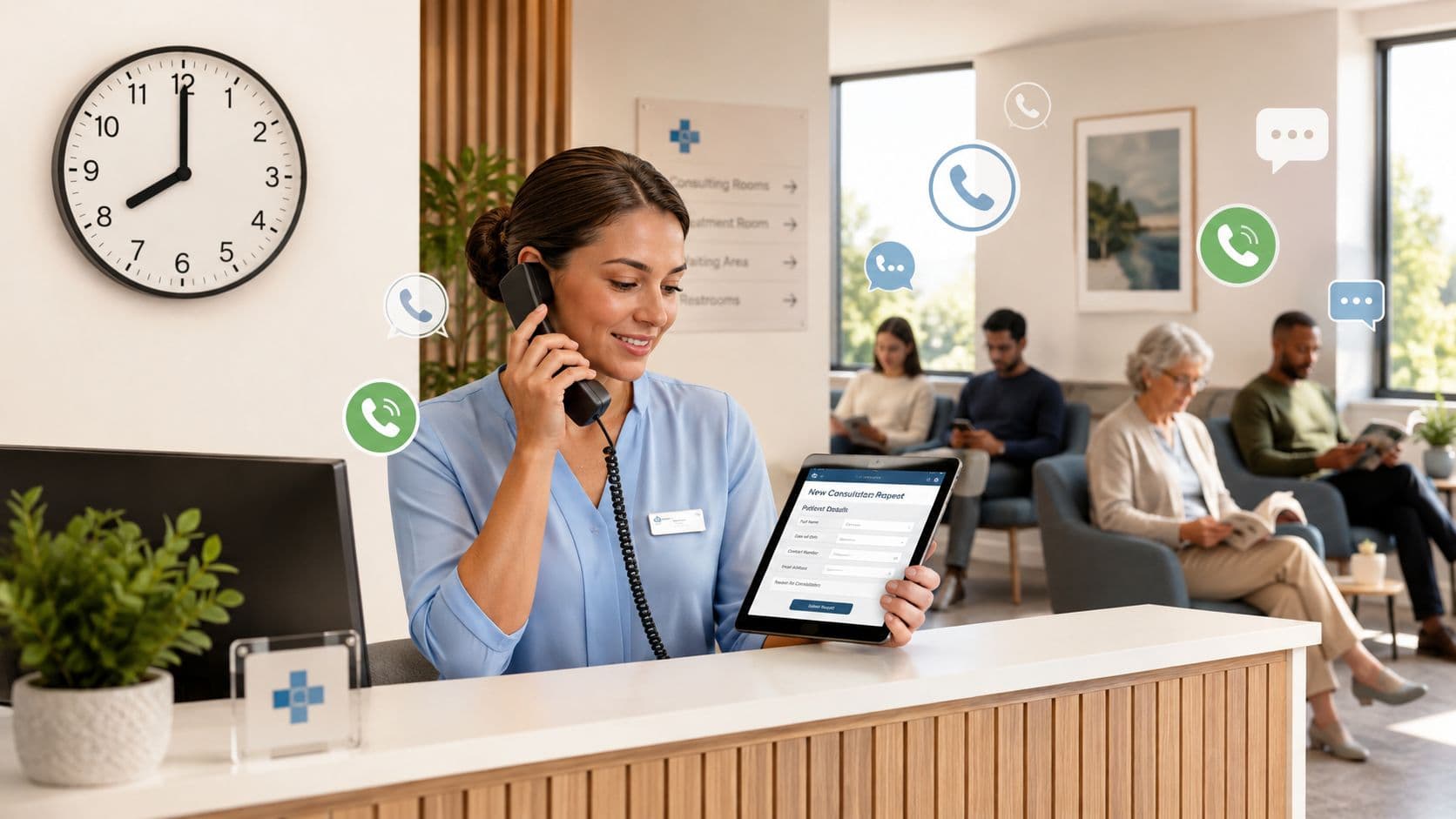

It's 8am. The phone queue is growing, the online inbox is filling, and reception is trying to help the patient standing at the desk. Nobody can yet say how many requests are new, how many are repeats, or how many need an appointment at all.
If you're deciding how to manage rising GP demand without more staff, start by separating the demand arriving from the work it creates. Recruitment may remain necessary, but the immediate opportunity is to stop allocating scarce clinical time through queues, historic booking templates and repeated handling.
Map Where Demand Arrives Before You Change It
A contact isn't a unit of workload. A request for a document, a deteriorating patient and a repeat enquiry about an unanswered message might each appear as another entry in the inbox, but they require different responses.
Count them together and you'll struggle to explain why a seemingly manageable morning overwhelmed the duty team. Count only appointments and you'll miss much of reception's work altogether.
Build a demand and capacity baseline
Use a spreadsheet with consistent categories before commissioning a complicated dashboard. Keep patient-identifiable information within the practice's approved environment, and give the extraction and reconciliation work a named owner.
Extract the incoming demand. Pull at least approximately four weeks of telephony and online-request records, including unsuccessful attempts where the systems capture them.
Classify the work. Segment contacts by day, hour, channel, clinical need and the professional who eventually handles them.
Match demand to capacity. Compare requests with available staff time and skills, not merely the number of people on the rota.
Forecast predictable peaks. Identify recurring pressure points, then adjust session templates and rotas to match the observed pattern.
Review the effects weekly. Examine access, safety and workload together rather than accepting a shorter queue as proof of improvement.
These are working sampling windows, not claims about how quickly a practice will achieve a result.
Demand sources to capture before changing the model
| Source | What to capture | Minimum window | What it reveals |
|---|---|---|---|
| Telephone system | Calls offered, answered and abandoned; time to answer, by hour | At least approximately four weeks | The true shape of the morning peak |
| Online consultation requests | Volume by day and hour, split into clinical and administrative | At least approximately four weeks | Channel shift and weekday patterns |
| Reception and in-person | Queue length, enquiry type, time spent per enquiry | At least approximately two weeks of sampling | Admin work that never reaches a clinician |
| Staff time | Hours spent reading, sorting and routing requests, by role | Approximately two weekly samples | Where operational hours actually go |
| Appointment book | Bookings by session, professional and time of request | At least approximately four weeks | What share of demand becomes an appointment |
Separate arrival time from handling time
NHS England recommends combining channel volumes with staff-time and skill information. Its capacity and demand guidance describes an analysis of approximately 10.5 million contacts in modern-general-practice sites, where almost all requests received a same-day response and the median response time was around four hours; a participating practice reported that around 37% of activity didn't result in an appointment after clinician-led prioritisation.
Those are comparison points, not targets. A response isn't necessarily a completed episode, and a request resolved without an appointment still consumes work.
Practical test: Sample around twenty requests from a recent day. Mark which needed a clinician, which were administrative and which repeated an earlier contact.
Use that sample to test your categories. It's a baseline, not a verdict on the team.
Smooth Peaks and Route Each Request to the Right Person
Peaks are a scheduling problem before they're a staffing problem. If routine document queries, prescription enquiries and new clinical presentations all compete for the same morning attention, adding slots won't fix the allocation problem.
Spread online intake across the day rather than encouraging everyone to submit at opening time. Make response arrangements clear, and move predictable routine work into planned sessions with fixed owners.
Make the rota follow the work
Protect capacity for the requests that predictably arrive, rather than repeatedly interrupting planned work to rescue the duty list. That may mean changing when existing staff review requests, not asking them to work longer.
The Care Quality Commission's primary care assessment reported more than approximately 700,000 additional registered patients on average in 2024/25 compared with 2023/24, while fully qualified full-time-equivalent GPs per 100,000 patients fell by around 0.7% over the two years to 2024/25. In the same assessment, around 44% of appointments were delivered by GPs, around 25% by other direct patient-care staff, and around 65% remained face-to-face.
The practical implication isn't to make every patient digital. It's to use the available professional mix deliberately while preserving the consultation format and continuity the patient needs.
Routing categories with owner and exit rule
| Category | Route | Owner | Exit rule |
|---|---|---|---|
| Urgent or red-flag | Same-day clinician review, with immediate escalation where indicated | Duty clinician | Escalation logged with a recorded outcome |
| Uncertain or deteriorating | GP review | Named GP | Returned to a GP if the answer changes |
| Continuity-sensitive chronic or multimorbidity | Named clinician where possible | Named clinician | Stays with the named clinician |
| Routine clinical with a defined pathway | Nurse, pharmacist or other professional within agreed scope | Pathway lead | Escalated to a GP when outside scope |
| Administrative | Non-clinical pathway with written rules | Reception or admin lead | Clinical content moved back to a clinician |
Define completion before transferring work
Routing isn't dumping. The receiving professional needs an agreed scope, capacity to do the work and a route back when the request falls outside that scope.
Say an administrative enquiry includes a new symptom. Reception shouldn't have to decide whether the symptom matters clinically; the written pathway should tell them how to return it for clinical assessment.
For every category, name an owner and define what done means. Sending a message isn't completion if nobody has accepted responsibility for the next action.
Where Automated Triage Sits Among the Five Models
You may have digitised demand without removing much work. Patients complete a structured request, but someone still reads it, assigns urgency, chooses a route and arranges the booking.
That is the structural limit of the model, not a failed rollout. Each of the five common approaches moves a different part of the triage task, and only one removes the human decision for routine cases.
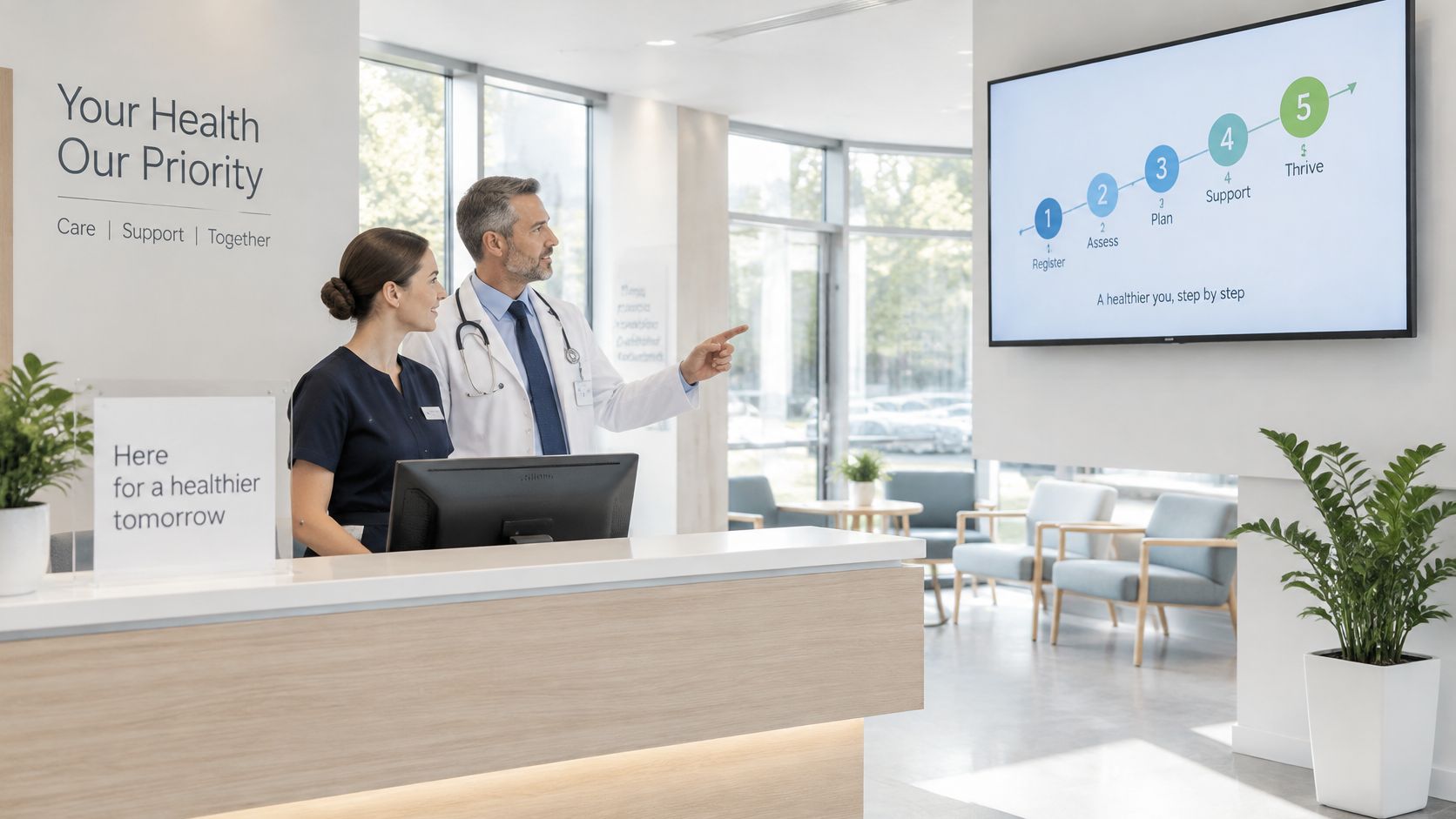
Credit what each model genuinely improves
Manual reception triage offers accessible human contact and practical navigation, particularly when staff know the population and work to clear boundaries. Manual GP-led triage puts clinical judgement into every decision, but spends GP time on requests that may never have needed it.
Form-based online consultation gives patients another route in and captures information before review. AI-assisted total triage goes further: it collects the history and suggests a priority, so the human review starts partway through instead of at a blank screen.
The dividing line is who decides. AI-assisted means a human still decides. Autonomous means the system does, within the practice's configured safety model and with defined escalation to clinicians.
Five triage models compared by who decides
| Model | What it changes | Who assigns urgency | Manual triage step |
|---|---|---|---|
| Manual reception triage | Routes calls and walk-ins by judgement and agreed rules | Reception staff within navigation rules, then a clinician | Remains for every request |
| Manual GP-led triage | Clinician reads and decides on each request | GP | Remains for every request |
| Form-based online consultation | Digitises intake into a structured form | Human reviewer after submission | Remains, though requests arrive in one place |
| AI-assisted total triage | Collects history and suggests a priority | Human clinician confirms | Remains, with faster review |
| Autonomous AI triage | Takes the history, assigns urgency within the practice's safety model, books or escalates | The system, with defined escalation to clinicians | Removed for routine cases |
Judge the removed step, not the technology label
Digitising intake, speeding up review and reorganising queues all reduce friction. Only autonomous triage removes the manual triage decision for routine cases, which makes it the end state for practices that want that workload gone rather than faster.
Langton Medical Group in Lichfield, with approximately 14,000 patients, removed 30 hours of GP-led triage a week, four GP sessions, five months after going live with GP Triage, saving around £163,000 a year without expanding the team. That is a GP-specific time figure, not combined clinical and administrative time.
The useful procurement question is which step no longer needs a person, and which work still requires protected human capacity.
Removing routine decisions does not remove responsibility for the service. Every request the system books, defers or escalates still needs a named owner and a recorded outcome, and that documented chain of responsibility is what separates a measured reduction in demand from an uncounted one.
Build One Workflow and Record Trail Across Every Channel
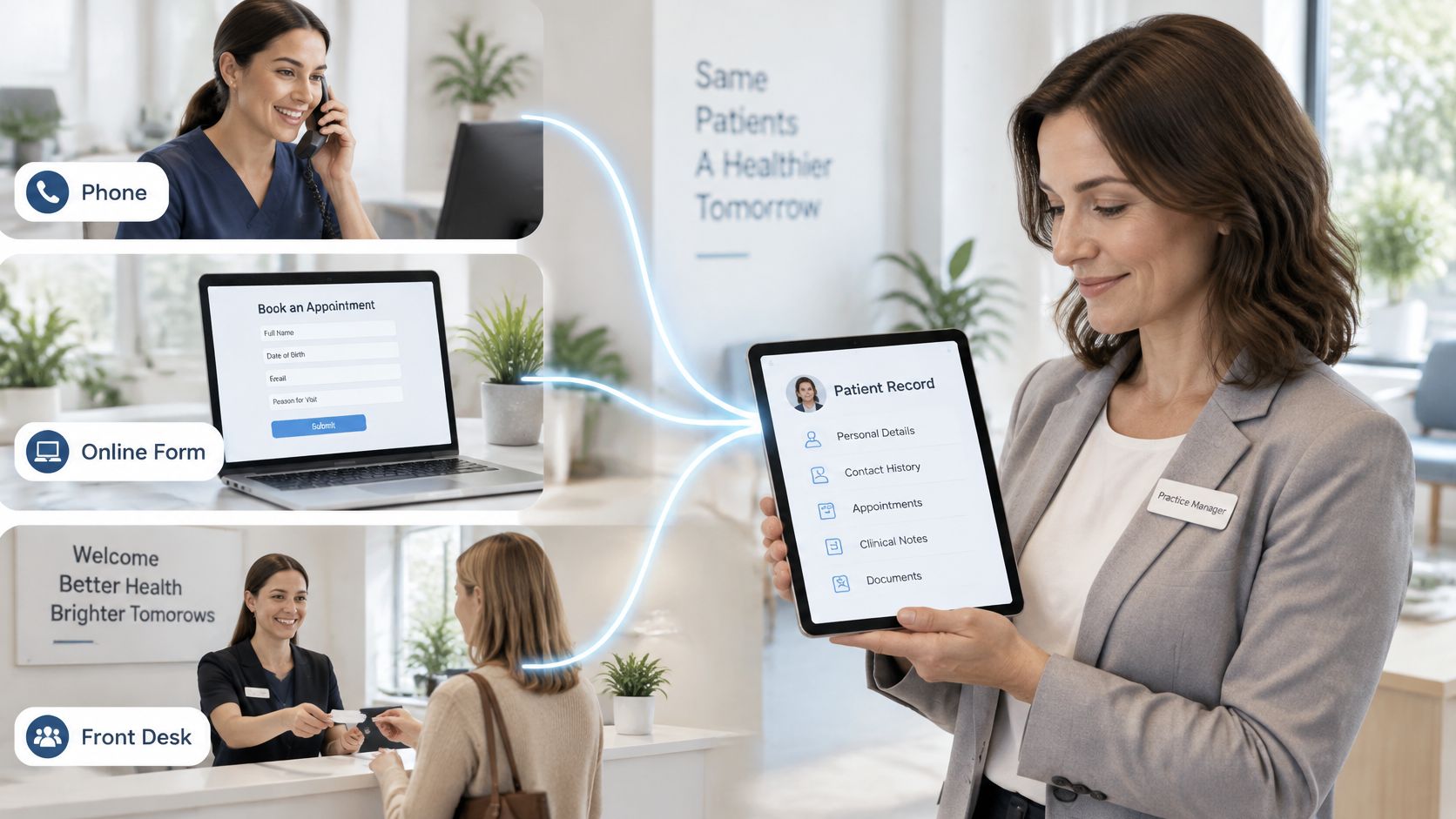
Parallel queues create avoidable work. A telephone request gets a callback, an online request waits for review, and an in-person enquiry generates a separate message, even when they concern the same episode.
A shared workflow doesn't mean forcing every patient through an identical interface. It means applying consistent decision rules and leaving a record that the next person can follow.
Make the pathway explicit
Agree the common pathway. Telephone, online and reception entry should lead into the same governed process, with appropriate support for patients who need help communicating.
Define the disposition set. Include book GP, book another professional, self-care advice, redirect, escalate now and defer. Deferral needs a reason, an owner and a review point.
Approve urgency and complexity criteria. Obtain the Clinical Safety Officer's sign-off before configuring the live workflow.
Specify the summary and destination. Confirm what information the triage summary contains and where staff will find it in the booking record.
Allocate exception queues. Name the person responsible for reviewing each queue and the cover arrangement when they're absent.
Audit exceptions and safety incidents weekly. Review what happened after the initial disposition, not just whether the request left the inbox.
Separate the system's output from the team's actions
Our integration pushes a triage summary into the booking record in the practice's clinical system. It doesn't read full patient records, support SNOMED coding or create tasks directly in the clinical system.
The team therefore needs an inbox routine, a named reviewer and a closing step for anything requiring action. Don't assume that information arriving in a record means somebody has acted on it.
The practice's existing recording rules still apply to the disposition. Staff should be able to distinguish the patient's reported information, the triage outcome and any subsequent clinician decision without reconstructing the sequence from disconnected messages.
Use a practical traceability exercise before launch. Ask a receptionist, a nurse and a GP to find the same request, its urgency and its outcome promptly, without help from the implementation lead.
If they can find the booking but not the unresolved action, the record trail isn't ready.
Set Escalation Rules and Safety Governance Before Go-Live
An escalation rule is only real when someone owns the next action. A red flag can be raised quickly and still become unsafe if it lands in an inbox nobody monitors. An uncertain request can also sit between services because the pathway did not name an accepting clinician.
Define the route, owner and fallback for each type of failure:
Red-flag presentations. Set an immediate override that bypasses routine queues and names the receiving clinical role.
Uncertain or conflicting information. Route the request to human review when symptoms, history or reported urgency cannot produce a clear disposition.
Failed handovers. Treat an escalation as open until the receiving person or service acknowledges it.
Undeliverable requests. Assign a named role to recover requests that cannot reach their intended booking destination.
Out-of-scope work. Give other professionals a defined route for returning work that exceeds the agreed pathway.
The record should show the patient's reported information, the triage outcome, any clinician decision and the person or service accepting responsibility. A faster initial disposition does not close the episode until that handover is documented.
Examine assurance without treating it as a guarantee
GP Triage's triage module has performed over 27 million triages with zero critical errors. GP Triage meets NHS Data Security and Protection Toolkit standards, has completed a DTAC assessment and has DCB0129 clinical safety documentation in place.
Those facts support assurance review, but they do not replace the deploying practice's local safety work. Check which component, version and workflow the documentation covers, then identify the responsibilities held by the supplier and the practice.
Clinically guided urgency assessment and immediate flagging of critical cases still need local decisions about destinations, thresholds and cover. The Clinical Safety Officer should review how the configured pathway handles each priority level, including what happens when the normal receiving service is unavailable.
Test access failures as well as clinical exceptions
NHS England's modern general practice model reported approximately 83 million online consultation requests over the preceding twelve months and noted that around 54.4% of respondents to the 2023 GP Patient Survey reported a good overall appointment-making experience.
At that scale, even a small share of failed journeys can create substantial follow-up work. Local testing should include:
Digital exclusion. Check whether patients needing telephone support, interpretation or accessible communication can complete the pathway without being sent back online.
Duplicate requests. Establish how staff recognise the same episode across channels and reconcile conflicting outcomes.
Unavailable appointments. Define who receives requests that cannot reach their intended booking destination.
Out-of-scope routing. Confirm how another professional returns work that exceeds the agreed pathway.
Missing acknowledgement. Test what happens when the intended recipient does not confirm acceptance.
Faster routing is useful only when patients can use the route and the receiving team can act on it.
Brief reception first because they will explain the change and recover failed journeys. Then brief GPs and partners, the PCN digital lead and the ICB, with the Clinical Safety Officer involved throughout.
Before the first live patient contact, agree who signs the configuration, deployment decision and escalation arrangements. The governance test is practical: every access attempt should be traceable to a disposition, and every diverted request should have documented responsibility.
Track Measures That Show Access Has Improved
Appointment statistics count recorded activity, not every attempt to obtain help. A practice can deliver more appointments while patients keep calling back, abandon the queue or fail to complete an online request.
NHS England's appointment-statistics supporting information explains that the figures don't measure total demand, the number of patients attempting to obtain an appointment or the full workload of general practice; approximately 30.1 million appointments were recorded in May 2025, including PCN appointment books.
Measure episodes and attempts separately
Keep raw attempts visible, but link related contacts into episodes where possible. Otherwise, a patient who phones after an unanswered submission may look like additional demand rather than unresolved demand.
Separate new from repeat requests, urgent from routine need, clinical from administrative work, and completed episodes from unresolved ones. Record redirected and deferred outcomes explicitly instead of placing everything without a booking into a resolved category.
Access and safety measures with warning signs
| Measure | How to calculate | Warning sign | Review cadence |
|---|---|---|---|
| Recontact within seven days | Patients with a second request within the defined seven-day window, divided by first requests | Rising after any channel change | Weekly |
| Conversion to appointment | Requests ending in a booked appointment as a share of requests, by channel | Falling without a matching rise in self-care or redirect outcomes | Monthly |
| Abandoned calls | Calls ended before answer, by hour | Peaks that don't shift after a change | Weekly |
| Urgent escalations | Same-day escalations with a recorded outcome, checked against all escalations | Escalations with no documented outcome | Weekly |
| Clinical rework | Dispositions reopened by a clinician | Rising reopenings after automated routing | Monthly |
| Channel equity | Completion and use by age, language and accessibility need | Under-use by digitally excluded groups | Quarterly |
| Complaints | Complaints by channel and request type | Complaints concentrated in a group or pathway | Quarterly |
The recontact window is an operational definition, not a clinical threshold. Keep it fixed so the practice can compare like with like.
Give the dashboard a decision owner
Review safety and exceptions weekly, including recontacts and abandoned calls. Examine conversion and clinical rework monthly, with a fuller channel-equity and complaints review quarterly; investigate an emerging safety concern immediately rather than waiting for a scheduled meeting.
Use staff-time samples to distinguish GP hours from other clinical hours and administrative hours. If the categories can't be separated reliably, describe the total as operational hours.
Keep definitions identical between reporting periods, and retain the pre-change baseline. If bookings rise while recontacts also rise or abandoned calls remain high, you've increased recorded throughput without demonstrating better access.
Confirm Your Pilot Scope Before You Commit
A useful pilot tests a defined operational problem. It doesn't try to redesign every access route while the team is still learning how exceptions work.
Keep the scope narrow enough to understand the result, but include the surrounding workload. Moving work from reception to the duty GP isn't a saving just because the reception queue looks better.
Set the decision rules in advance
Choose a starting channel. Select the route creating the clearest peak or heaviest administrative handling burden. Keep alternative access available.
Use your baseline. Compare the pilot with the demand pattern and staff-time categories already measured, including work generated after the initial disposition.
Agree the safety model. Involve the Clinical Safety Officer and request the DCB0129 and DCB0160 documentation before live patient contact.
Define stop-or-continue criteria. Specify which access, exception and workload findings permit continuation, require modification or trigger a pause.
Model the return from your own inputs
Include implementation, training, audit and exception-review time in the calculation. Distinguish cash expenditure avoided from time released for other work; they aren't interchangeable.
Don't assume that removing triage time automatically creates bookable appointments. Partners still need to decide how released capacity will be used and whether the resulting appointment mix matches patient need.
A credible commitment follows a demonstrated improvement against your own baseline. It shouldn't depend on reproducing another practice's saving.
GP Triage offers autonomous AI triage and booking for NHS primary care, removing the manual triage step for routine cases within a configured safety model. Visit GP Triage to book a demo, and bring your baseline demand data and routing categories so the discussion starts with your practice's workload.