
When comparing Anima and GP Triage, you're probably not short of demand. You're short of people to read, judge and route it. The useful comparison isn't a feature list. It's a single operational question: who, or what, decides urgency, and when does that decision happen in relation to booking?
Why the Triage Step Decides Your 8am Problem
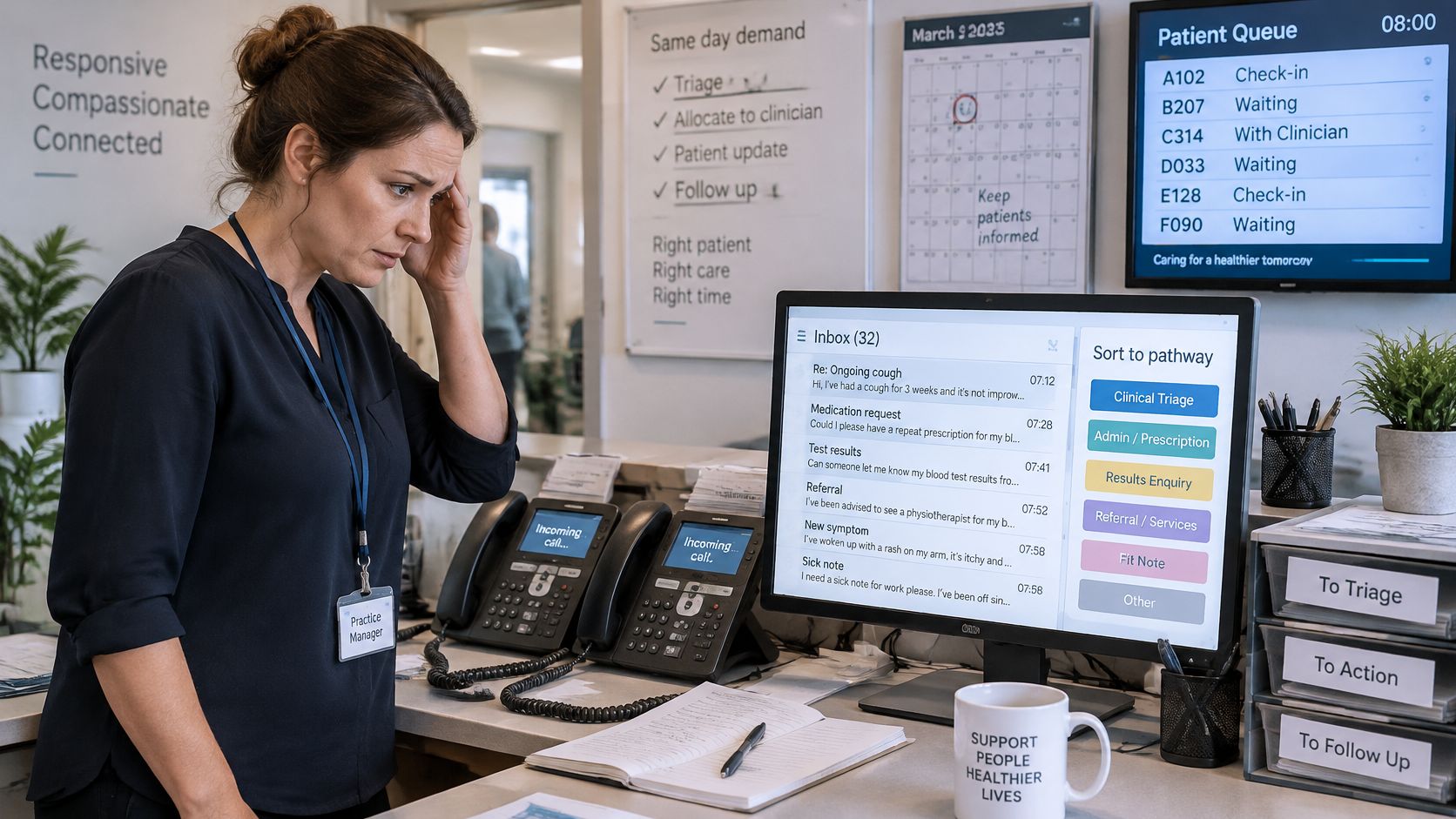
It's approximately 8am on a Monday. The phone queue is already full, reception is working through overnight online requests, and a GP is reading free-text submissions to decide who needs to be seen today, who can wait, and who should go somewhere else. Nothing has been booked yet, because nobody has had time to make the routing decision.
The direct answer is this. Manual reception triage, manual GP-led triage, form-based online consultation and AI-assisted total triage all keep a person in that decision step. They digitise, accelerate or reorganise it. Autonomous AI triage is different in kind, because the system assesses urgency before booking and removes the manual triage step for routine requests.
That distinction matters at current volumes. The NHS England operational performance update for March 2025 reported approximately 382.6 million GP appointments in the 12 months ending January 2025, around 23% higher than the comparable period ending March 2019/20. In January 2025, around 52.6% of practice appointments occurred on the same day or the day after booking, while around 82.7% took place within approximately 14 days.
What to test, not what to believe
Access pressure is therefore a routing problem as much as a slot problem. Most patients are seen quickly, so a slow triage step consumes the very capacity needed for same-day care. A form that moves demand from phone to screen hasn't solved that if your team still reads every submission.
Apply the same criteria to every platform you're assessing. You'll get three practical outputs from doing so: a side-by-side view of model and assurance, a way to read safety claims without overstating them, and a scripted test you can run before signing.
Triage Model and Assurance at a Glance
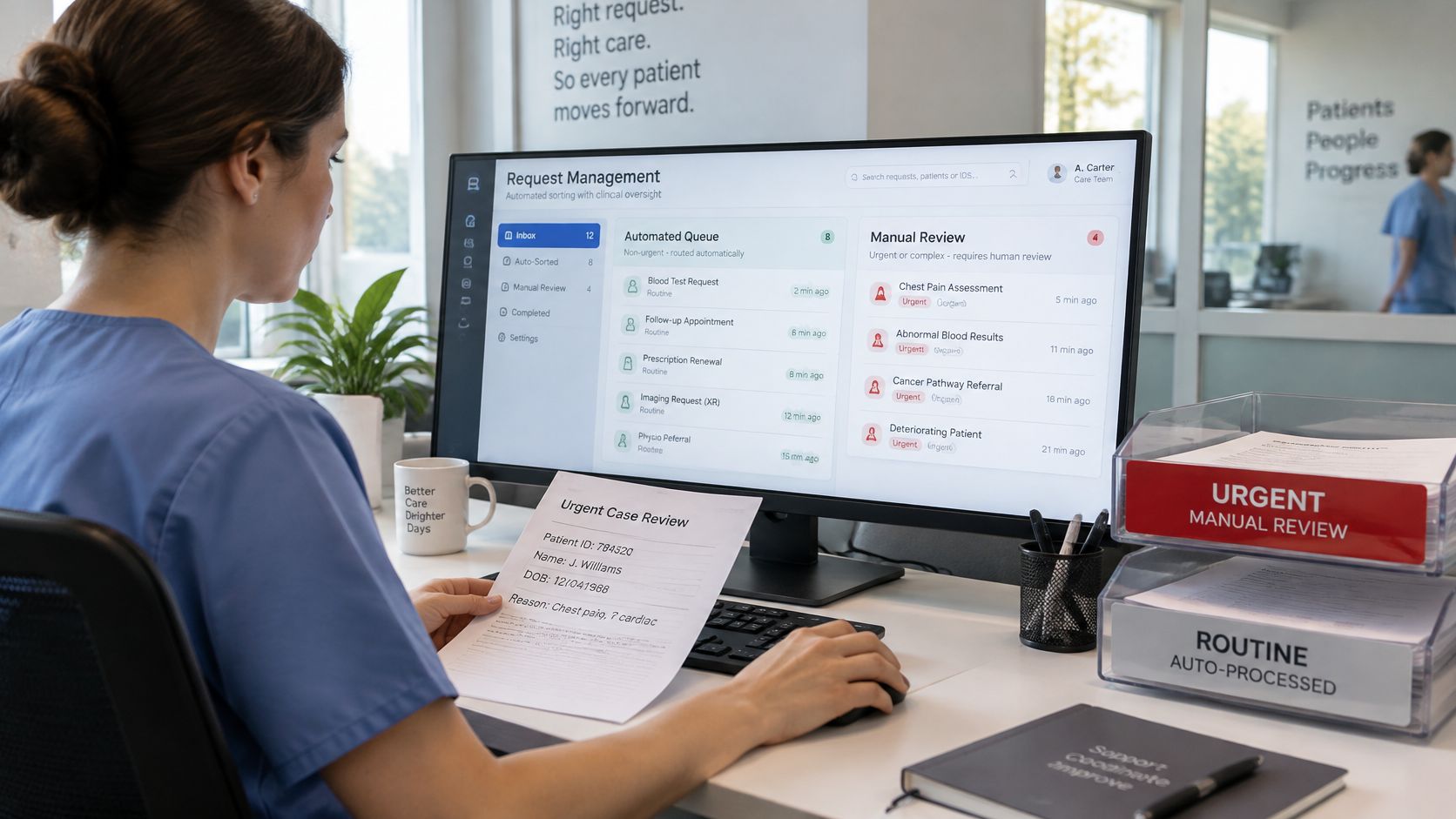
For a practice weighing an AI tool, the key distinction is where the urgency decision happens. A form can collect useful information while leaving staff to assess and route each request. An autonomous triage model makes the urgency assessment before booking, with exceptions and escalations handled according to the practice's processes.
Reception-led triage places that decision with staff; GP-led triage places it with a clinician. AI-assisted systems can structure requests or suggest priorities, while retaining a human decision-maker. Autonomous AI triage removes the manual assessment step, so every patient arrives pre-prioritised. These models differ in workload, clinician involvement and the governance the practice needs to put in place.
The NHS total triage principle
NHS England guidance on remote total triage in general practice defines total triage as patients first providing information about why they are contacting the practice, followed by triage to determine the appropriate care and urgency before an appointment is made.
Use that sequence to distinguish intake from triage: a portal that forwards a message collects demand, while a triage system assesses urgency before booking. The human role in that assessment depends on the model.
| Criterion | GP Triage |
|---|---|
| Triage model | Autonomous AI triage; urgency assessed before booking |
| Clinical safety evidence | Over 27 million triages completed with zero critical errors |
| Clinical documentation | DCB0129 clinical safety documentation in place |
| Clinical system integration | Integrates with existing EHR systems and NHS Spine |
| Escalation of red flags | Rapidly identifies and escalates high-priority medical concerns |
For other suppliers, treat undocumented information as unconfirmed rather than equivalent. Ask how the model routes urgent cases, what happens when it cannot complete an assessment, and how the practice oversees its use. The right choice depends on demand, staffing, digital access and how much manual triage the practice intends to retain.
GP Triage's integrated AI triage module covers 2,700+ symptoms, conditions and risk factors. That breadth describes the range covered, not the safety of every routing decision. Practices should consider how the system handles the presentations their patients are likely to submit.
Reading Clinical Safety Claims Without Being Misled
A practice comparing triage models needs to know where urgency is decided and what evidence supports that decision. GP Triage's module has performed over 27 million triages with zero critical errors. That record is relevant to the system's triage performance, but it does not by itself establish patient outcomes or performance in every local workflow.
What the wider UK evidence shows
The published UK picture is useful, but it is not a head-to-head trial between named products. A UK primary-care evaluation of an AI triage tool published in JMIR reported around 83.7% agreement with GP urgency ratings across three categories, and the tool was more likely to over-triage.
Over-triage usually means patients are seen sooner or by a more senior clinician than their presentation requires. That can use clinical capacity. Under-triage can delay needed assessment or send a patient to the wrong pathway, so practices should examine it separately.
The same source summarises a UK evidence review reporting safe-triage rates of around 81% to approximately 97.6%, under-triage of around 2% to approximately 17.2% and over-triage of around 8% to approximately 29%, while noting a small evidence base with limited prospective validation. These ranges do not support a confident ranking of products. They do show why headline agreement figures need context.
Evidence to request from every supplier
- Red-flag sensitivity: Performance on presentations that must not wait.
- Under-triage and over-triage: Reported separately, not combined into accuracy.
- Override rates: How often staff change the system's decision, and in which direction.
- Time to clinician review: For escalated and uncertain cases, stated in minutes or hours.
- Results by patient group: Age, ethnicity, language, disability and deprivation, where available.
Subgroup reporting remains a gap in the evidence base. If a supplier cannot break down performance by patient group, record that limitation in your assessment. An overall average cannot show whether a model performs consistently across the patients using your service.
A concordance figure shows agreement with GP decisions. It does not prove better outcomes, equal performance across patient groups, or safety in your configured workflow.
Assess each claim by asking for its denominator, case mix, incident definition and reporting route. Without those details, a headline figure offers little basis for comparing how models make urgency decisions.
Assurance Paperwork and Clinical Governance
A practice may adopt the same triage tool as another surgery and still need a different safety case. Local assurance depends on how the system is configured, who monitors its outputs and how it fits the practice's staffing and escalation arrangements.
GP Triage meets NHS Data Security and Protection Toolkit (DSPT) standards, has completed a DTAC assessment and has DCB0129 clinical safety documentation in place. The deploying practice or ICB must hold its own DCB0160 clinical safety case for the local deployment.
What NHS England expects locally
NHS England's primary-care patient safety strategy states that practices must offer and promote an online consultation tool. It also identifies digital clinical safety training for primary-care staff and says Integrated Care Boards must identify Clinical Safety Officers to support general practice in implementing digital tools safely.
For a practice, that means assigning accountable people and protected time. They need to review hazards, approve local procedures, monitor incidents and assess whether changes to the configuration introduce new risks.
Documents to hold before go-live
- Local clinical safety case and hazard log: Record the risks of your deployment and how they will be managed.
- DCB0129 and DCB0160 evidence: Review the supplier's DCB0129 documentation and maintain your organisation's DCB0160 clinical safety case.
- Information governance evidence: Assess the relevant data protection and security material against your own requirements.
- Configured escalation rules: Document local red-flag handling, safety-netting and fallback routes.
- Incident reporting route: Name the route into your existing practice process, including who reviews incidents and how learning is recorded.
Approve the system against your local safety arrangements, not just its default settings. Specify which presentations require same-day clinical review, what happens when no suitable appointment is available, and who monitors uncertain cases near the end of the working day.
Name an owner before launch. Without protected time for clinical safety oversight, the practice may not identify or respond to deployment risks promptly.
Escalation, Red Flags and Symptom Coverage
Test the case that keeps partners awake. At approximately 7am, a patient submits crushing central chest pain with breathlessness. In an autonomous pathway, the system should identify a critical presentation immediately and escalate under rules configurable to your safety model. In a form-based or AI-assisted pathway, the same request may be flagged and prioritised, but time to clinical sight still depends on a person opening the queue.
Neither answer is automatically acceptable. What matters is the elapsed time to the right human action, and what the patient is told to do in the meantime. Measure it, don't assume it.
We provide urgency assessment guided by established NHS protocols and flag critical cases immediately by rapidly identifying and escalating high-priority concerns. Our module covers approximately 2,700+ symptoms, conditions and risk factors across adult and paediatric presentations. Ask any supplier to show its coverage in documentation you can retain and test against.
Edge cases that expose weak design
Digital pathways fail at the edges first. A patient with low literacy abandons a long questionnaire. A carer submits on behalf of a relative. A patient needs an interpreter. A receptionist enters a phone request and it receives a thinner assessment than the online version.
- Incomplete journeys: Does an abandoned request disappear, or does it trigger a follow-up route?
- Reception-entered requests: Do they receive equivalent clinical assessment to self-submitted requests?
- Language and accessibility: How are interpreters, carers and patients unable to complete a questionnaire supported?
- Urgent bypass: Can a patient in distress reach a human without completing a digital route first?
A scripted red-flag test
Run identical scenarios through every platform, with your Clinical Safety Officer present.
- Adult chest pain: Central pain with associated symptoms.
- Unwell child: High fever with reduced responsiveness.
- Possible stroke: Facial weakness and speech disturbance.
- Incomplete request: Stops partway through symptom entry.
- Non-English request: Same clinical content in another language.
- Reception-entered equivalent: Test one entered by staff from a phone call.
For each scenario, record the urgency assigned, the patient-facing safety-netting advice, the time to human review and whether a clinician sees it outside core hours. Record what appears in the booking record too.
Those results belong to your practice and they outweigh brochure claims. If a supplier won't run your scenarios live, treat that as information.
Workflow Impact and Integration With Your Clinical System
At 8am, a shorter phone queue can coexist with a full inbox of requests awaiting clinical review. Queue management and urgency assessment affect different parts of the workflow: automation can sort and prioritise requests, while autonomous triage assesses urgency without requiring manual assessment of each routine request.
If manual review is the bottleneck, faster intake alone may leave the workload largely unchanged. If the problem is incomplete information at first contact, structured intake may help even when clinicians still make the urgency decisions.
Measure demand before and after
NHS England guidance on aligning capacity with demand in general practice recommends analysing call and online-request volumes, their distribution, telephone wait times and dropped calls by time and day.
Record these measures before implementation and continue tracking them afterwards. A single week is a weak comparison because demand changes with season, staffing and local pressures.
Add measures that show how requests move through the whole practice:
- Demand by channel: Requests per day by phone, online and in person.
- Time to clinical disposition: Minutes or hours from submission to decision.
- Share booked automatically: Percentage of eligible requests, with the denominator stated.
- Repeat contacts: Further contacts for the same problem within approximately seven days.
- Escalation rate: Percentage routed for urgent human review.
- Staff time per request: Minutes per completed request, split by role.
Keep GP, other clinical and administrative hours separate. They have different costs and operational value. If a supplier reports a combined total, label it as operational hours and ask for the breakdown.
GP Triage provides analytics for practices, PCNs and ICBs to track demand, workload and outcomes, and integrates securely with the NHS Spine. Compare those measures with your own baseline, not another practice's results.
Integration questions that matter
Ask each supplier to define in writing exactly what its integration reads, writes and supports. GP Triage integrates with existing EHR systems for data synchronisation. Confirm what information appears in the clinical record, where it appears, who can see it and how changes are audited.
Test identity matching and a failed write-back as part of implementation planning. A demonstration of a successful booking does not establish how exceptions or integration failures will be handled.
Practice Case Studies and How to Model Your Return
Practice results show what automation can release, but they are not a forecast for every surgery. Starting workflows, staffing and patient demand all affect the return.
Langton Medical Group serves approximately 14,000 patients in Lichfield. Five months after going live with GP Triage, it had removed 30 hours of GP-led triage per week, equivalent to four GP sessions, and was saving around £163,000 a year without expanding its team.
A separate practice recovered over 420 hours of clinical and administrative time in four weeks by automating triage. Treat that as a combined operational-hours figure, not as GP time or a cash saving. GP Triage also reports a 31% increase in patient adoption at Swanscombe Health Centre.
Build your own model in five steps
- Count weekly requests by channel: Use a typical week, not your busiest day.
- Time manual triage per request: Record GP, other clinical and administrative minutes separately.
- Map steps removed and retained: Include exceptions, escalations and ongoing safety oversight.
- Value released time locally: Convert GP time into sessions and staff time into paid hours.
- Model low, expected and high scenarios: Vary the share of requests booked autonomously.
Autonomous triage can remove manual assessment, but practices still need to account for governance, configuration, incident review and patients who cannot use the digital route. Leaving those costs out can overstate the return.
Then decide what happens to the time released. Converting GP triage time into clinical sessions creates capacity; absorbing it into existing workloads may reduce pressure without producing a cash saving. Those are different benefits, and the model should keep them separate.
Present the result as a range with its assumptions visible. That gives partners and commissioners a basis for checking how changes in request volumes or staffing affect the estimate.
Run a Scripted Test Before You Sign
A supplier demonstration is useful only if it answers questions about your practice's workload and safety requirements. Use the same scenarios and measures to compare triage models, especially where urgency is assessed and who must act on the result.
| Practice situation | What to prioritise | Evidence to request |
|---|---|---|
| High 8am phone demand | Intake channels and time to clinical disposition | Demand by channel and disposition times over several months |
| Large paediatric caseload | Paediatric escalation and age coverage | Results split by adult and paediatric presentations |
| Patients with limited digital access | Non-digital access and reception-entered assessment | Performance by patient group and fallback workflow |
| PCN or ICB commissioning across sites | Network analytics and shared metric definitions | Common metric definitions and data access arrangements |
| Limited reception capacity | Share booked automatically and staff hours per request | Staff hours per request before and after go-live, and share auto-booked |
A three-step pilot
- Run scripted scenarios: Record urgency decisions, safety-netting, time to review and out-of-hours handling.
- Measure workflow against a baseline: Track demand by channel, repeat contacts, escalation rates and staff minutes per request.
- Review assurance documents before go-live: Request the safety case, hazard log, escalation configuration and incident route in writing.
Set failure thresholds before the pilot starts. Define what under-triage finding would pause it, and what rate of abandoned journeys would make the pathway unacceptable for your population. Agreeing these criteria in advance makes the results easier to interpret.
Compare cost on the same basis
GP Triage pricing uses an annual per-patient structure, with discounts available for PCNs, SNPs, Federations, Partnerships and ICBs. Ask every supplier to set out exactly what its quote includes.
Compare costs for the same registered population and contract term, including implementation, training, integration and any per-request charges. A headline per-patient figure is difficult to compare with an inclusive price unless you know what each quote covers.
GP Triage offers a free demo, bookable via its website. Bring your scenario list, baseline measures and Clinical Safety Officer, and ask the supplier to run the test against your requirements. The useful question is whether the model removes manual triage while routing patients at the right urgency.
If manual triage is consuming GP sessions your patients need, book a free demo and test red-flag scenarios against an autonomous triage and booking workflow for NHS primary care. Bring your baseline demand data, safety questions and Clinical Safety Officer, then assess the results against your practice's model. Start at GP Triage.