
Patients the practice identifies as clinically urgent must be dealt with on the same day, but that doesn't always mean a face-to-face GP appointment. Non-urgent requests still need a clear next step, rather than an instruction to call back and start again.
Your online queue is open, the phones are busy and reception has patients waiting. The appointment book hasn't grown just because patients can submit more requests. The operational problem is finding urgent need within that demand, acting on it and leaving a record that shows what happened.
For NHS practices in England, same-day access requirements for GP practices are best understood as three distinct duties: open intake, an appropriate response and same-day action for clinically urgent need. The contractual detail below concerns England, not a single UK-wide contract.
Same-Day Access Requirements at a Glance
On the morning the online queue no longer has a cap, demand hasn't disappeared. Some of it has changed address. A practice can keep its submission route open and still fail to identify an urgent request sitting among medication queries and routine administration.
Under the 2026/27 GP contract, NHS England's supplementary contractual guidance requires practices to deal with patients they identify as clinically urgent on the same day, regardless of whether they telephone, walk in or submit an online request. Core hours are 8:00am to 6:30pm, Monday to Friday, excluding specified bank holidays, and online consultation requests must not be numerically capped during those hours.
Dealt with means appropriate action, not automatically a GP consulting room. Clinical advice, another professional, prescribing, referral or escalation may be the appropriate outcome.
Separate access from appointment supply
Same-day access duties under the 2026/27 GP contract
| Duty | Applies to | What good looks like | What it does not require |
|---|---|---|---|
| Core-hours access | Telephone, walk-in and online throughout core hours | All three routes remain accessible | Extended-hours cover beyond the stated core day |
| Uncapped online requests | Online consultation requests during core hours | Patients can submit non-urgent appointment, medication and administrative requests without a numeric cap | A same-day or next-day consultation for every submission |
| Same-day action for clinically urgent need | Requests the practice identifies as clinically urgent, through any channel | Appropriate advice, care, prescribing, referral or escalation that day | A face-to-face GP appointment for every urgent contact |
| Response for other requests | Non-urgent clinical and administrative requests during core hours | An appropriate response explaining how and when the issue will be handled | Unlimited appointments or routine same-day GP slots |
| No call-back dead end | Patients who cannot immediately be offered an appointment | A clear next step with responsibility retained | A guaranteed timed GP appointment that day |
The practical distinction is between accepting demand and allocating care. An open online tool doesn't promise an appointment to everyone who uses it. Equally, a full appointment book doesn't remove the need to assess incoming requests.
Give the duty team explicit ownership of unclassified demand. Otherwise reception may assume the online team is checking it, while the online team assumes the duty clinician is watching urgent flags.
Operational rule: A request needs an owner before it needs an appointment slot.
The layers remain separate: patients can submit requests, the practice classifies urgency, and patients identified as clinically urgent receive same-day action. Mixing those layers produces either an impossible promise of unlimited consultations or an unsafe assumption that a submission confirmation completes the job.
What Dealt With Means for Urgent Need
A sorting-office analogy helps: not every parcel needs overnight delivery, but someone must identify the urgent parcels before they remain buried in ordinary post. In general practice, the equivalent is an urgency decision, not a booking timestamp.
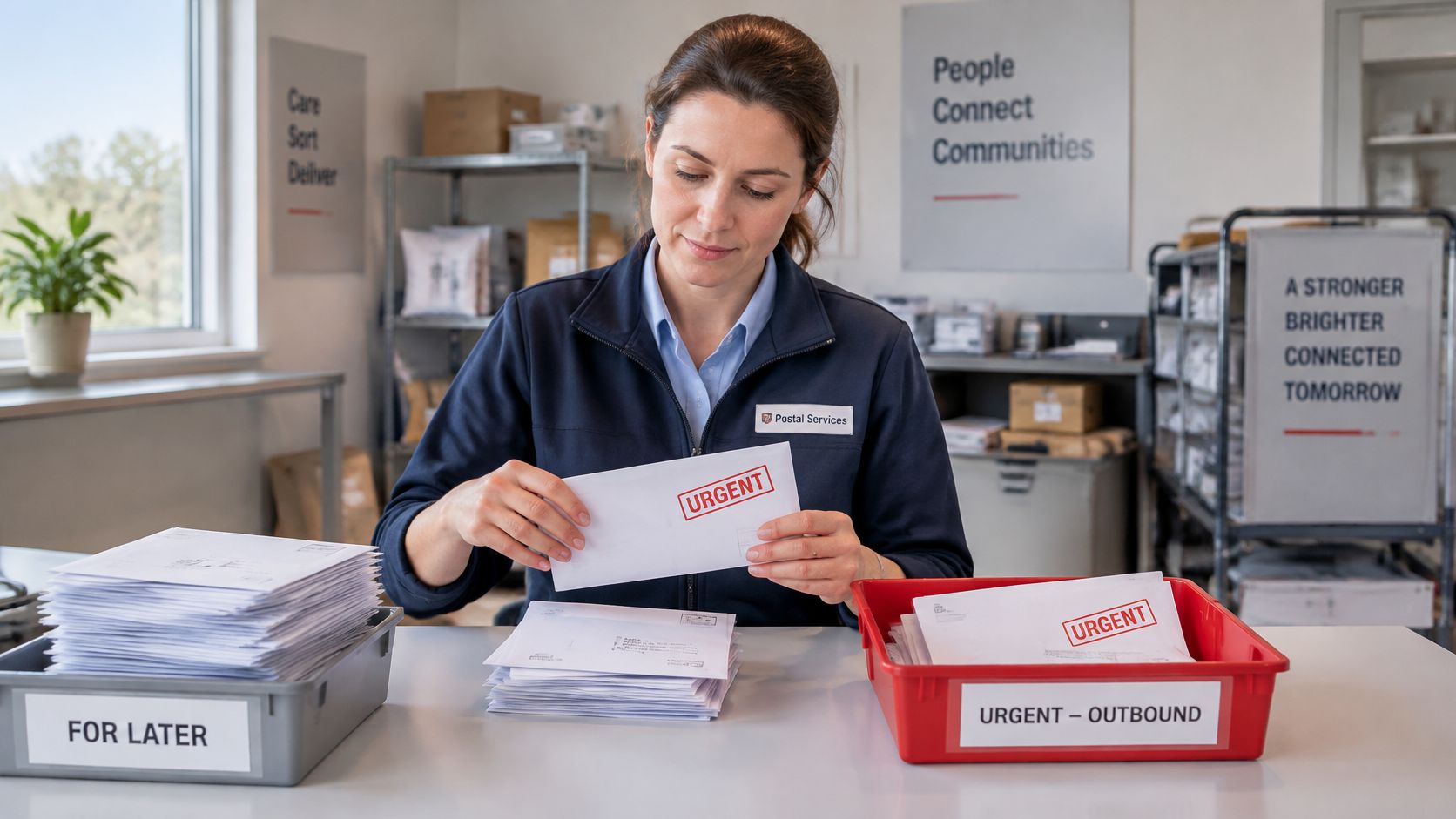
Clinically urgent is the practice's clinical judgement. It isn't determined by which channel the patient uses, how forcefully they request an appointment or whether they arrived before another patient.
The government's explanation of urgent-access requirements describes outcomes including an in-person, telephone, online or video appointment, clinical advice or care, appropriate signposting, or contact to obtain information or explain when further action will occur. That flexibility should support a suitable response, not become a reason to record an acknowledgement as completed clinical care.
Distinguish earlier policy from the contractual duty
The NHS England access recovery plan describes same-day telephone or face-to-face assessment for clinically urgent need, with following-day assessment after afternoon contact where clinically appropriate, and appointments within approximately two weeks for non-urgent needs requiring a consultation.
That earlier afternoon flexibility shouldn't be treated as a blanket exemption from the explicit same-day contractual duty. An operator needs to know which document establishes the current requirement and which describes the earlier recovery model.
For a routine request, a useful response explains the planned action and timing. For an urgent request, the record must demonstrate the appropriate action taken, rather than merely confirm receipt.
Write a patient-facing policy that means something
A practice could use the following wording in its access policy:
We assess requests according to clinical need. If we identify your need as clinically urgent, we will take appropriate action that day. For other requests, we will explain the next step and when it will happen. A same-day response doesn't always mean same-day treatment or a face-to-face GP appointment.
Test that wording against the actual workflow. If staff can't say who reviews a request, who contacts the patient and what happens when contact fails, the policy promises more certainty than the process provides.
The control point is urgency classification at demand, supported by the presenting request, decision, action, time and escalation outcome. First-come allocation can't substitute for that decision.
What the Same-Day Figures Actually Count
A patient can contact the practice today and receive an appointment today, yet still have waited a long time to get through. These are different parts of access, and national appointment figures capture only some of them.
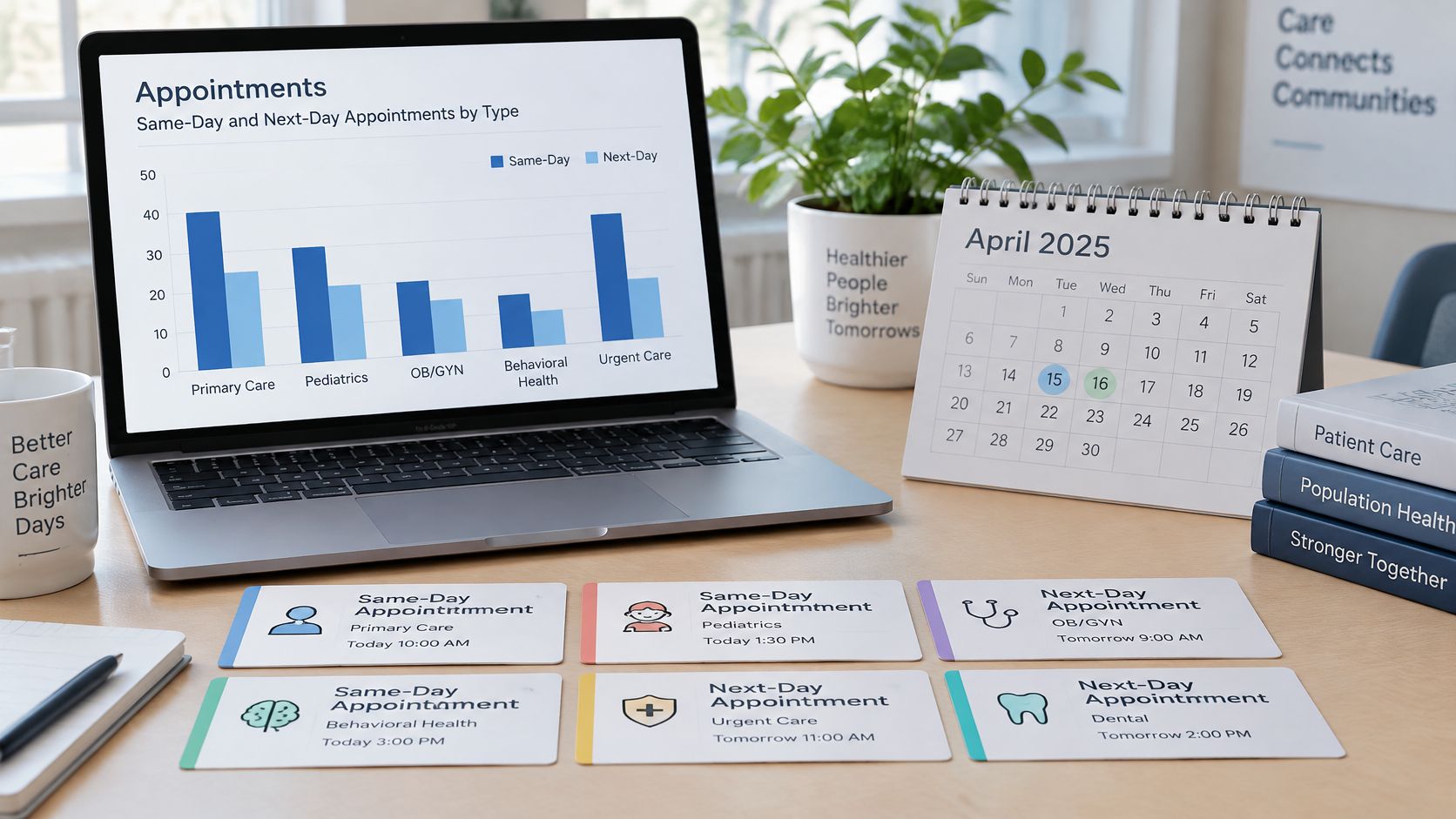
The Nuffield Trust's analysis of access to GP services found that England had approximately 25.2 million appointments per month in 2019, with approximately 42% booked and attended on the same day. These figures describe appointment activity, not how well practices identify urgent need.
Keep each measure attached to its denominator
In the 2024 GP Patient Survey, approximately 27.1% of patients in England said their most recent appointment took place on the day they contacted their practice. A separate NHS England operational performance update reported that approximately 51.6% of appointments in July 2024 took place on the booking day or the following day.
These figures answer different questions. Appointment records count activity; the survey reports patients' experience. Neither shows whether every urgent request was recognised and acted on appropriately.
National same-day figures and what they measure
| Measure | Period | Same day | Two to seven days | Eight to fourteen days | Monthly volume |
|---|---|---|---|---|---|
| Booking-to-appointment interval, England | 2019 monthly average | Approximately 42%, around 10.5 million | Approximately 20%, around 4.9 million | Approximately 14%, around 3.5 million | Around 25.2 million appointments |
| Patients whose latest appointment occurred on their contact day | 2024 GP Patient Survey | Approximately 27.1% of patients | Not reported in this measure | Not reported in this measure | Patient experience measure, not activity volume |
| Appointments on the booking day or following day | July 2024 | Approximately 51.6% combined same-day and next-day, not same-day alone | Not reported in this measure | Not reported in this measure | Not stated for this measure |
The survey starts with the patient's contact. Appointment activity starts with the booking. Neither records how long someone waited to reach the practice before a booking existed.
Look for patients missing from the average
North West London's primary care access report documents local variation in same-day or next-day access. A PCN average can therefore conceal differences between neighbourhoods and contact channels.
Online intake may ease pressure on morning phone lines, while leaving some patients unable to complete the process because of language, disability or limited digital access. Track completion, not just how many people start.
A PCN or ICB dashboard should answer three distinct questions:
- Urgent activity: What share of acute appointments takes place on the same day?
- Other demand: How long until patients receive a clear next step?
- Missing patients: Who abandons contact, is redirected elsewhere or never completes the pathway?
Recording, Metrics and the Safety Trail
Unrecorded reception sorting won't substantiate a same-day access claim. The NHS England consolidated appointment-recording guidance says triage work should be recorded in appointment books under “clinical triage”, whether it happens by telephone, online consultation or another route.
This makes assessment capacity visible and distinguishable from completed consultations. It also supports local planning and monitoring rather than leaving triage hidden within an undifferentiated administrative workload.
Measure delivery and detection separately
The contractual monthly calculation is same-day General Consultation Acute appointments divided by all appointments in that category. Treat this as a delivery measure for recorded acute activity, not proof that every urgent request was detected.
Recommended monitoring KPIs
| KPI | Calculation | What it tells you |
|---|---|---|
| Acute same-day ratio | Same-day General Consultation Acute appointments divided by all appointments in that category, monthly | Same-day delivery within recorded acute activity |
| Urgent cases dealt with same day | Urgent-flagged contacts with recorded same-day action divided by all urgent-flagged contacts | Whether identification converts into action |
| Time to next step, non-urgent | Median core-hours time from contact to a clear next step | Typical response speed, with overdue cases reviewed separately |
| Abandoned contacts | Started but unfinished online requests and calls, by channel | Where patients leave the pathway |
| Redirects to urgent care | Urgent or emergency service redirects divided by triaged contacts | Escalation patterns requiring review |
| Triage recorded as clinical triage | Recorded clinical-triage entries divided by all triage activity | Reporting completeness |
| Channel and cohort split | Requests and completions by channel, age, language and deprivation band | Differences in successful access |
These are monitoring definitions, not additional contractual targets. A median can look acceptable while individual patients wait too long; a redirect rate doesn't establish whether each redirect was appropriate.
Reconstruct the clinical decision
For a red-flag case, the Clinical Safety Officer should be able to retrieve:
- Presentation: What the patient reported and through which route.
- Decision: The urgency classification and who or what made it.
- Action: What happened, when it happened and what the patient was told.
- Escalation: The receiving clinician or service and the recorded outcome.
Name the Clinical Safety Officer and document red-flag handling, failed contact and assisted access. Where software supports or makes clinical decisions, review DCB0129 supplier documentation alongside the practice's DCB0160 deployment assessment; one doesn't replace the other.
GP Triage meets NHS Data Security and Protection Toolkit standards, has completed a DTAC assessment and has DCB0129 clinical safety documentation in place. Those credentials support due diligence, but don't remove local deployment responsibilities.
For an ICB review, I would sample ten urgent and ten non-urgent records as a practical audit exercise. Each should show a decision, a time and a next step, not just an appointment label.
Five Triage Models Against the Duty
A practice can accept requests continuously, respond to them within the required timeframe, and still miss a same-day clinical action if urgent cases are not identified. Compare each model by who assesses urgency, what work remains for staff and how exceptions reach a clinician.
Triage models and the same-day access duty
| Model | Who decides urgency | Manual step that remains | Same-day failure mode |
|---|---|---|---|
| Manual reception triage | Reception staff, using a protocol | Staff handle each contact | Urgent clinical detail may be missed in a telephone queue |
| Manual GP-led triage | A GP | A clinician reads and routes each request | GP capacity is used before an appointment is allocated |
| Form-based online consultation | A staff member reading the form | The inbox is triaged individually | Urgent free text may wait behind routine requests |
| AI-assisted total triage | A human using an AI suggestion | Someone confirms or changes each assessment | The decision queue may move faster, but still needs staff |
| Autonomous AI triage | The system within the practice's safety model | Staff handle exceptions and escalations | Poor configuration or escalation arrangements can leave risk unmanaged |
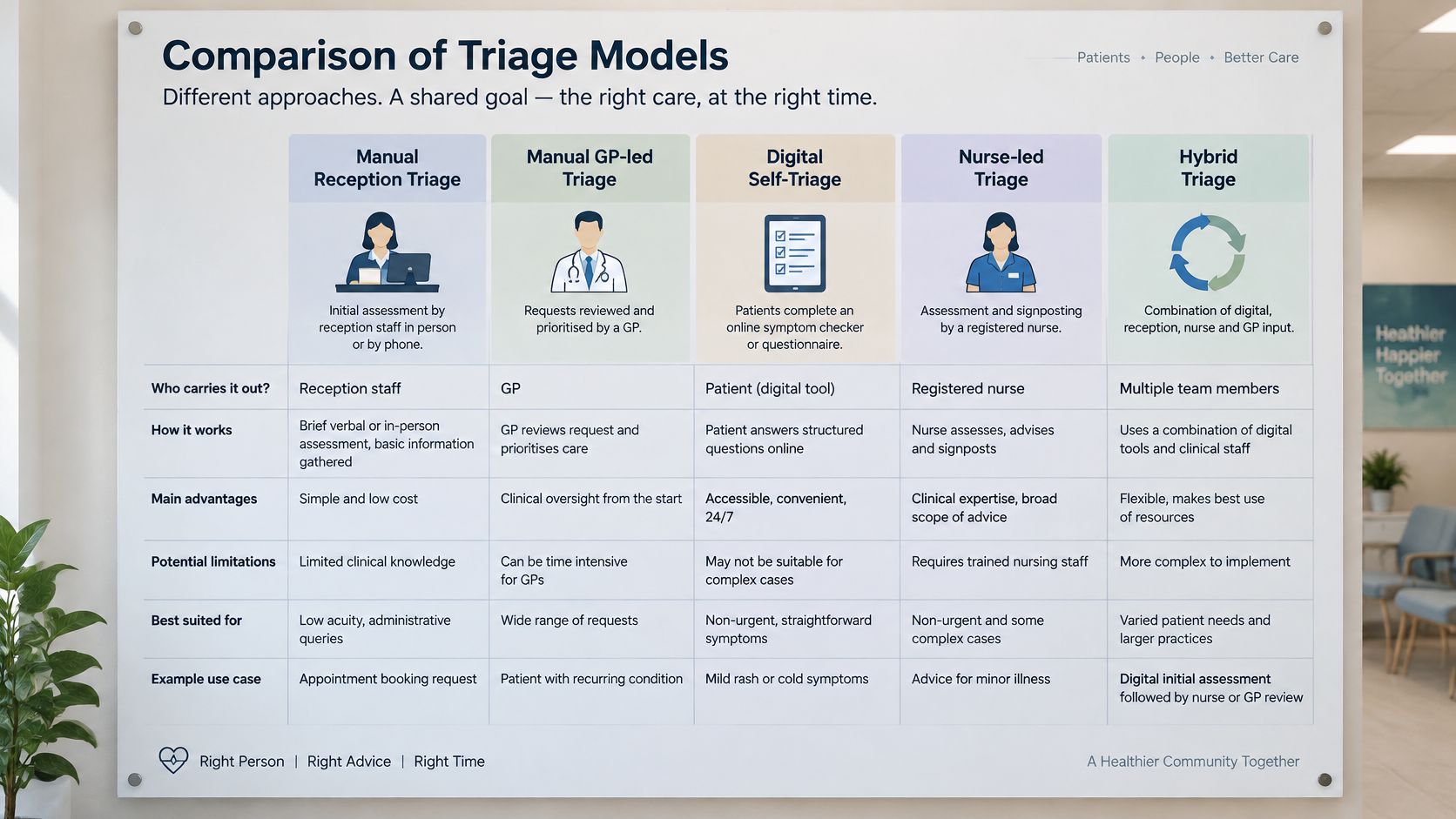
Credit what each model does well
Reception triage can handle straightforward administration and navigation. GP-led triage brings clinical judgement to ambiguous presentations, but uses GP time before care is allocated.
Online forms can collect a more structured history than an interrupted telephone conversation. A person still needs to interpret that history unless the form is part of an automated triage process.
AI-assisted triage structures information and supports a human decision-maker. Autonomous triage removes routine manual assessment within its configured scope; exceptions and escalations still need a clear route to clinical staff.
Test the whole pathway
GP Triage provides autonomous AI-powered triage and booking for NHS primary care. Patients can enter symptoms online, by telephone or with help at reception. The system assesses urgency using established NHS protocols, flags high-priority cases for escalation and can book routine cases without manual admin time. It integrates with GP clinical systems and writes structured triage summaries into the clinical record.
The triage module covers more than 2,700 symptoms, conditions and risk factors. It has performed over 27 million triages with zero critical errors. These figures describe the system's reported track record; they do not replace local decisions about safety arrangements or escalation.
Compare who makes the decision, what happens to exceptions and whether the booking outcome matches the assessed urgency. An intake screen alone does not show how much work remains.
Langton Medical Group in Lichfield, with approximately 14,000 patients, removed 30 hours of GP-led triage a week, equivalent to four GP sessions, five months after going live with GP Triage. The practice saved around £163,000 a year without expanding its team. This is one practice's result, not a forecast for others; demand, staffing and appointment rules affect what another practice may achieve.
A Core Hours Compliance Checklist
The NHS England online-consultation FAQs describe the requirement applying from approximately 1 October 2025: online tools remain available throughout core hours for non-urgent appointment requests, medication queries and administration. They distinguish an appropriate response explaining how the request will be handled from a same-day or next-day consultation.
The Modern General Practice model supports a unified navigation process across telephone, online and walk-in access, with structured information collected at contact. Use that as the operating design, rather than creating separate priority rules for each doorway.
Take this routine to the partners' meeting
Publish the access arrangements. State core hours clearly and keep telephone, walk-in and online routes available together. Check that website wording, recorded telephone messages and reception notices agree.
Remove numeric online caps. Test appointment, medication and administrative request routes separately. An open homepage is insufficient if the actual submission pathway closes.
Use one navigation process. Collect comparable information whether the patient types it or a member of staff records it. Arrival at reception shouldn't confer clinical priority.
Classify before allocating. Agree urgency rules, red flags and immediate escalation responsibilities. Staff need a workable route for uncertainty, not pressure to guess.
Record the response. Urgent cases need documented same-day action. Other patients need an explanation of the next step, including the intended timing where a consultation is required.
Remove the restart instruction. If an appointment can't immediately be offered, retain responsibility for the request. Tell the patient who will act and how they will hear.
Make triage reportable. Use the clinical-triage category in the appointment book. Reconcile activity that otherwise remains in message lists or reception notes.
Protect assisted access. Name the route for patients who abandon forms, need language support, have a disability or can't get through by telephone. Review successful completion, not just attempted contact.
Match staffing to demand. Use daily contact patterns to adjust rotas and appointment supply. When measuring released time, separate GP-led triage from reception and administrative time; use operational hours if the split is unknown.
Agree the full-capacity response. Identify the responsible clinician, alternative service and patient communication when urgent capacity is exhausted. If using automated booking, test practice-configured rules and the triage summary reaching the booking record.
Close the review loop
Review the acute same-day ratio, urgent cases without documented action and abandoned contacts monthly. Give each exception an owner and a corrective action; a dashboard without follow-through is only a retrospective count.
Common Pitfalls and Mitigation
Most failures occur between steps rather than at the point of submission. Assign each mitigation to a named role and review outstanding actions at the governance meeting.
Opening intake without supervising it. An uncapped queue can still be unread. Give the duty owner scheduled checks of outstanding urgent flags, alongside immediate red-flag escalation that doesn't wait for a sweep.
Prioritising arrival order. A walk-in shouldn't automatically displace a more urgent telephone request. Apply a common urgency process across routes.
Counting all same-day activity as urgent access. Routine appointments can inflate the headline. Review acute activity and urgent-contact outcomes separately.
Sending patients back to the beginning. Replace ring-again instructions with an explicit next step. Record who owns the follow-up.
Hiding assessment within administration. Reconcile triage activity with appointment-book entries. The reporting owner should investigate missing records.
Treating PCN averages as equitable access. Split completion and response measures by neighbourhood, channel and cohort. Investigate differences before assuming patient preference explains them.
Discovering the escalation rule when capacity runs out. Agree the clinician, service and communication route beforehand. Make it configurable to the practice's safety model, rather than relying on whoever happens to be available.
Making digital access the only workable route. Keep telephone and in-person assistance operational. Name who follows up patients who struggle to complete the pathway.
Governance test: Every exception should end with an accountable person and an action, not merely a discussion in the minutes.
Judge the Model Before You Change It
Start with the failure you need to remove. A practice with unclear ownership may benefit more from a disciplined handover than from replacing its intake system. A practice whose clinicians still review every routine request has a different, structural workload problem.
Ask what remains dependent on manual review
- Can an urgent case wait behind unread routine requests? If yes, the pathway still depends on someone reaching it in time.
- Is GP time spent deciding where requests go rather than dealing with the urgent cohort? Check the appointment book and actual work, not the supplier's description.
- Can you show an auditor the decision, the time and the next step? If not, improve the record as well as the response.
Manual, form-based and AI-assisted approaches can be sensible earlier steps. Their limit is that a person still makes each routing decision. Autonomous triage changes that dependency, but it doesn't remove the practice's responsibility for configuration, escalation, capacity or assisted access.
Judge the proposed model against realistic adult and paediatric requests, an exhausted appointment book and a patient who needs help completing the process. The useful end state isn't fewer clicks. It's less routine manual triage with a demonstrable next step and an auditable safety pathway.
GP Triage offers autonomous AI triage and booking for NHS GP practices across the UK. Practice managers, GP partners, PCN and ICB digital leads can visit GP Triage to book a free demo and test the patient flow against their own safety model, same-day escalation arrangements and appointment rules.