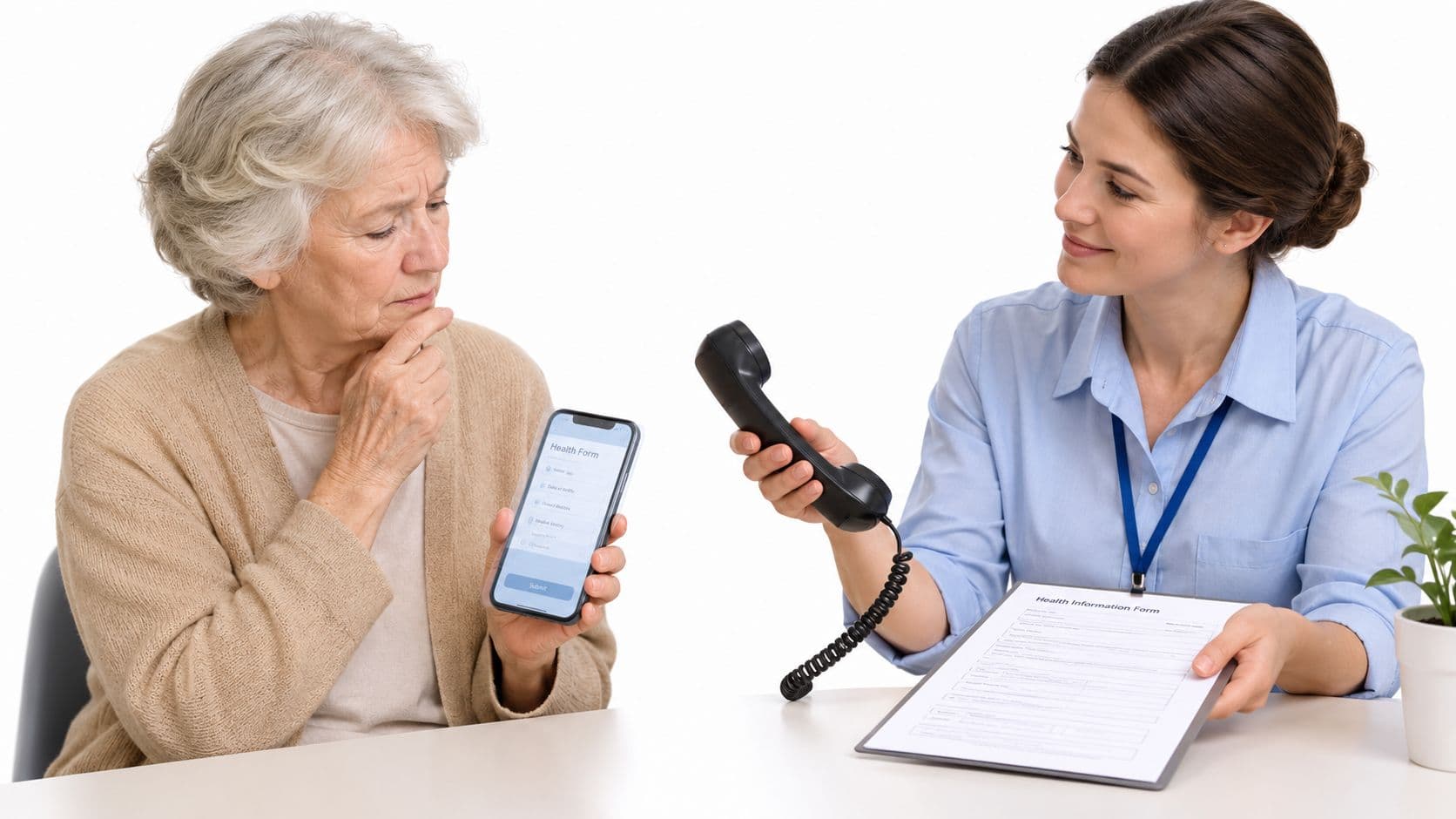
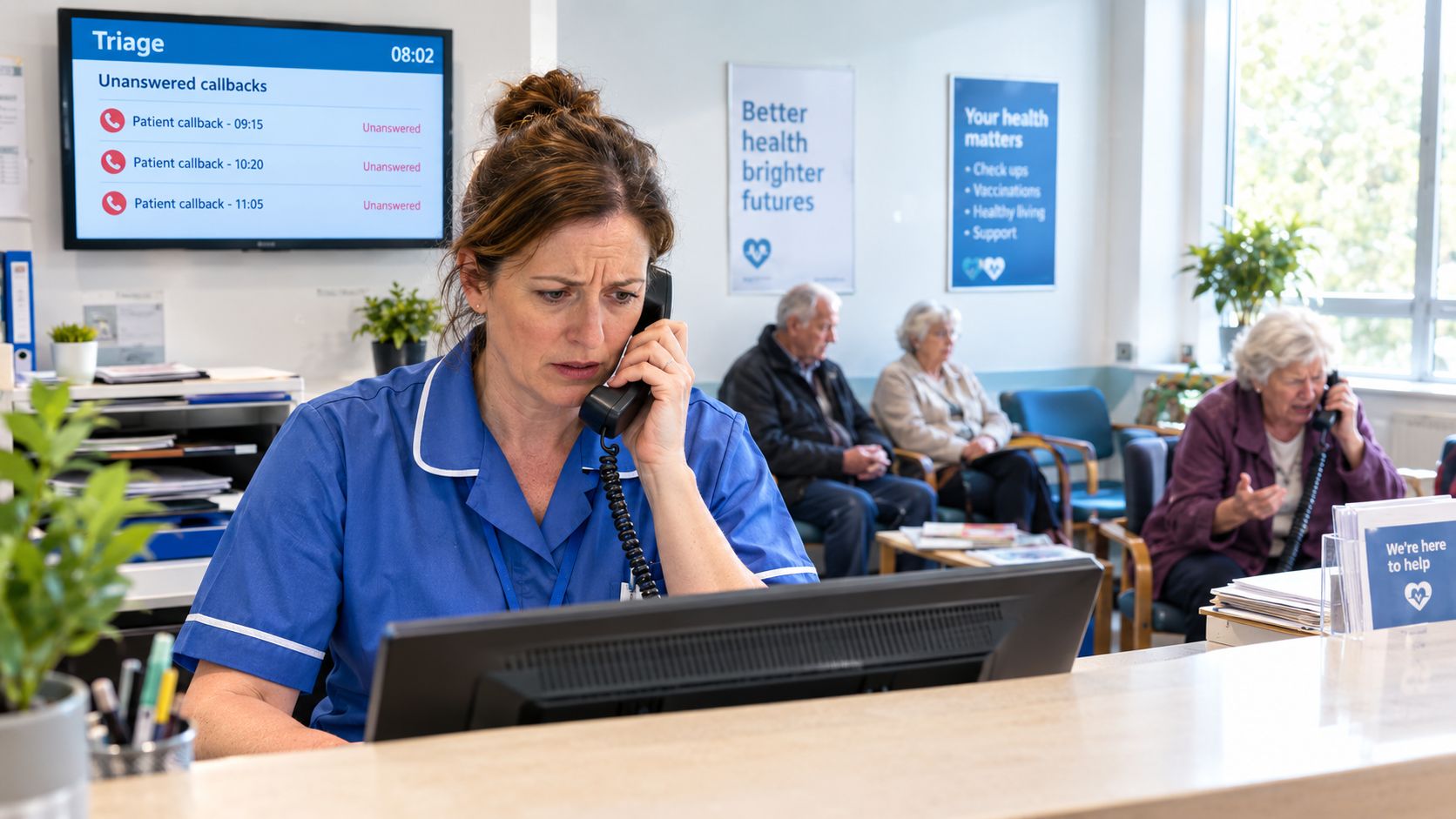
At 8:02 on a Monday morning, the practice phone queue is already filling. A patient who can't use the online form waits for an answer while another patient abandons a symptom questionnaire halfway through. Both requests may be clinically important, but the system can only prioritise what it successfully receives.
That's the central problem in understanding how digitally excluded patients use online triage. Digital exclusion isn't limited to having no broadband or smartphone. It also includes the patient who owns a device but can't interpret a symptom list, the person who can't write confidently in English, and the older adult who becomes lost when a form asks for information in an unfamiliar sequence.
Online access can widen the front door to primary care. Used as the only front door, it can become a filter. The practical task for practices is to build a hybrid pathway in which online triage adds capacity without making digital confidence a condition of receiving care.
TLDR: Digitally excluded patients do use online triage, but many struggle to complete it because of language, literacy, disability, low confidence, poor connectivity or clinical complexity. Practices should treat online triage as one access route, not the only one, and keep telephone, in-person and assisted options visible and easy to use.
What Monday Morning Looks Like for a Digitally Excluded Patient
At 8:02am, Margaret, aged 78, starts calling her practice. She has her repeat prescription list beside her and a note about worsening breathlessness. The recorded message tells her that online requests are available. She stays on the line.
At 8:20am, after approximately 18 minutes, the call drops. Margaret tries again, then walks to the practice. The reception area smells of wet coats and disinfectant. The queue moves slowly. When she reaches the desk, she's told that she should have completed the online form.
Margaret isn't refusing digital access. She's unable to make the route work at the point when she needs care. The distinction matters. A person may have a phone and still lack the confidence, dexterity, vision, language skills or concentration required to complete a structured clinical request.
The form captures some patients better than others
Later that morning, Yusuf, aged 34, completes the practice form. English isn't his strongest language. He understands that something feels wrong, but the free-text box asks him to describe the problem in his own words. He can't explain the chest tightness clearly, so he selects “other” and submits a short description.
The form has accepted the request, but acceptance isn't the same as understanding. A clinician or receptionist must still recognise what the patient meant, particularly when the wording is vague or the symptom doesn't fit the options offered.
The historical NHS evidence is clear that uptake isn't equal. In a UK evidence brief on telephone and digital triage, online consultations represented approximately 16% of patients in deprivation quintile 1, compared with approximately 20% in quintile 2, 22% in quintiles 3 and 4, and 21% in quintile 5, with the difference reported as statistically significant (UK evidence brief on mitigating inequalities in telephone and digital triage).
Operational rule: If a patient can't complete the digital route, the practice still owns the access problem.
When online triage becomes the default front door without a credible parallel route, the practice isn't designing access. It's designing a filter. The patients most likely to fail that filter may also be older, disabled, socially excluded, less confident with written language or living with complex health needs.
Who Counts as Digitally Excluded in Primary Care
Digital exclusion has two components: connectivity exclusion and capability exclusion. Connectivity exclusion covers the absence of a suitable device, dependable internet access or enough data. Capability exclusion affects patients who have the equipment but cannot use it reliably for a clinical task.
That distinction matters in practice. Local evidence from east London found that approximately 93% of respondents had an internet-capable device and approximately 91% had home internet, yet approximately 16% were still classified as digitally excluded because they lacked access or did not know how to use the internet (Healthwatch evidence review on total triage and digital exclusion). A device and a connection therefore provide no assurance that a patient can complete online triage safely.
Capability is a clinical access issue
Capability can be affected by several practical factors:
Language and literacy: A patient may follow spoken explanations but struggle with written clinical terms.
Cognition and concentration: Pain, anxiety, frailty or illness can make a long sequence of questions unmanageable.
Disability: Small text, weak contrast, limited dexterity or reliance on assistive technology can interrupt completion.
Digital confidence: An unfamiliar login, identity check or upload request may stop the patient before clinical information reaches the practice.
Carer dependency: An unpaid carer may manage access but be unavailable when symptoms begin.
Clinical complexity: A patient living with several conditions may not know which symptom category best describes the immediate concern.
The east London evidence found that digitally excluded respondents were more likely to be older, disabled, in poorer health and from Black or Asian ethnic groups. That combination creates an equity risk. Patients who need a route that accepts uncertainty may have the greatest difficulty expressing their problem in the format that route requires.
Build for the groups already in your list
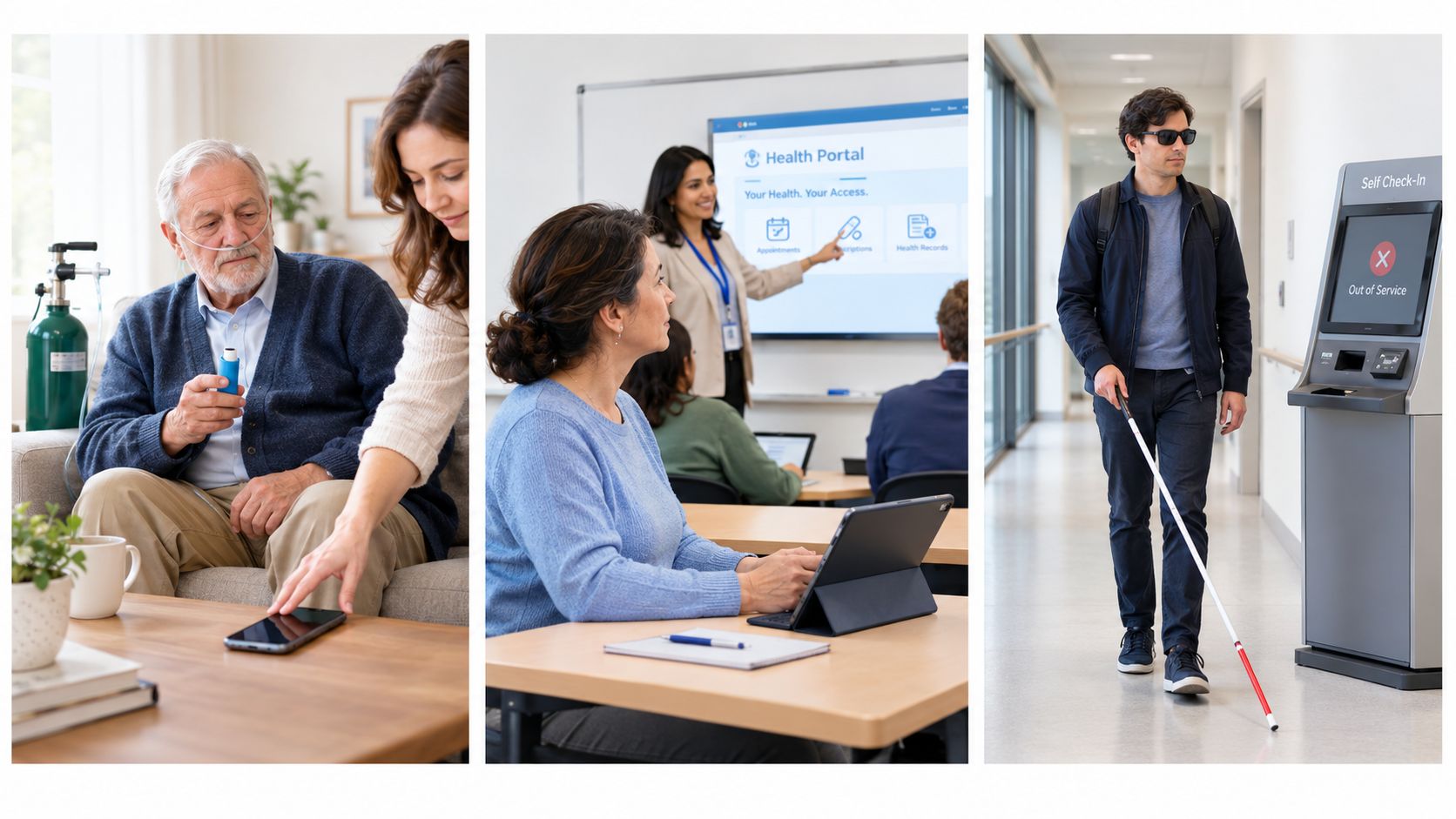
Expect digitally excluded patients among older adults, people with learning disabilities, adults with low literacy, non-English speakers, unpaid carers, housebound patients and people who feel anxious about digital tools despite owning a suitable device.
Every access channel excludes somebody. Tablets may address device availability but do not solve comprehension. Plain language can reduce cognitive load but cannot help a patient without connectivity. Translation may improve understanding, yet a human route remains necessary when the patient's description is still uncertain.
NHS-linked guidance recommends keeping telephone and in-person access available for patients who cannot use digital tools, rather than making online access compulsory (NHS digital inclusion evidence signpost). This is part of safe access design. Autonomous triage can handle clear, suitable requests while parallel routes give higher-need patients a way to reach staff when capability, confidence or clinical complexity prevents completion.
The Six Barriers Online Triage Creates for Excluded Patients
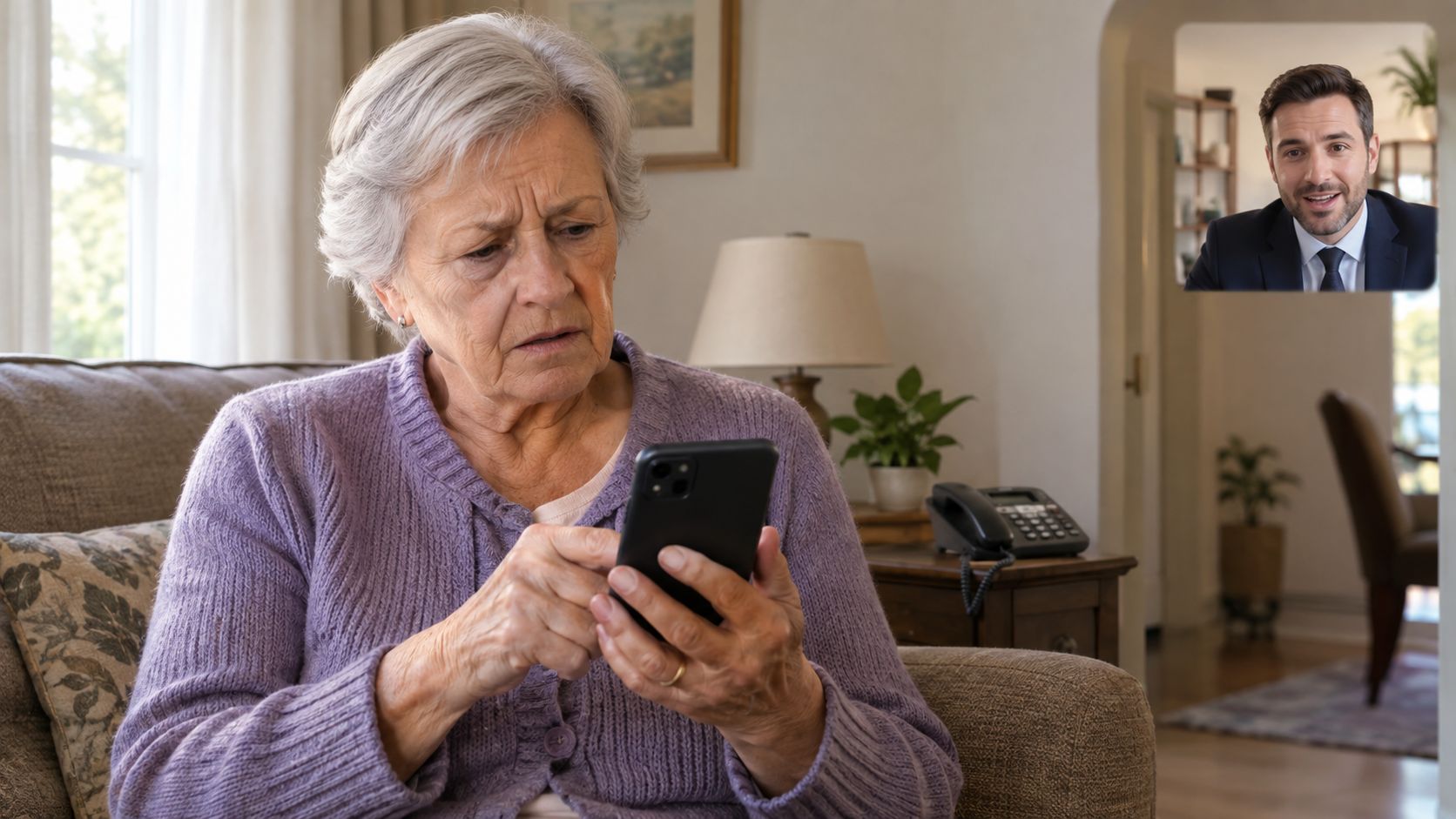
A patient can own a smartphone and still be unable to complete online triage safely. Healthwatch reported that people with low digital literacy or language barriers struggled with online booking and consultation systems. Many felt excluded at the booking stage and stopped trying to access care (Healthwatch report on digital exclusion).
The barriers below are practical failure points documented in patient-facing research.
| Barrier | Who it hits hardest | Failure mode |
|---|---|---|
| Form-first access | Older patients, people with disabilities and patients without reliable connectivity | The phone or walk-in route becomes a fallback, so the patient waits, abandons the request or arrives without a recorded clinical summary. |
| Complex wording | People with low literacy, cognitive impairment or limited English | The patient selects an incorrect symptom pathway or misunderstands an urgency question. |
| Free-text descriptions | Non-English speakers, people with low literacy and patients in distress | The patient cannot describe the symptom accurately, leaving staff to interpret an incomplete account. |
| Mandatory identity fields | Patients without confidence using digital identity tools, carers acting for others and people with unstable circumstances | The request stops before clinical information reaches the practice. |
| Synchronous response expectations | Housebound patients, unpaid carers and people without daytime device access | The patient misses a message, cannot respond promptly or assumes no response means no care. |
| Prioritisation based on concise narratives | Patients with vague, complex or poorly expressed symptoms | A serious complaint may appear less urgent because the patient's wording is incomplete or non-specific. |
The form-first default
NHS England's online consultation toolkit advises practices to avoid assuming that online-first access suits every patient. People unsuitable for an online consultation should retain direct or fast-track access to face-to-face or telephone appointments (NHS England online consultations implementation toolkit).
A form-first route can support safe triage when alternatives remain visible, staffed and usable. The risk rises when the form becomes the only accepted entry point. Autonomous triage can process clear, suitable requests, while a parallel phone or in-person route protects patients whose capability, confidence or clinical complexity prevents completion.
Language is part of clinical safety
A webpage may meet technical accessibility standards and still fail clinically. Long dropdowns, ambiguous symptom labels and compulsory free text require patients to translate their experience into the practice's categories, often while unwell or distressed.
Practical guidance on digital journeys for older patients is available in this resource on accessibility for older adults. The test is whether the patient can complete the clinical task accurately, without guessing or relying on another person to interpret each question.
Practices should reduce avoidable interpretation work rather than remove clinical questioning. Plain language, short pathways, clear urgency prompts and a visible human route give autonomous triage better information and give staff a safer opportunity to identify uncertainty. That design treats digital exclusion as a capability and service-design problem, with parallel access routes preventing the highest-need patients from being filtered out.
Three Patient Journeys That Show Where Access Breaks Down
These composite journeys reflect predictable points of failure in digital-first intake.
Margaret abandons the form
Margaret has COPD and relies on her daughter to manage her phone. Her daughter is at work when Margaret's breathlessness worsens. Margaret opens the website, finds the text difficult to read and reaches a mandatory free-text field. She can't explain what has changed, so she closes the browser.
The system lost her at the point where it required independent reading and written description. The safety risk is that a patient with a potentially important respiratory change never enters the practice's triage queue. She eventually redials at approximately 8:30am and reaches the practice by telephone.
That route catches her, but only because she persists. A different patient may not.
The wrong dropdown changes the story
A 40-year-old patient with low health literacy reaches a long list of conditions. The patient chooses the closest label rather than the most clinically accurate one, then answers the severity question on the basis of what the label appears to mean.
The system loses the patient at categorisation. A routing decision built on the wrong category can make the complaint look less urgent than the patient's actual condition. In this journey, there's no reliable safety net unless the form asks follow-up questions that uncover the discrepancy or a staff member reviews the submission carefully.
The problem isn't that the patient failed to follow instructions. The form demanded a level of classification the patient didn't possess.
The language barrier becomes an abandoned request
An asylum seeker whose first language isn't English opens the form and encounters clinical terms that don't map easily onto everyday speech. The patient tries to continue, but the questions become harder to interpret. After reaching the free-text stage, the patient abandons the request and doesn't call.
The system loses the patient at comprehension, with no alternative handoff. The safety risk is delayed care. The patient presents approximately 11 days later in a worsening state. That delay is not proof that the form caused the deterioration, but it shows how a failed digital route can leave no visible record for the practice to act on.
These aren't unusual technical glitches. They're the predictable output of a design that measures completed forms rather than patients who started, struggled and disappeared.
Comparing the Alternative Access Channels
No single access channel works well for every patient or every demand pattern. The safer model is a portfolio in which online triage sits beside telephone, walk-in, receptionist-assisted entry and community support.
| Channel | Equity | Clinical safety | Operational load |
|---|---|---|---|
| Telephone | Familiar for many patients and useful for spoken clarification, but difficult for some people with hearing loss, anxiety or limited language confidence | Allows a human to identify uncertainty, although queues and rushed conversations can affect the initial account | Can create concentrated demand at opening time and requires sufficient call-handling capacity |
| Walk-in | Builds trust and helps patients who can't use digital tools or reach the phone | Staff can observe distress and clarify the request, but unmanaged queues can delay assessment | Visible and resource-intensive, particularly during busy periods |
| Receptionist-assisted digital entry | Helps patients with capability barriers while preserving structured information | A receptionist can clarify the patient's account and seek urgent help when appropriate, within the practice's safety model | Depends on trained staff, suitable space and protected time |
| Community navigator | Can reach patients who distrust or can't use practice routes | Provides supported access, but the navigator isn't a substitute for clinical assessment | Extends reach but relies on local partnerships and coordination |
Match the channel to the barrier
Telephone access is familiar, but familiarity doesn't make it universally equitable. Patients with hearing loss, anxiety or limited spoken English may find a phone queue and a pressured conversation harder than a carefully designed digital route.
Walk-in access offers immediacy and human contact. It can also move an invisible queue into the reception area, where staff must manage demand without allowing the presence of a queue to become a substitute for clinical prioritisation.
Receptionist-assisted entry is often the most direct response to capability exclusion. The patient speaks, the receptionist records the request, and the patient can review the information and consent to its use. That approach protects the patient's voice, but the practice must define who provides assistance and how urgent symptoms are escalated.
For patients who need communication support during consultations, practices may also consider tools such as real-time captions for medical visits. This addresses communication during the appointment, not the whole access pathway, so it should complement rather than replace assisted booking.
Community navigators can reach people who don't engage with the practice's digital or telephone routes. Their limitation is operational rather than conceptual. The practice needs time to establish referral arrangements, clarify responsibilities and ensure that a navigation referral doesn't become an unmonitored clinical queue.
What GP Practices Can Do Differently
The first change is public and simple. Put a clear non-digital access promise on the practice website, in waiting-room materials and on text reminders. Patients should know that telephone and in-person routes remain legitimate ways to request care, not penalties for failing to use the form.
Remove avoidable friction
Review the online pathway from the perspective of someone who is unwell, using a small screen and reading in a second language.
Reduce mandatory fields: Keep only the information needed to make the next safe decision.
Use plain-language labels: Replace internal terminology with wording patients use themselves.
Make urgent routes visible: A patient with worrying symptoms shouldn't have to complete a long form to find emergency advice.
Offer assisted completion: Let a receptionist submit the request while the patient explains it aloud, then allow the patient to review and consent.
Record preferred access needs: Keep communication preferences visible so the next contact doesn't recreate the same barrier.
NHS guidance says reception staff should support patients who can't access digital tools, and Healthwatch has warned against presenting online access as the only route (NHS digital inclusion evidence signpost). The policy only becomes real when reception teams have a script, authority and time to provide that support.
Treat abandonment as a signal
An incomplete request, repeated visit to the same page or failed submission should be treated as a potential access event, not a missing data point. Where the practice uses AI-assisted intake, it can configure the workflow to identify these signals and create a human follow-up process, provided that the arrangement is clinically governed and compatible with the practice's safety model.
Autonomous AI triage changes the operational question. Instead of asking a clinician or receptionist to review every submitted request, the system can assess the request, determine the appropriate route and book within the configured pathway. GP Triage, an autonomous AI triage and booking platform using Infermedica as a Class 2B medical device, supports adult and paediatric presentations and pushes a triage summary into the booking record.
To date, the platform has processed approximately two million triages with zero recorded clinical safety incidents to date, with around 97% concordance with GP decision-making, using the approved safety and regulatory wording (GP Triage). Those figures don't remove the need for parallel routes or local governance. They show why practices should assess the whole operating model, including how patients enter when they can't use the web route.
Audit the route, not just the queue
Review access data monthly. Look at which channels patients use, where requests stop, how many people need assisted entry and whether complaints or missed contacts cluster around a particular route. Combine this with safeguarding reviews, urgent care feedback and patient participation input.
The question is not, “How many online forms were completed?” It's, “Who tried to get through, who disappeared, and what did the practice do next?”
Designing Triage That Protects the Highest-Need Patients
A practice should judge its triage design by what happens to the patient most likely to fall out of the system, not by the average experience of confident digital users.
Three tests are useful:
Red flags must be catchable through every entry mode. The safety model should allow urgent concerns to surface whether the patient starts online, by telephone, at reception or through supported access. A failure here can mean a missed emergency presentation or delayed escalation.
Patients need a human handoff in a language and format they can use. A form that records incomplete answers without offering clarification can lose the clinical story. The consequence may be a missed safeguarding concern or an avoidable delay.
Complex patients need continuity, not repeated categorisation. Where a patient's needs are already known to the practice, the route should avoid forcing them to reconstruct their history in a new form. Fragmented care is a design failure, even when each individual transaction appears complete.
The right operating model is therefore not online-only, and it isn't manual-by-default either. It combines accessible digital intake, telephone and in-person alternatives, assisted completion, clear escalation and ongoing review of excluded groups. Configure autonomous triage to widen the front door, while keeping human routes open for patients who need support.
See how GP Triage can support autonomous triage and booking alongside parallel telephone and in-person access routes. Visit the platform to discuss your practice's patient mix, safety model and operational requirements.