
Some results take months to show. With GP Triage, the impact of autonomous triage is visible in weeks.
Swanscombe serves a registered population of around 37,000 patients. Four weeks after going live on GP Triage, the practice had returned more than 422 hours of clinical and admin time to its team, booked over 5,000 appointments without a clinician touching a single form, and seen patient adoption climb week on week. Here's how.
A large list, rising demand, finite hours
A practice of 37,000 patients generates an enormous volume of daily contacts. Under a manual model, every one of those requests has to be read, understood, prioritised and routed by a person — a GP reviewing a form, a receptionist sending a booking link, someone making a call back. That work is invisible in the appointment figures, but it consumes hours of clinical and admin time every single day.
The question Swanscombe faced is the one facing most practices right now: how do you keep up with rising demand without simply asking already-stretched people to do more?
The results, four weeks in
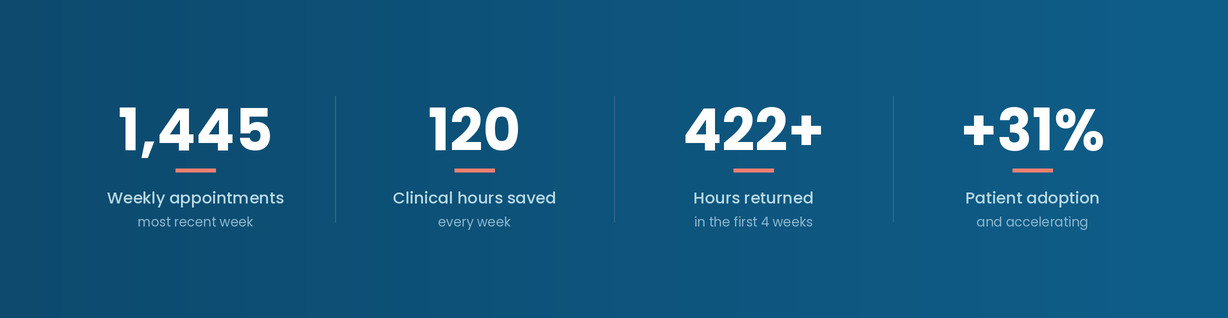
- 120 clinical and admin hours saved — every week. In its most recent week live, GP Triage processed 1,445 patient requests autonomously. At the NHS benchmark of five minutes per manual triage and booking act, that's 7,225 minutes — 120 hours — returned to the practice in a single week.
- 5,068 appointments booked autonomously in the first four weeks. That added up to over 422 hours of clinical and admin time returned since go-live — the equivalent of more than ten full working weeks of staff time, recovered in just four.
- Weekly appointment volumes grew 31% over the four weeks, rising from 1,104 to 1,445. The trajectory is upward, and the pattern is self-reinforcing: the more patients use GP Triage, the more clinical time is freed for direct care.
- Online patient access more than tripled — from 8% to around 26% of the list. Swanscombe's previous online system was used by only about 8% of registered patients each month. On GP Triage that has climbed to around 26% — clear evidence that patients adopt online access readily when it's this fast and easy to use.
Clinicians start the day with patients, not paperwork.
What this looks like over a year
The early numbers are striking, but the annual picture is what makes the case. Annualised at the current rate, GP Triage is on track to return over 6,200 hours of clinical and admin time to Swanscombe Health Centre every year — the equivalent of more than three full-time members of staff. Every year.
Want to see what autonomous triage could return to your practice? Book a demo here.
Figures from the GP Triage platform dashboard, weeks commencing 23 February to 16 March 2026. Time savings based on the NHS benchmark of five minutes per manual triage and booking act; annualised projection based on the most recent weekly volume of 1,445 appointments.