
Most digital triage case studies compare a practice to itself before and after go-live. Nuneaton & Bedworth PCN offers something harder to argue with: the same eleven practices, the same month of the year, measured against the provider they used before — and against GP Triage a year later.
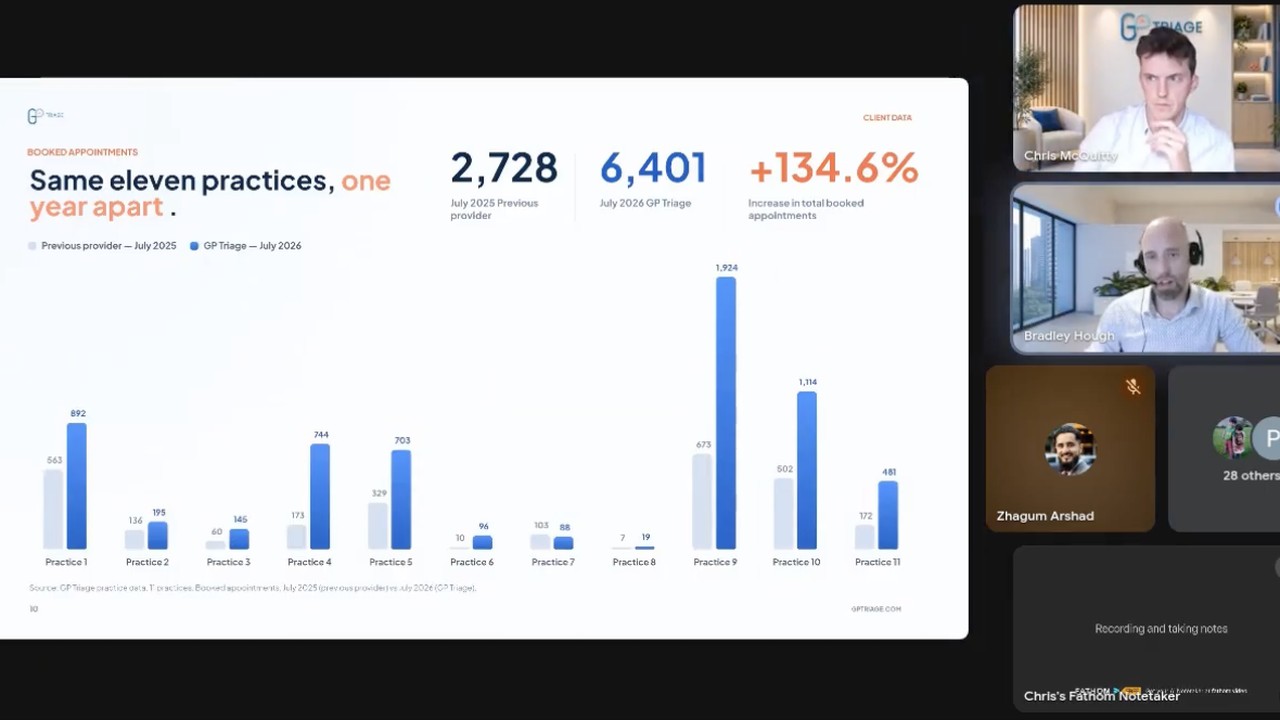
The result? Booked appointments more than doubled. +134.6%, same eleven practices, one year apart.
The headline: 2,728 → 6,401
In July 2025, the eleven practices of Nuneaton & Bedworth booked 2,728 appointments through their previous provider. In July 2026, the same eleven practices booked 6,401 through GP Triage — a 134.6% increase in booked appointments.
This isn't a comparison flattered by new practices joining or a quiet month chosen for effect. It's a like-for-like, month-on-month, provider-on-provider comparison across the whole network. Ten of the eleven practices grew; several multiplied their booked volume several times over. One practice went from 673 booked appointments to 1,924 — nearly a threefold jump — in twelve months.
When a whole PCN routes more than twice the volume through a new front door, patients are finding it, using it, and getting booked. That is the single clearest signal that autonomous triage is working as designed.
A full year of scale
Across the last twelve months, the eleven practices have, through GP Triage:
- Booked 31,748 appointments autonomously
- Handled 16,497 admin requests
- Completed around 99% of those admin requests — with only a tiny fraction still in progress at any time
Demand held steady and high all year. Monthly booked volumes sat in the thousands from late spring onward, and admin requests tracked alongside them — the two streams the platform absorbs so that reception and clinical teams don't have to.
The booking engine that doesn't drop the ball
Scale is only worth having if it's reliable. Across roughly 31,750 bookings, the platform recorded fewer than 90 booking failures in total — and failure tracking only began on 18 September 2026, so that figure covers the busiest, most recent stretch. The largest practice had over 10,000 autonomous bookings in the same time period.
For a system booking patients directly into live clinical diaries across eleven practices, that is an exceptional reliability record — and it's the kind of operational detail that reassures a cautious partner far more than a headline growth figure alone.
Built for a PCN, not just a practice
Nuneaton & Bedworth didn't only use GP Triage as eleven separate front doors. They used it to power a shared PCN hub — pooled capacity that any of the practices can route demand into.
Monthly hub bookings grew from 923 in January 2026 to 1,069 in August, climbing steadily with no additional administrative burden on the practices feeding into it. And crucially, 24.1% of all hub bookings were enhanced-access slots — evening and weekend capacity, actually used. The hub isn't just absorbing overflow; it's unlocking the extended-hours capacity that so often sits half-empty because patients never find it.
Access for the whole population
A recurring worry about digital access is that it works for the young and digitally confident and leaves everyone else behind. The year's demographic data says otherwise. Bookings came from every age band, peaking among patients aged 31–45 but with strong representation right across the spectrum — including more than 1,800 bookings from patients aged 76 and over.
And it isn't only acute, same-day demand. The triage mix spans semi-urgent, urgent and non-urgent appointments, emergency (999) escalation where needed, physiotherapy, medication reviews, cervical smears and mental health — a genuine front door for the full breadth of primary care, including the preventative and routine work that keeps a population healthy.
What this means in practice
The pattern across Nuneaton & Bedworth is consistent at every level we look. Year-on-year, bookings more than doubled against the previous provider. Across the year, the platform absorbed over 48,000 combined appointments and admin requests. Reliability held at well over 99%. Enhanced-access and hub capacity filled up. And patients of every age used it.
This is what autonomous triage looks like once it's embedded across a whole PCN: not a pilot, not a novelty, but the default way an entire network manages demand — safely, consistently, and at scale.
Hear it from the PCN
We sat down with Brad Hough, Digital Transformation Lead at Nuneaton & Bedworth PCN, to go deeper on how autonomous triage has changed the way all eleven practices manage access — what worked, what they learned, and where it's heading next.
▶ Watch the full conversation with Brad Hough
Want to see what autonomous triage could do across your PCN? Book a demo here.
Data source: GP Triage platform data, eleven Nuneaton & Bedworth practices. Year-on-year comparison: booked appointments, July 2025 (previous provider) vs July 2026 (GP Triage). Full-year figures cover the trailing twelve months.