
In late October, Silicon Practice (Schappit Ltd) entered administration and stopped trading. NHS England estimates that just under 500 practices across England and Wales were affected. Many lost their website, their FootFall online consultation service and their chatbot, often with little or no warning.
For the practices involved, this isn't an IT inconvenience. Requests that used to come in online are now landing on already busy phone lines and reception desks. Teams are spending time on workarounds that should be going to patients.
We know many of the people affected. They're colleagues across primary care, and we want to help where we can.
First steps for affected practices
This guidance applies whichever supplier you choose. Aim for continuity first, and don't rush a long-term decision.
Tell patients how to reach you now. Post up-to-date phone, opening-hours and urgent-care details through SMS, social media, your phone message and notices in the practice.
Check for missed requests. Some forms submitted just before the shutdown may not have reached you. Remind patients to call if they haven't heard back.
Work out what you've actually lost. It may be your website, your online consultation route or both. Each needs a different fix.
Get a simple holding page live. A basic page with contact details, opening hours, prescription information and links to NHS services gives you breathing room.
Talk to your ICB digital team. Many ICBs are coordinating support and can advise on approved suppliers and procurement routes.
Choose a replacement carefully. Look at clinical safety, information governance, integration with your clinical system and the supplier's long-term stability.
How autonomous AI triage can help
Replacing FootFall with another online form fixes the access problem but not the workload problem. GP Triage is an autonomous AI triage and booking platform. It doesn't just collect patient requests; it triages them and books them.
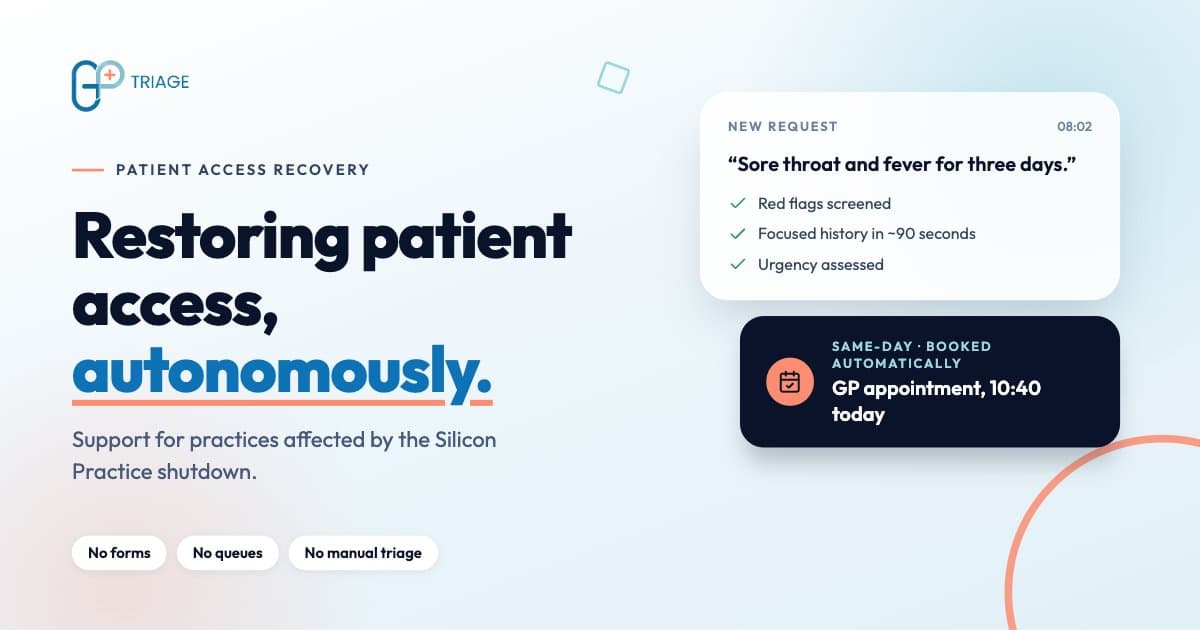
A static form brings a flood of requests that a GP or receptionist still has to read, triage and book. GP Triage removes that step. In around 90 seconds, the AI takes a focused history, asking follow-up questions based on each answer, just as a clinician would. It screens for red flags, assesses urgency, and then books the patient straight into the right appointment slot in your clinical system, or signposts them to Pharmacy First, self-care or another service.
No forms. No queues. No manual triage.
For affected practices, that means:
A link patients can use straight away. Share it by text, on a holding page while your website is rebuilt.\
Appointment requests and admin queries in one place, so prescriptions, fit notes and letters don't end up back on the phones.
Hands-on setup from our onboarding team, including configuration, staff training and patient communication materials.
A route for patients who can't go online. Reception can complete the same flow on a patient's behalf.
Room to decide later. Our priority is getting you back on your feet. Longer-term arrangements can wait until you've settled.
Practices already using GP Triage have removed an estimated ~40 hours of GP-led triage a week, equivalent to around 4 GP sessions returned every week. You can start with a hybrid model, with some requests going to a staff inbox, and increase autonomy as your team gains confidence.
We'll also work alongside whichever website provider you choose.
Fast, but safe
Autonomous doesn't mean uncontrolled. GP Triage is a purpose-built clinical triage engine following clinically governed pathways, not a general-purpose chatbot. Nothing goes live with patient data until the right safeguards are in place.
GP Triage uses a MHRA Class IIb medical device, built specifically for primary care, with over 2 million triages processed and zero recorded clinical safety incidents to date.
We provide our DCB0129 clinical safety documentation, plus templates for your DCB0160 and DPIA, to keep sign-off quick.
A data processing agreement is in place before any patient uses the service.
GP Triage is available through the G-Cloud 15 framework, which gives ICBs and practices a compliant procurement route.
Talk to us
If your practice has been affected, get in touch for a no-obligation conversation about how autonomous triage could work for your practice, and how quickly we can get you live. If you only need help with your website, or already have something in place, we're still happy to point you in the right direction.
Email info@gptriage.com or visit www.gptriage.com. We'll come back to you the same working day.
Our thoughts are with the practice teams who've had a difficult few weeks, and with the Silicon Practice staff affected by the closure.